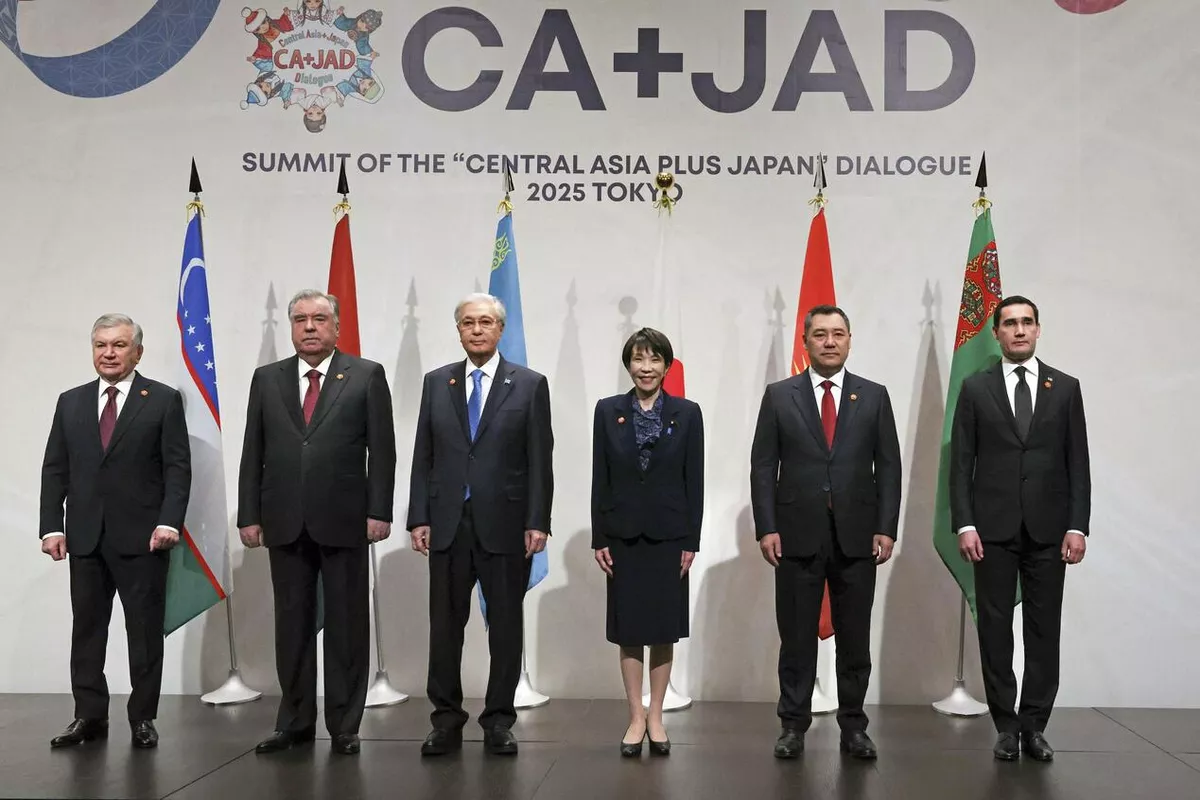
Photo: Kyodo
Japan and five Central Asian nations agreed on Saturday to establish a transport route connecting the region to Europe that avoids passing through Russia, aiming to secure stable supplies of critical minerals and energy.
In Tokyo, Japan hosted its first-ever summit with Kazakhstan, Kyrgyzstan, Tajikistan, Turkmenistan and Uzbekistan at a time when Russia and China are seeking to expand their trade and economic influence in the resource-rich region, The Caspian Post reports, citing Kyodo.
In a bid to strengthen economic relations, Japan and the five countries adopted the "Tokyo Declaration," focusing on decarbonization, logistics facilitation and cooperation on human resource development.
"The international situation has changed drastically, and the region's importance is growing as a trade route connecting Asia and Europe," Japanese Prime Minister Sanae Takaichi said at the outset of the meeting.
The "Caspian Sea route" is intended to provide stable supplies of critical minerals, including rare metals, as well as energy sources such as oil and natural gas.
The summit was originally planned for August 2024 in Kazakhstan, but it was postponed after then Prime Minister Fumio Kishida canceled his trip amid an advisory warning of a higher-than-usual possibility of a massive earthquake across a wide stretch of Japan.
Takaichi told reporters after the gathering that Japan plans to launch new business projects worth a total of 3 trillion yen ($19 billion) in Central Asia over five years, and that the countries also agreed to cooperate on artificial intelligence.
"Central Asia has great significance and potential in terms of geopolitical importance, economic security and mutually beneficial business opportunities," she said. "I'm glad that more than 150 public- and private-sector documents were signed on this occasion."
Since launching a dialogue framework with the five former Soviet republics in 2004, earlier than China, Russia and the United States, Japan has held 10 foreign ministerial meetings.
Share on social media