Chinese Technology Aids Recovery of "Dry Tears" of Central Asia
Situated between Kazakhstan and Uzbekistan, the Aral Sea was once the world's fourth-largest lake, nourishing the vast lands around it.
However, since the 1960s, under the dual impact of a surge in water use from human activities and climate change, the sea has shrunk rapidly, with its area reduced by more than 90 percent, earning the Aral Sea the distressing title of the "dry tears" of Central Asia, The Caspian Post reports via Global Times.
In April 2010, after an inspection of the Aral Sea, Ban Ki-moon, then Secretary-General of the United Nations, called the drying up of the sea one of the planet's most shocking disasters, according to the UN News.
In May 2018, the Aral Sea region was hit by a catastrophic sand and salt storm. This disaster severely affected western Uzbekistan and northern Turkmenistan, and became one of the iconic events indicating the worsening ecological crisis of the Aral Sea, according to Xu Wenqiang, a professor from the Xinjiang Institute of Ecology and Geography of the Chinese Academy of Sciences (CAS).
This crisis also became an opportunity for the government of Uzbekistan to take the initiative to seek cooperation with China in Aral Sea management. In September 2018, the Ministry of Innovative Development of Uzbekistan took the initiative to send a letter to the Xinjiang Institute of Ecology and Geography, CAS, formally putting forward a request for assistance, hoping that China would participate in the ecological management of the Aral Sea.
Two months later, in November that year, a delegation from the CAS visited Uzbekistan, and the two sides reached a preliminary consensus on cooperation in Aral Sea ecological restoration, officially kicking off the China-Uzbekistan cooperation in Aral Sea management, Xu said.
Why can China's ecological management experience in Xinjiang become an important support for Aral Sea restoration? Wu Miao, also a professor from the CAS Xinjiang institute, said that Northwest China's Xinjiang Uygur Autonomous Region and the Aral Sea region are highly similar in natural environments such as climate, vegetation and soil, and both face common challenges including water scarcity, land degradation, accelerating desertification under climate change and increasing impacts of human activities.
After years of research and practice, Xinjiang has accumulated rich achievements in desertification control, including selecting stress-resistant plants (salt-tolerant, drought-tolerant and high-temperature-tolerant) combined with mechanical and chemical sand control measures to curb desertification, using halophytes and saltwater irrigation to improve salinized land, and developing drought-tolerant cash crops such as Cistanche deserticola to improve local people's livelihoods. "These achievements and experiences can be applied to Aral Sea management in a targeted manner," Wu said.
The two countries' cooperation in Aral Sea management has achieved remarkable results.
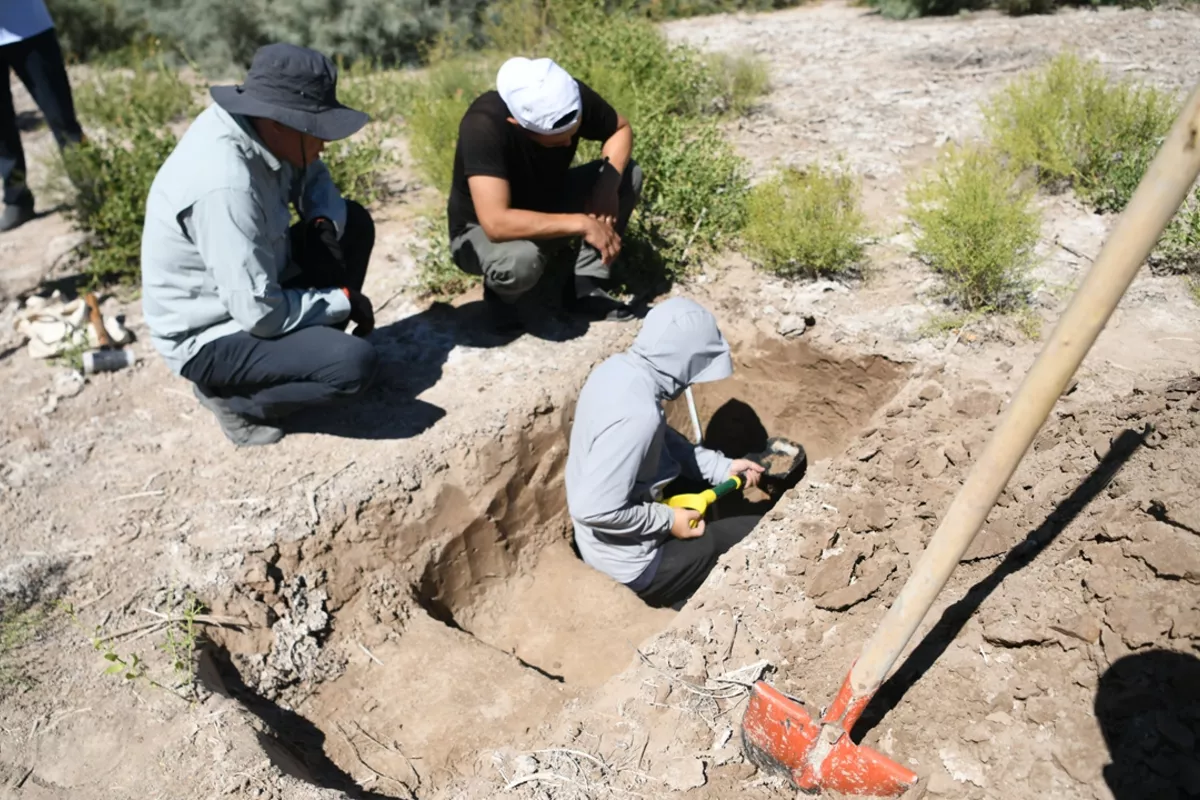
In Uzbekistan's Nukus, a joint China-Uzbekistan research project has introduced an innovative solar-powered smart irrigation system for cotton cultivation. By integrating photovoltaic panels, plastic-mulch drip irrigation and smart fertigation, the project has tripled cotton yields and significantly reduced production costs and water consumption.
Professor Wang Ping from the Xinjiang Institute of Ecology and Geography, CAS, introduced that in the past three years, the research team has successfully carried out experiments and demonstrations on water-saving agriculture and ecological management technologies based on photovoltaic technology in the Aral Sea region.
Data show that under the premise of saving more than 30 percent of water, the photovoltaic water-saving cotton planting technology has achieved the highest local cotton yield, close to 5 tons per hectare, which has been widely recognized by local farmers and officials, according to Wang.
The China-Uzbekistan cooperation in Aral Sea management is a vivid practice of China's participation in global sustainable development and contribution of Chinese solutions, Wang said.
"Chinese experts have applied and localized mature technologies in the local area, providing solid technical support for Uzbekistan. This pragmatic cooperation has been recognized and welcomed by various countries, and also conveys to the international community China's management concept," he said.
By Leng Shumei