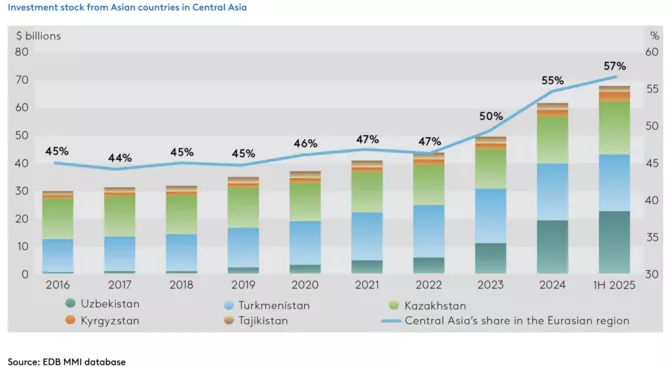
Foreign direct investment (FDI) stock from Asian countries into Central Asia has more than doubled over the past decade, reaching $68 billion in the first half of 2025, according to the Eurasian Development Bank.
Data from the bank’s Monitoring of Mutual Investments report, released in January, show that Asian FDI stock in the region rose 2.3 times between 2016 and mid-2025 - climbing from $29.9 billion to $68 billion, The Caspian Post reports, citing The Astana Times.
The report highlights that this dynamic has enabled Central Asia to establish itself as a “center of attraction for investment in Eurasia.” The momentum has accelerated noticeably in recent years.
“A particularly noticeable acceleration has been observed since 2023, when the region’s share in the total investments of external partners reached 50%. By the end of the first half of 2025, this share had grown to 57%,” the report reads.
Gulf States Drive Recent Investment Growth
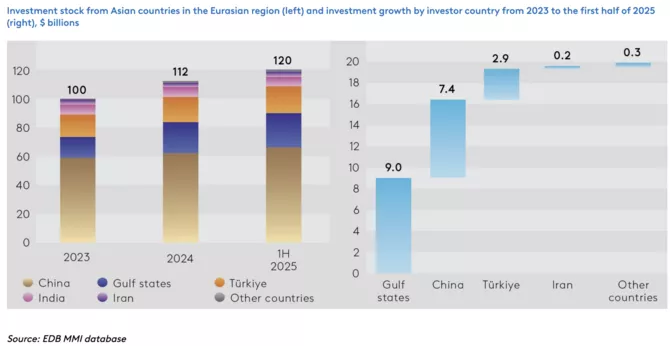
By country group, the Gulf states, which include Bahrain, Kuwait, Oman, Qatar, Saudi Arabia and the UAE, have emerged as the primary drivers of recent investment growth. Of the $20 billion increase in Asian investment stock since 2016, Gulf investors accounted for roughly $9 billion, or 45%.
In the longer term, the Gulf states also demonstrate the fastest growth rates in the Eurasian region. Since 2016, their investments have expanded at an average annual rate of 13.9%, more than double the average growth rate of investments from all external partners (6.8%).
Despite this broad inflow, Central Asia’s investment portfolio remains highly concentrated geographically. According to EDB data, 92% of Asian FDI stock is concentrated in three countries. Uzbekistan leads with $22.6 billion and shows the most rapid expansion, with FDI stock increasing more than 45-fold since 2016. Turkmenistan follows with $20.6 billion, and Kazakhstan with $19.3 billion.
Power sector becomes the new growth engine
More than 84% of mutual investment between Eurasian countries and Asian partners is concentrated in extractive industries, power generation, and manufacturing. However, long-term trends point to a clear structural shift away from extractive dominance toward a more diversified investment model.
“Although the extractive industry sector remains the largest in terms of FDI stock, its share has declined from 55% in 2016 to 35% in the first half of 2025, primarily due to the rapid growth of investment in the power sector,” reads the report.
The power sector stands out as the most rapidly transforming segment. Over the past decade, its share of mutual FDI in the Eurasian region increased nearly tenfold, from 2.6% in 2016 to 26% by mid-2025. A similar pattern is evident in investments coming from Asian countries, where the power sector’s share rose from 2% to 17%.
Analysts note that the pace of expansion has been particularly notable since 2024. In just a year and a half, power projects accounted for more than half of the total increase in attracted investments, $10.1 billion out of $19.8 billion. The most active investors in this segment are the Gulf states and China.
“In a year and a half, the Gulf states invested about $5 billion. As a result, their FDI stock reached $8.3 billion by the end of the first half of 2025, allowing them to surpass China in investment stock in the power sector of the Eurasian region [$8.2 billion],” the report states.
India, Vietnam, Afghanistan, and Indonesia: Distinct Investment Profiles
Among Asian partners, investment cooperation with India is substantial. Mutual FDI stock between India and the Eurasian region reached $13.4 billion, with near parity between incoming and outgoing flows. Indian investments are concentrated primarily in Russia’s and Azerbaijan’s oil and gas sectors.
Vietnam presents a smaller but structurally evolving investment presence. Its FDI stock in the Eurasian region grew from $613 million in 2016 to $825 million by mid-2025, an increase of 34%, accompanied by geographic and sectoral diversification.
Russia remains Vietnam’s primary destination, accounting for $570 million or 69% of the portfolio, though this share is declining due to depreciation in oil and gas assets.
At the same time, Central Asia’s role is expanding. Vietnamese investments in Kazakhstan reached $128 million, while ROX Group has increased activity in the Kyrgyz Republic and Uzbekistan, focusing on real estate and renewable energy projects.
Afghanistan, while relatively small in absolute terms, is viewed as a strategically important niche market. By mid-2025, total FDI stock reached $190 million, with the Eurasian region acting as a net capital exporter.
Turkmenistan is the largest investor, accounting for 52% of the portfolio ($99 million), largely through infrastructure and power projects, most notably the TAPI gas pipeline, a 1,814-kilometer project that will transport natural gas from Turkmenistan’s Galkynysh field to South Asia.
Uzbekistan is implementing gas production projects, Azerbaijan operates an oil refinery in Hairatan, and Kazakhstan’s involvement remains limited. Overall, investment activity is infrastructure-oriented, with a focus on transit, logistics, and energy.
Indonesia’s presence in the Eurasian region is centered on a single but significant industrial project. Indorama Corp’s acquisition of 99% of FerganaAzot in Uzbekistan, coupled with commitments to modernize production, brought total investment to an estimated $240 million by mid-2025. According to the report, the broader pipeline of announced projects suggests potential for expanded cooperation.
Eurasian Capital Flows into Asia
Eurasian countries themselves remain active exporters of capital. By the end of the first half of 2025, their FDI stock in Asian partner countries reached $56.6 billion, reflecting a 12.5% increase over the previous 18 months.
Russia and Azerbaijan dominate outward investment, accounting for 72% and 23%, respectively. Capital allocation is geographically concentrated, with Türkiye absorbing 78% of Eurasian investments, followed by India (12%), Vietnam (4%), and China (2%).
Türkiye is the largest recipient, with FDI stock from the Eurasian region reaching $44 billion, more than twice the volume of Turkish investments in the Eurasian region ($18.6 billion). Russian and Azerbaijani companies are the primary contributors, mainly in power generation and oil refining. According to the report, in recent years, Kazakhstan has also emerged as an active investor, primarily driven by major financial-sector deals by Kaspi Bank.
Investments in India have shown steady growth. Between 2016 and the first half of 2025, Eurasian FDI stock increased more than sevenfold to $6.6 billion, largely due to Russian investments in oil refining. Investment volumes in Vietnam have remained relatively stable at $2.35 billion. However, the country composition is shifting: Russia’s share declined from 92% in 2016 to 74%, while Kazakhstan’s share rose from 8% to 25%, indicating gradual diversification.
The EDB’s Monitoring of Mutual Investments report is a flagship analytical initiative designed to systematically track, verify, and analyze mutual FDI stock across the Eurasian region. It also examines investment links with key external partners in Asia, enabling a comprehensive assessment of the scale, structure, and geography of cross-border investment flows.