The European Union is developing a new transport connectivity platform linking Central Asia with Europe through the South Caucasus and the Black Sea. At the same time, Uzbekistan is advancing the China-Kyrgyzstan-Uzbekistan railway and the Trans-Afghan Corridor, seeking access both to European markets and to South Asian ports.
The Caspian Post spoke with Kyrgyz economist and expert Marat Musuraliev about whether the countries of the region can develop a unified transport strategy, how the competing routes will interact, and what role Azerbaijan will play in the emerging logistics architecture.

photo: Kyrgyz economist and expert Marat Musuraliev
- What is preventing Central Asia from developing a unified transport strategy?
- Central Asia does not have a single market for goods. Crossing each border involves three separate inspections of every transport unit - whether a truck, railway wagon or container - by border, customs and phytosanitary authorities.
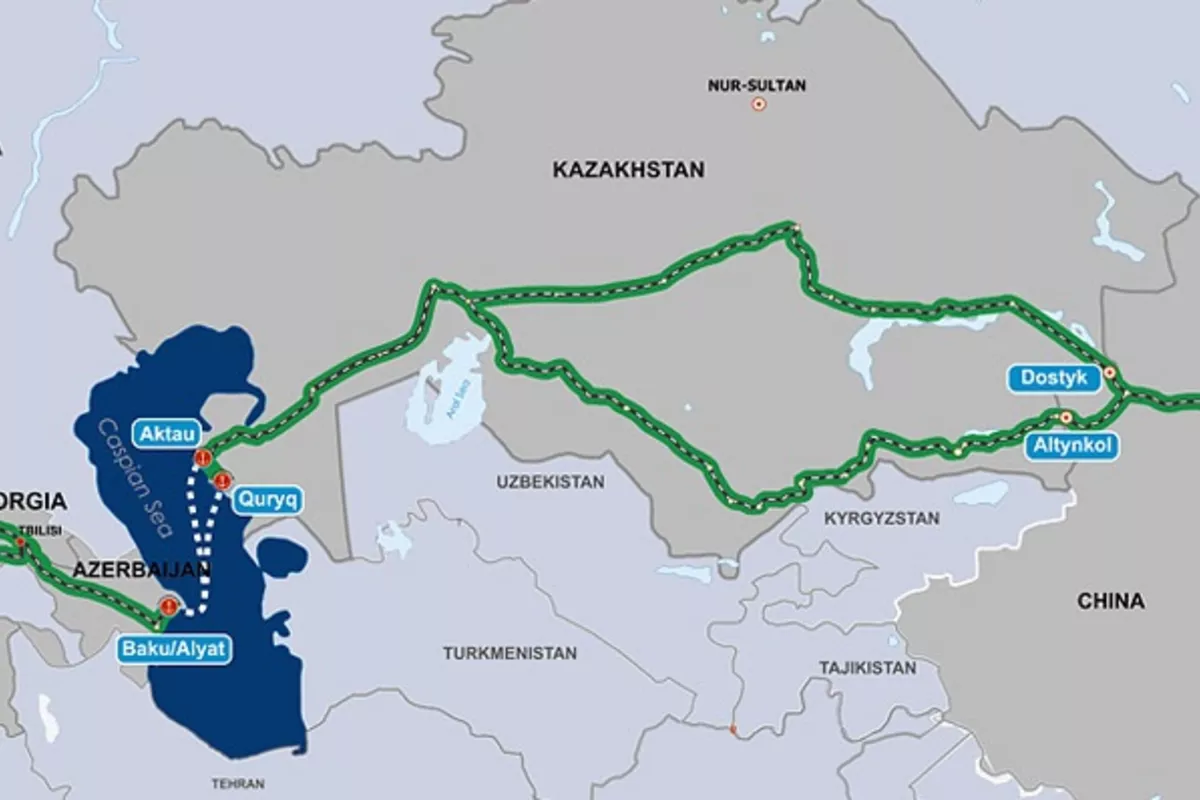
At present, there is only one functioning east-west route: China-Kazakhstan-Caspian Sea-Azerbaijan-Georgia-Türkiye-European Union. The route runs largely across flat terrain, is double-tracked for around half of its length, and has no unnecessary intermediate borders within Central Asia that would lead to additional inspections, delays and financial costs.
The China-EU route involves five international border crossings: China-Kazakhstan, Kazakhstan-Azerbaijan through the Caspian ports, Azerbaijan-Georgia, Georgia-Türkiye and Türkiye-EU.
In theory, another route could become operational by 2030: China-Kyrgyzstan-Uzbekistan-Turkmenistan-Caspian Sea, continuing through Azerbaijan to the European Union.
However, this route crosses mountainous terrain. At the Kyrgyz-Chinese border, it will rise to more than 3,500 metres above sea level. Between the Fergana Valley and the Tashkent Region, the railway will again climb to the Kamchik Tunnel at an altitude of nearly 1,500 metres. It will also involve additional intermediate borders, including the Kyrgyz-Uzbek and Uzbek-Turkmen borders. As a result, the total number of international borders along the China-EU route will increase to seven.
Another obstacle is the need for four cargo transshipment procedures: at the Caspian ports, where cargo must be transferred from railway wagons to ferries and then back to rail, as well as at the China-Kazakhstan and Georgia-Türkiye borders.
This is because China, Türkiye and the European Union use the standard railway gauge of 1,435 millimetres, while the former Soviet countries use the broader 1,520-millimetre gauge.
Even the route through Kazakhstan, despite its flat terrain and smaller number of intermediate borders, is not straightforward for transcontinental transportation. Such routes are generally capable of attracting only between 5% and 8% of the total freight base, primarily goods that require critically short delivery times and have a high value per unit.
Ocean shipping will remain the dominant mode of freight transportation because its energy consumption per unit is approximately 10 times lower, while its carrying capacity is hundreds of times greater.
A single Triple E-class ocean container ship can carry around 18,000 twenty-foot containers at once. Transporting the same volume overland would require approximately 100 freight trains. No border crossing would be physically capable of processing that number of trains in a single day.
This is why the overwhelming majority of global freight is transported by ocean-going vessels, and this will remain the case for the foreseeable future.
Demand for transcontinental land routes may rise sharply when maritime straits become blocked, as happened in the Strait of Hormuz this year and previously in the Suez Canal. However, the impact of such disruptions should not be overstated.
Most oil-producing countries have already developed alternative pipeline routes that bypass high-risk locations.
Saudi Arabia has the East-West oil pipeline, which can transport up to 95% of the country’s oil production from the Gulf across the Arabian Peninsula to the Red Sea. The United Arab Emirates has the Habshan-Fujairah pipeline, capable of carrying up to 65% of its production. Iraq has the Kirkuk-Ceyhan pipeline, with capacity equivalent to 46% of its production, while Iran has the Goreh-Jask pipeline, capable of transporting around 50% of the country’s output.
As a result, the Gulf states were able to export 73% of their oil production to global markets while bypassing the temporarily closed Strait of Hormuz.
The consequences of closing maritime straits should therefore neither be exaggerated nor underestimated.
In addition, both the United States and China have established strategic oil reserves.
For reference, the US Strategic Petroleum Reserve has fallen to 311.4 million barrels. Given the current level of net imports and strict limitations on the speed at which oil can be withdrawn from underground salt caverns, this would be sufficient for approximately 25 to 37 days.
The International Energy Agency’s 90-day requirement, however, applies to the combined volume of national reserves, including both government-controlled and commercial stocks.
China’s strategic oil reserves are estimated at approximately 1.4 billion barrels, including both state reserves and commercial storage facilities. This gives the country a considerable degree of energy autonomy. The accumulated volume is sufficient to cover more than 90 to 100 days of China’s net oil imports.
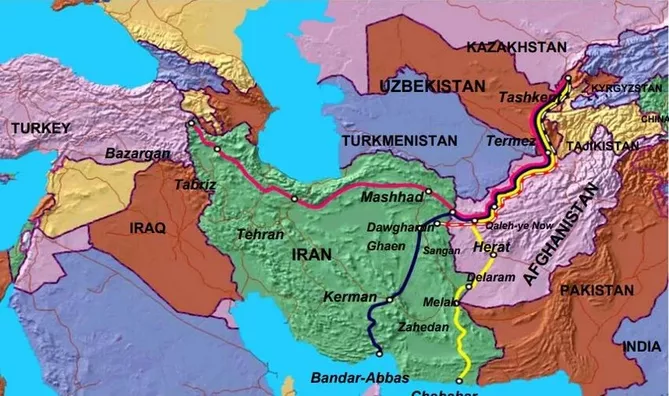
photo: ResearchGate
- Are the Middle Corridor and the Trans-Afghan route competitors or complementary transport directions?
- I do not believe the issue can be framed quite that way.
There is currently no railway running across Afghanistan. There are several dead-end railway sections extending into Afghanistan from neighbouring countries, and all of them use different railway gauges.
It is also necessary to consider that transit requires more than the railway infrastructure itself. A country must be able to guarantee the security of freight and must have at least moderate investment and logistics ratings.
For these reasons, I would prefer not to comment on the Trans-Afghan route at this stage.
- Can Azerbaijan become Central Asia’s principal western gateway?
- It can, and it is already becoming one.
The main constraints include the shallow waters in the Kazakh and Russian sectors of the Caspian Sea, where depths are limited to approximately four to six metres. This significantly restricts the permissible deadweight of vessels and increases freight tariffs across the Caspian.
Another problem is the insufficiently developed infrastructure of ports on the eastern coast of the Caspian Sea.
These ports require sheltered harbours that would allow ships to be loaded and unloaded continuously, regardless of wind and wave conditions. At present, they are unable to operate for as much as 25% of the year because of adverse weather.
- Which problems are more serious: tariffs, customs procedures, a shortage of vessels or insufficient port capacity?
- On land, it is necessary to integrate the information systems of border, customs and phytosanitary authorities. This would allow their work to be synchronised and reduce the time required to cross international borders.
At sea, the main problems are the insufficient development of port infrastructure on the eastern coast of the Caspian, the ports’ open harbours and vulnerability to wind and waves, the shortage of vessels, the shallow waters in the northern Caspian and the continuing decline in the sea’s water level.
Between 80% and 88% of the water entering the Caspian Sea comes from the Volga River. A decline in the river’s flow therefore results in the further shallowing of the Caspian.
- Does the Central Asia-Caspian Sea-South Caucasus-Europe route need a single operator?
- A single operator would certainly help reduce transit times across Central Asia, particularly at the region’s intermediate borders.
The railway from China through Kyrgyzstan to Uzbekistan is expected to be completed by 2030, so this issue remains under discussion. However, the process of integrating the operations of Kazakh and Chinese transport operators is already under way.
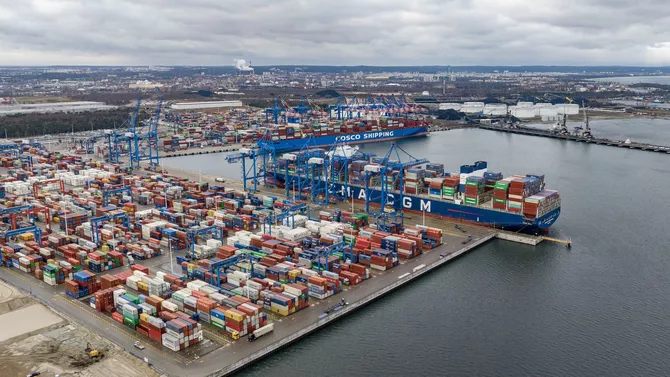
photo: worldcargonews
- How realistic is it to reduce delivery times to European ports?
- Kazakh and Azerbaijani operators are already carrying out the relevant calculations. At present, cargo can be delivered from China to Azerbaijan in approximately 12 to 20 days.
It is worth noting that, when sending cargo, China primarily focuses on delivery times and only then on tariffs.
The principal stages and estimated delivery times are as follows.
Expedited container trains departing from Chinese cities such as Xi’an or Chengdu can reach the border with Kazakhstan, or the relevant point on the multimodal route, within five to eight days.
Transit from the Kazakh border through Kazakhstan and across the Caspian Sea to ports or terminals in Azerbaijan, including Absheron station and Baku, takes an additional seven to 12 days.
The main causes of delays are congestion at the ports of Aktau and Kuryk, queues for ferries to Baku and customs clearance procedures.
Should it prove impossible to stabilise the volume of water flowing from the Volga into the Caspian Sea, the sea will continue to become shallower. In that case, it will be difficult to provide a clear answer regarding future cargo delivery times.
- Who will finance the necessary infrastructure: the EU, China, Türkiye, international banks or the countries of the region themselves?
- I believe the European Union will be primarily occupied with financing its own defence capabilities and providing assistance to Ukraine.
China has the world’s largest foreign exchange and gold reserves, but its proposals should be assessed through a risk-oriented approach.
The railway China built through Laos towards Thailand has so far created more difficulties than economic benefits for Laos. The same applies to the Chinese-built railway in Kenya. At present, it is difficult to speak of either project as being highly profitable or capable of quickly recovering its costs.
Türkiye, in my view, could invest in regional infrastructure.
One potentially promising route would run from Kars through Nakhchivan, along the Araz River, to the Port of Alat. It would be particularly advantageous if the railway were constructed using both the 1,520-millimetre and 1,435-millimetre gauges.
This would make it possible to provide seamless freight transit from the Port of Alat to the European Union, including for cargo arriving from Asia.
Naturally, both a SWOT analysis - assessing the project’s strengths, weaknesses, opportunities and threats - and a full feasibility study would have to be conducted before any final decision is made.
Revenue from railway freight transit, paid in Swiss francs, represents a virtually unlimited form of non-resource exports for all participating countries, including those of the South Caucasus.