The Middle East is once again entering a phase of unsettling déjà vu: wherever a “reduction of presence” is announced, the shadow of ISIS soon reappears, and talk of stabilization gives way to scenarios of managed chaos. A coincidence? Hardly. Beneath the visible turbulence lies subtle geopolitical engineering, where terrorism is used not as an end in itself, but as an instrument for redrawing borders, reshaping identities, and recalibrating balances of power.
The Caspian Post spoke with Turkish political scientist Hüsamettin İnaç about why the “return” of ISIS is not a vacuum but a calculation, who benefits from the federalization of Syria and Iraq, how the Al-Hol camp is becoming a detonator of instability, and what hard choices now face Türkiye - directly, without diplomatic euphemisms, and with an eye on what comes next.
- How should the renewed activation of ISIS be interpreted against the backdrop of the simultaneous withdrawal of some of the US-led coalition forces from a number of bases? Are we witnessing a genuine “security vacuum,” or a controlled process of strategic rebalancing?
- The reappearance of ISIS on the agenda actually points to an attempt by the United States to implement a new geopolitical “design” in the region, primarily in Syria and Iraq. This is about seeking a new configuration of influence. It is no coincidence that Donald Trump himself stated that the structure known as ISIS was formed under the administration of Barack Obama and Hillary Clinton.
In essence, ISIS is a terrorist organization of American origin, created from fragmented remnants, including elements formed after events linked to the Revolutionary Guard.
The United States uses this instrument where and when it deems necessary: in Pakistan, Afghanistan, Iraq, or Syria.
That is why its new “return to the stage” has a clear objective - to prevent the restoration of Syria’s territorial integrity and to push the country toward a federal model.
A similar pattern can be observed in northern Iraq, where efforts are being made to strengthen the federal structure and enhance the barzanist factor, turning it into a more significant lever of pressure on Baghdad. In this context, it becomes evident that ISIS is once again being activated in the region precisely to achieve these goals.
The fact is simple and telling: wherever American forces withdraw, ISIS almost immediately appears. That alone is enough to draw conclusions.
- Is the transitional administration in Damascus under Ahmed al-Sharaa capable of bringing the ISIS threat under sustainable control, or does the current phase of power transformation objectively create conditions for a new wave of internal destabilization?
- Ahmed al-Sharaa’s statement that he intends to participate in the international coalition against ISIS and confront this structure inside his own country is undoubtedly an important and politically significant step.
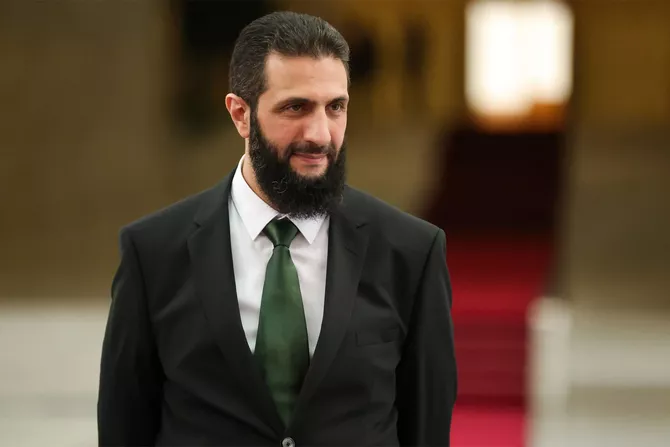
Syria's Transitional Government / AFP
However, as is well known, Damascus today simply does not have the real resources or leverage to conduct a full-fledged, independent struggle against such threats. In practice, this is more likely to act as a factor of additional destabilization rather than an element of state consolidation. The country is already under pressure from numerous armed groups and separatist elements, a significant portion of which receive external support.
Particular attention should be paid to the situation in the north and east of the country, where PKK/YPG terrorist structures have not been eliminated. On the contrary, they remain combat-capable and continue to control significant territories.
In addition, in the eastern and southern regions - among Alawite and Druze communities - resistance to integration into a unified state is also evident. These supra-structures are said to receive substantial political and other forms of support from Israel.
Under such conditions, when the state is simultaneously attempting to neutralize internal hotspots, draft a new constitution, rebuild the foundations of statehood, and shape a national identity, the sudden activation of ISIS appears far from accidental. On the contrary, it serves as additional confirmation that the United States is objectively not interested in preserving the country’s territorial integrity.
In essence, ISIS today does not exist as an independent, ideologically coherent organization. Its “revival” is not connected with a strengthened mission or worldview platform. Rather, this instrument is activated precisely when there is a need to destabilize a state and trigger processes of fragmentation.
In this context, ISIS acts not as a subject, but as a mechanism - an element of a scenario implemented with the participation of the United States and Israel within a broader coalition logic.
- Should the mass escape of tens of thousands of detainees from the Al-Hol camp be seen as a sign of weakening Syrian statehood, or are we dealing with an element of a more complex, multi-layered game involving tribal structures and informal actors?
- The escape of thousands of detainees from Al-Hol did not occur spontaneously or accidentally - it was carried out with the awareness of the United States and Israel, and with the direct involvement of PKK/YPG structures. The purpose of such actions is obvious: the dissolution of radical elements into the civilian environment and the artificial creation of instability hotspots.
Within the logic of American and Israeli strategic thinking, as well as the broader Western approach, such chaos is used to legitimize the PKK/YPG as an allegedly “inevitable” and “effective” partner in the fight against terrorism. In the West, this construct is viewed as a secular force formally compatible with the Western model and capable of acting against radical Islamist groups.
However, from our perspective, reality looks entirely different. The PKK is a structure ready to shed blood for minimal reward, devoid of moral reference points, acting exclusively as an instrument of external powers. The PKK, YPG, and their affiliated branches are essentially the same structure, masked under different names.
What is happening should therefore be viewed as part of a broader strategy to weaken the region. Through Iraq and Syria, there is a systematic expansion of American and Israeli presence, not only in military terms, but also in political and socio-political dimensions.
The Iran factor also deserves attention. The deployment of large combat air groups in the region - from the Gerald Ford aircraft carrier to other strike platforms - cannot be viewed solely in the context of pressure on Tehran. We are dealing with a far more ambitious project aimed at reshaping the regional balance of power and using the Middle East as a space for long-term geopolitical engineering.
In other words, the region is being prepared not for stabilization, but for managed tension - in the interests of external actors.
- From the perspective of Türkiye’s interests, does the renewed activity of ISIS mean that Ankara must revise its security doctrine in northern Syria and along the Iraqi border? Should we expect new military or diplomatic steps from Ankara?
- The very fact that this issue has been placed on the agenda and that terrorists were released from Al-Hol already indicates that the American-Israeli alliance is not interested in ensuring Türkiye’s national security.
Until recently, at least after the operations carried out between 6 and 30 January, there was a belief that the SDF/PKK/YPG terrorist organization had been cornered and was on the verge of total destruction. Unfortunately, this did not happen.
The militants of this structure were preserved and concentrated in several areas - in Ayn al-Arab (Kobani), as well as in Hasakah and Qamishli. Moreover, they continue to maintain a significant military presence, which directly contradicts the interests of the Syrian state. This indicates not integration, but the preservation of military and administrative autonomy.
For Türkiye, such developments are unacceptable. We are talking about the creation of a “state within a state,” in other words, the de facto statehood of the PKK.
Under these circumstances, Türkiye undoubtedly must conduct a military operation. At a minimum, it is necessary to neutralize the core of the SDF - approximately 8,000 to 10,000 militants. Key figures must be eliminated so that Türkiye can guarantee its national security.
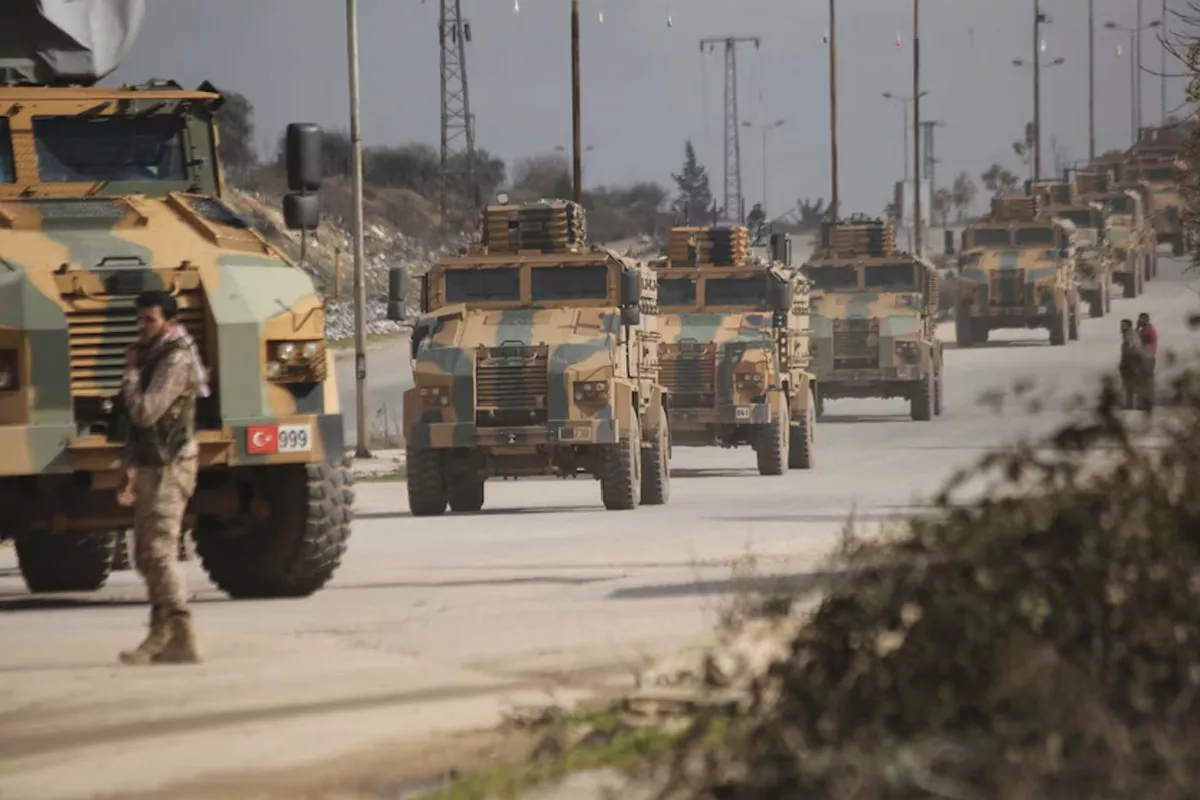
Consequently, Türkiye may need to deploy a large-scale military presence in the region - up to 100,000 to 150,000 troops, establishing permanent bases in Hasakah, Qamishli, and Ayn al-Arab (Kobani), without subsequent withdrawal. Only then, in this view, can long-term security be ensured.