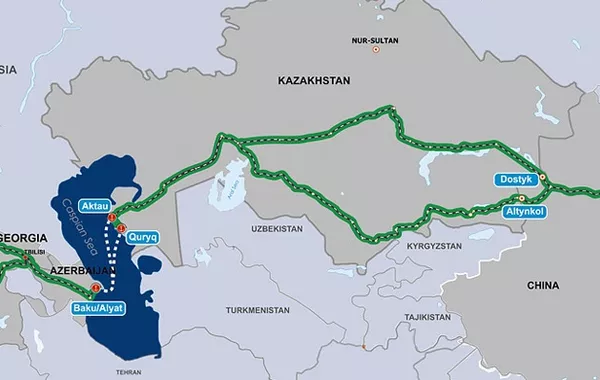
The Caspian region remains one of the few areas where international law still functions and geography itself discourages large-scale war. Precisely for this reason, however, it is surrounded by persistent rumors, “gray-zone scenarios,” and expert speculation, especially amid the potential escalation around Iran, rising transit volumes along the Middle Corridor, and growing Western interest in alternative routes that bypass traditional hubs of instability.
Amid this turbulence, what reflects genuine risk and what is overstated noise? Could a strike on Iran reverberate across the Caspian - and if so, where would the impact be felt: in ports, in insurance markets, or in the calculations of politicians and traders? How vulnerable is the Caspian corridor for Kazakhstan and Azerbaijan, and where is the line between military risk and market-driven anxiety?
The Caspian Post discussed these and related issues with Farhad Kassenov, head of the A+Analytics research center and a Kazakh political scientist.
- The Convention on the Legal Status of the Caspian Sea enshrines the principle of non-presence of armed forces of non-Caspian states and prohibits providing one’s territory for aggression against another party. If the United States strikes Iran, how quickly could Tehran “circumvent” Caspian restrictions without violating the Convention? And which “gray scenarios” do you consider most realistic specifically for the Caspian?
- First, I do not expect any direct impact on Caspian routes, and there are several reasons for this. The transit corridors are geographically distant from the presumed zone of hostilities, and escalation, by all logic, would not extend to the waters of the Caspian Sea.
If we consider a possible US strike on Iran, the primary focus would be on the country’s land territory and key facilities around Tehran. Iran’s Caspian ports are not priority military targets for the United States and, with high probability, would not be struck. Accordingly, no direct risks to shipping in the Caspian would arise.
Moreover, the distance from the Port of Alat to the nearest Iranian ports is about 400 kilometers, and to the Port of Aktau in Kazakhstan roughly 700 kilometers. Even at the “narrowest” point, this distance is too great to suggest a physical threat to merchant vessels, bulk carriers, or transport infrastructure. Objectively, this route does not fall within a zone of direct military risk.
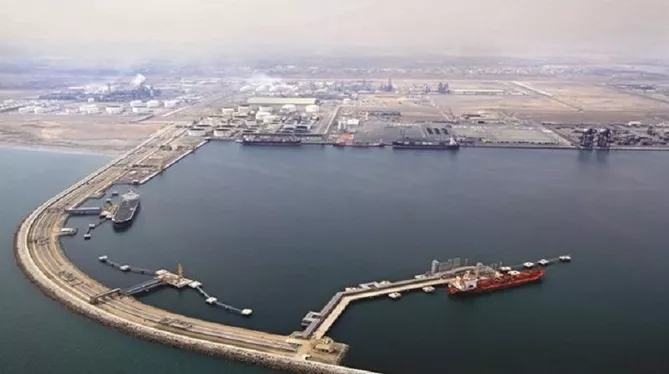
Photo credit: Chabahar port
Yes, short-term caution is possible: a temporary slowdown in transit for several days due to airspace detours or higher insurance premiums. But this would amount to a tactical pause rather than a prolonged suspension of shipments.
Regarding the Convention and Caspian restrictions, the key point is that armed forces of non-Caspian states, including the United States, physically cannot be present on the Caspian Sea. It is a closed body of water with no external access. Therefore, the Convention’s provisions on the non-presence of third-country armed forces cannot be “circumvented” in a literal sense, simply because there is nothing to circumvent.
If hostilities begin, they would take place outside the Caspian theater, meaning the Convention itself would not become an instrument of pressure or violation.
As for “gray scenarios” in the Caspian, the most realistic one is not military but logistical and psychological: a short-term decline in transit volumes, higher insurance rates, and increased caution among shipping and aviation companies.
Blockades, military incidents, or attempts to draw the Caspian into the conflict should not be expected.
- What about Russia?
- The Russia factor is also limited. Theoretically, one could imagine political support for Iran from Moscow. However, practical military involvement by Russia is unlikely. The reasons are clear: Russia is already deeply engaged in the Ukrainian conflict; it is in a complex and sensitive negotiation process with the United States; and any sharp move against Washington in the Iranian direction would undermine that track.
Most likely, Moscow’s reaction would be confined to statements at the UN Security Council level and diplomatic messaging.
- According to KazTransOil, as early as January 2024, the transportation of Kazakh oil from Aktau to Baku increased. In parallel, Kazakhstan and SOCAR agreed in 2024 to expand transit through Azerbaijan. If Iran is struck, what will “break” first in the Caspian corridor - physical logistics such as ports and transshipment, the financial component such as insurance and freight, or political nervousness among participants?
- Substantively speaking, physical logistics in the Caspian corridor is, I repeat, the least vulnerable component.
The route between Kazakhstan and Azerbaijan is expanding outside Iranian directions, so potential strikes on Iran would not have a direct physical impact on it. This is confirmed by current dynamics: according to KazTransOil, in January 2024 alone the volume of Kazakh oil transported along the Aktau-Baku route reached 116,000 tons, and during 2024, Kazakhstan and SOCAR agreed to further increase transit through Azerbaijan. In other words, infrastructurally the route is not only functioning but scaling up.
What would “break” first is neither port operations nor transshipment, but the financial component.
This primarily concerns insurance and freight. These services are arranged through international insurance and chartering structures that traditionally react very sensitively to political instability, and even more so to military action. The mere fact of a military operation typically leads to revised risk coefficients and higher premiums.
This factor is particularly important now, as both Kazakhstan and Azerbaijan are implementing projects to acquire new vessels, and their insurance is arranged through global companies. In the event of military escalation, this would inevitably increase transportation costs, primarily due to higher insurance and freight expenses.
At the same time, it should be noted that the maritime component of the Middle Corridor is already its weakest link in terms of cost. Additional financial burdens may be significant, but they are secondary in nature and would not undermine the route itself.
Photo credit: Azernews
As for political nervousness, it will undoubtedly arise - this is a standard reaction among markets and operators. However, its effect is usually temporary and largely depends on the scale and duration of the operation. Once the active phase ends, tensions generally subside. The only uncertainty is how and when that would occur.
- Last year’s US and Israeli strikes on Iran officially targeted nuclear facilities, yet in expert circles versions are increasingly voiced about threats to infrastructure in the Caspian region - port logistics, energy hubs, and security systems. In your view, what exactly was affected in the Caspian direction, and how has this already influenced or could influence transit from Central Asia, primarily Kazakhstan, through Azerbaijan to Europe?
- First, the strikes themselves were limited in scope and directed exclusively at facilities linked to the nuclear program. Iran’s Caspian ports, essentially two major ones, do not hold military-strategic significance for the United States. They are not used for troop movements, there is no concentration of military infrastructure there, and they are not logistical elements capable of influencing the course of potential hostilities.
Second, even in a hypothetical scenario of a serious military setback for Tehran, these ports cannot be viewed as independent strongholds for retaining power or forming centers of resistance. Historical parallels, including the Iraqi experience and the localization of resistance in certain cities, are not applicable here. Iran’s Caspian ports do not serve as regime “outposts” and cannot become centers of autonomous defense.
Third, the Caspian direction as a whole has not been and is not an object of military pressure. Neither port infrastructure, nor energy hubs, nor reserve storage systems in the Caspian have been struck or considered targets. Accordingly, there are no grounds to speak of a “Caspian impact” in practical terms.
This leads to the key conclusion: transit from Kazakhstan across the Caspian, through Azerbaijan and onward to Europe, has not been disrupted and does not face systemic risks specifically linked to strikes on Iran. Logistical routes, energy corridors, and security infrastructure in this direction continue to function normally.
In other words, in the Caspian direction we are dealing not with tangible threats, but with expert speculation that is not supported by the nature of the strikes, military logic, or the actual consequences for regional transit.