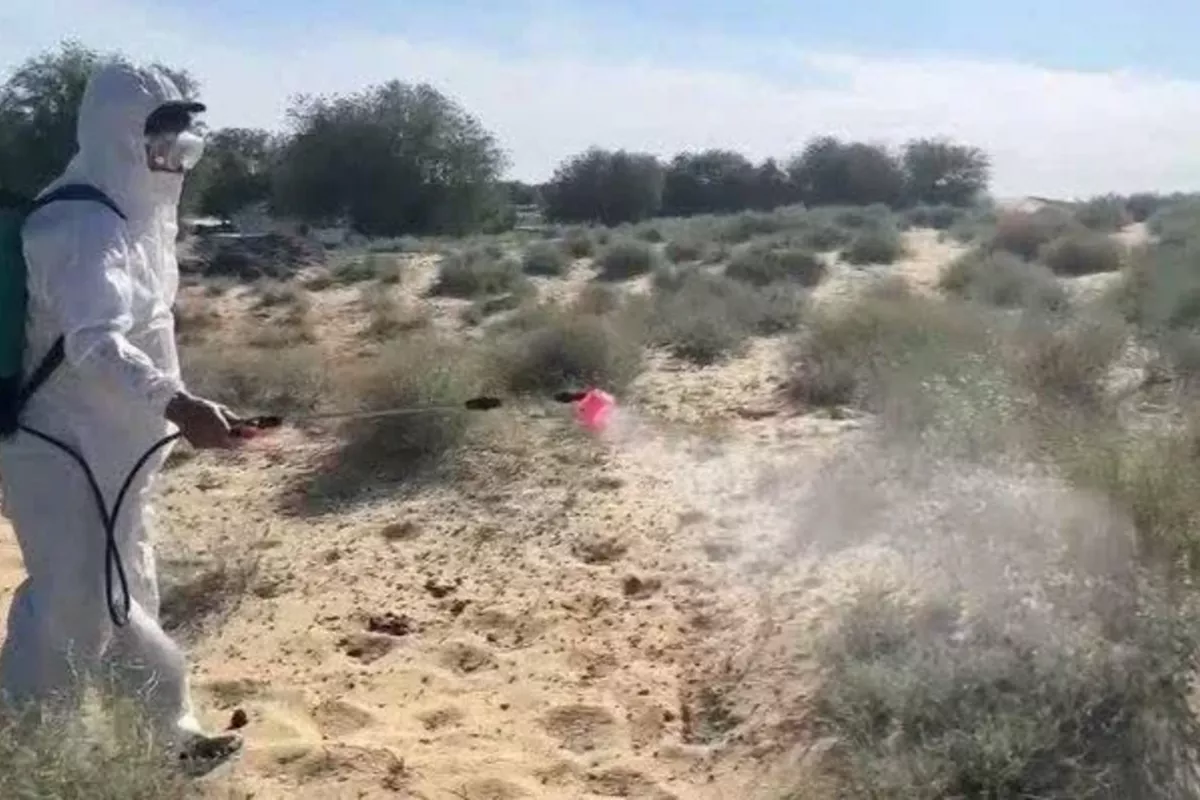
File photo by Kazakh Agriculture Ministry
A joint scientific effort between Kazakhstan and China is showing promising results in the fight against one of agriculture’s most destructive pests - the Moroccan locust.
Field trials of a new biological plant protection product have been successfully completed in Kazakhstan’s Turkistan region, The Caspian Post reports via Kazinform.
The innovation is based on the entomopathogenic fungus Metarhizium anisopliae, a naturally occurring microorganism that infects and kills insects, offering a safer alternative to chemical pesticides.
The international project is part of a broader Kazakhstan-China initiative focused on developing fungal biopesticides to control locust populations in cross-border breeding zones.
Promising results in field conditions
Trials were carried out on pastures in the Kazygurt district, where researchers placed locusts in controlled monitoring cages after treatment. Scientists observed the insects daily to track infection and mortality rates.
By the third day, clear signs of fungal infection began to appear. Mortality rates reached 70-80% by day five, while by day nine, all tested locusts had died.
A dangerous agricultural pest
The Moroccan locust (Dociostaurus maroccanus) is considered one of the most destructive locust species, capable of rapidly spreading across large areas and causing severe damage to crops and pasturelands.
Toward greener pest control
Researchers say the next step is to expand trials across different climate zones and refine guidelines for integrating the biopesticide into national pest monitoring and control systems.
The findings highlight the potential of fungal-based solutions as an environmentally friendly alternative to chemical insecticides, reducing ecological impact while maintaining effectiveness.
Earlier reports also noted that Kazakhstan plans to deploy more than 100 agricultural drones to strengthen locust control efforts across vulnerable regions.
Share on social media