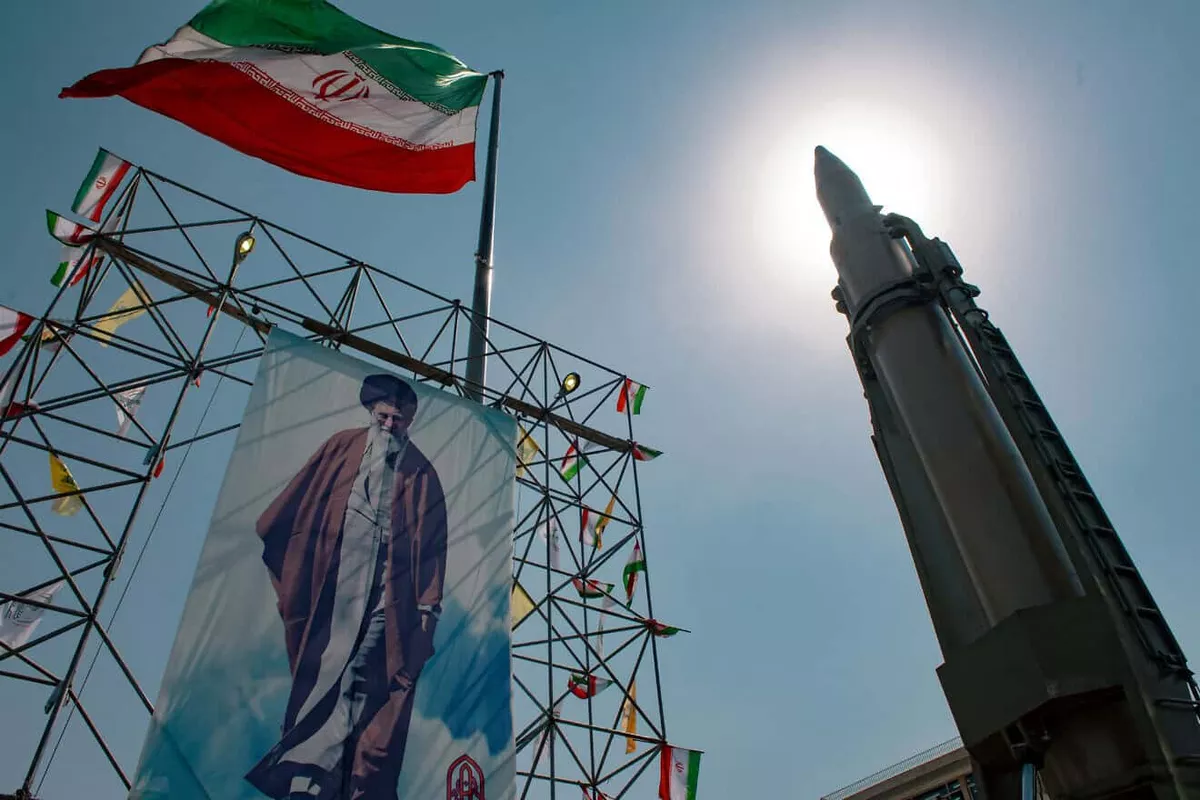
The world is holding its breath. The scale of military concentration - aircraft, naval assets, refueling tankers, and an unprecedented stockpile of munitions positioned across the region - suggests that a war with Iran may be closer than ever.
Hope remains that escalation can be avoided. But judging by the intensity of the rhetoric and the uncompromising posture of all sides, the conflict could enter a hot phase at any moment.
Tehran is under no illusions.
The leadership of the Islamic Republic fully understands the gravity of the moment. Rather than reacting emotionally, it is doing what revolutionary regimes do best when confronted with existential risk: designing continuity.
Iran is not merely preparing for military confrontation. It is constructing a multi-layered system to prevent institutional collapse in the event of decapitation strikes, internal unrest, or the elimination of senior leadership. The underlying principle guiding this process is simple and uncompromising: the regime must survive under any circumstances.
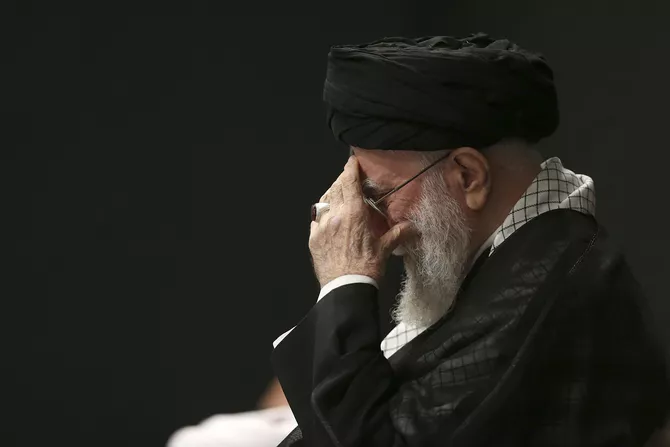
Photo credit: OPB
According to reporting by The New York Times, Supreme Leader Ayatollah Ali Khamenei has issued explicit instructions outlining succession mechanisms in the event of his death. The structure reportedly defines the configuration of political and military leadership and identifies those responsible for governing the country during armed conflict and potential domestic instability.
Iranian authorities have developed a detailed contingency plan in case of a U.S. military operation. This plan goes beyond military retaliation. It ensures that even in the event of the rahbar’s death, the governing system remains stable, operational, and viable.
Citing senior Iranian officials, The New York Times reported that Khamenei has ordered preparations for successors at multiple levels of political and military command in the event of targeted eliminations. The directive reportedly establishes four tiers of personal succession and calls for the formation of a narrow circle of trusted decision-makers empowered to act if the country loses its top leadership.
In truth, this is not an innovation - it is adaptation.
Hamas and Hezbollah implemented similar layered command systems after Israel eliminated their senior leadership. Iran has clearly absorbed those lessons. The difference lies in scale: what those organizations applied at the movement level, Tehran is now institutionalizing at the state level.
Within this emerging structure, one figure stands out: Ali Larijani.
Larijani, currently Secretary of the Supreme National Security Council, has seen his political weight increase sharply in recent months. In the event of war, sources within Iranian security structures told The New York Times that special police corps, intelligence services, and units of the Islamic Revolutionary Guard Corps (IRGC) would patrol major cities to maintain order.
Tehran is preparing not only for foreign bombardment, but also for internal volatility.
In an interview with CBS, Iran’s Foreign Minister Abbas Araghchi emphasized that Tehran has drawn lessons from the 12-day war in June of last year. At the outset of those hostilities, Israel eliminated key Iranian military commanders through precision strikes, triggering chaos that disrupted Iran’s ability to mount coordinated resistance.
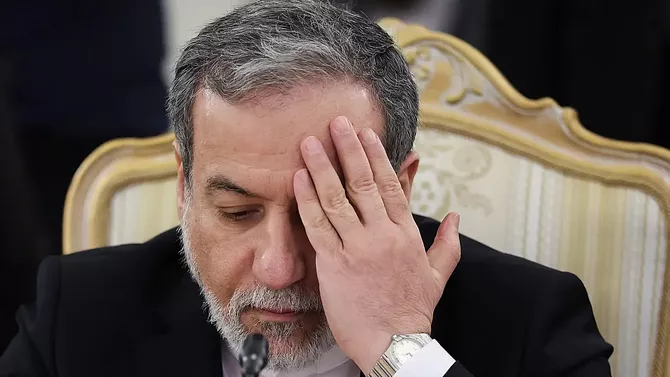
Photo credit: Euronews
The regime does not intend to allow such a scenario to be repeated.
Khamenei has reportedly designated four potential successors for each senior military and state official appointed by him. All other officials have been instructed to appoint at least four deputies of their own. The Supreme Leader has also named three possible successors for himself - though their identities remain undisclosed.
This is redundancy elevated to doctrine.
At the same time, the regime faces an equally serious internal challenge: eroding public support.
Recent developments point to a widening fracture within Iranian society. According to Iranian agencies and Telegram channels, after a brief lull, unrest and student demonstrations have once again erupted at Tehran University and several other higher education institutions. The protests resumed with the start of the new academic semester in the second half of February and coincided with the 40th day of mourning for those killed during the January protests - a deeply symbolic milestone in Iranian political culture.
Iranian youth are now visibly divided. Some stand ready to defend the Islamic Republic and its Supreme Leader. Others openly challenge the authorities, whom officials describe as “destructive elements.”
Thus, in anticipation of renewed hostilities and even his hypothetical death, Khamenei has identified a narrow inner circle authorized to make decisions in moments of extreme crisis.
Among those trusted figures are Ali Larijani; Khamenei’s chief military adviser Yahya Rahim Safavi; Speaker of Parliament Mohammad Bagher Ghalibaf; and Khamenei’s chief of staff Ali Asghar Hejazi.
Additionally, a new coordinating military body - the National Defense Council - has been established under Admiral Ali Shamkhani.
In practice, however, day-to-day governance has effectively shifted to Ali Larijani.
Since January 2025, amid mass protests against the ayatollah regime and growing expectations of U.S. airstrikes, Larijani has consolidated unprecedented authority. Khamenei entrusted him with suppressing unrest and preparing the country for war. He maintains contact with key external partners of the regime - Russia, Qatar, and Oman - and, from behind the scenes, oversees negotiations with the United States regarding Iran’s nuclear program, although these talks are formally conducted by Foreign Minister Araghchi.
Larijani’s background helps explain his current position.
At 67, he belongs to one of Iran’s most influential political families. His father was a prominent Shiite jurist. One brother serves as Khamenei’s foreign policy adviser; another previously headed Iran’s judiciary. Larijani himself currently chairs the Expediency Council, an advisory body to the Supreme Leader. Numerous relatives hold significant positions within Iran’s religious and political establishment.
Ali Larijani rose to the rank of brigadier general in the IRGC and led the state broadcasting corporation for 10 years. In 2005, he ran for president, finishing sixth. After Mahmoud Ahmadinejad won that election, Larijani was appointed Secretary of the Supreme National Security Council. He left that post in 2008 to become Speaker of Parliament, a position he held until 2020.
He is personally close to Khamenei and enjoys his full trust.
In the 2000s, Larijani supervised negotiations with the United States over Iran’s nuclear program. In the 2020s, he became one of the principal architects of Iran’s strategic rapprochement with China.
Since early 2025, his public profile has risen sharply, while the influence of President Mahmoud Pezeshkian has noticeably declined. It was Larijani who traveled to Moscow to meet President Vladimir Putin and who engaged with Middle Eastern leaders. He represents the Islamic Republic’s position in the media and on social platforms.
The balance of power inside Tehran is evident in small but telling details. President Pezeshkian reportedly had to seek Larijani’s approval to ease internet restrictions imposed to suppress protests - restrictions that significantly damaged Iran’s economy. In January, when U.S. presidential envoy Steve Witkoff contacted Foreign Minister Araghchi regarding potential executions of detained protesters, Araghchi sought guidance from President Pezeshkian. The president reportedly replied that all contacts with the Americans should be coordinated not with him, but with Larijani.
This is not symbolic. It reflects where operational authority now lies.
A successor appears ready. The structure is built. The redundancies are in place.
But another, more sensitive question is circulating within Iran’s elite: who could become the “Iranian Delcy”?
The reference is to Delcy Rodríguez of Venezuela, a figure associated with maintaining regime continuity under intense U.S. pressure while recalibrating external relations to preserve elite survival.
The idea itself is revealing.
Iran’s ruling elite controls substantial material resources. Economic networks, strategic assets, and patronage structures - all are deeply embedded within the regime’s power architecture. It is difficult to imagine that those who hold such leverage would willingly sacrifice everything for ideological rigidity alone.
Survival, not purity, may ultimately determine decisions.
Iran has prepared for decapitation. It has layered its command structures. It has identified successors. It has empowered trusted figures. It has mobilized security forces. It has created new institutions.
The regime is engineering its endurance.
But institutional design does not guarantee historical outcomes.
The central question is no longer whether Iran is preparing for war. It is.
The real question is whether the succession architecture will have time to function, or whether escalation will move faster than the system can respond.
In Tehran today, survival is not rhetoric. It is strategy.