ASELSAN Unveils TUFAN Naval Drone for Swarm Warfare
ASELSAN revealed the TUFAN unmanned surface vehicle for the first time at SAHA 2026 in Istanbul, underscoring Türkiye’s growing focus on expanding autonomous maritime strike capabilities amid NATO and regional navies’ preparations for contested operations against low-cost asymmetric threats.
Displayed on 5 May 2026 alongside the KILIÇ autonomous underwater strike family, the system signals Ankara’s effort to adapt combat concepts proven in drone warfare to littoral combat, distributed attacks, and saturation strikes against larger naval formations, The Caspian Post reports, citing Army Recognition.
TUFAN is designed to increase offensive reach while reducing the risk to crewed platforms in high-threat coastal environments, reinforcing a broader shift toward autonomous naval warfare and layered maritime strike networks. Its introduction reflects growing interest in unmanned systems capable of overwhelming traditional defenses through coordinated attacks, rapid deployment, and persistent operations in confined or heavily defended waters.
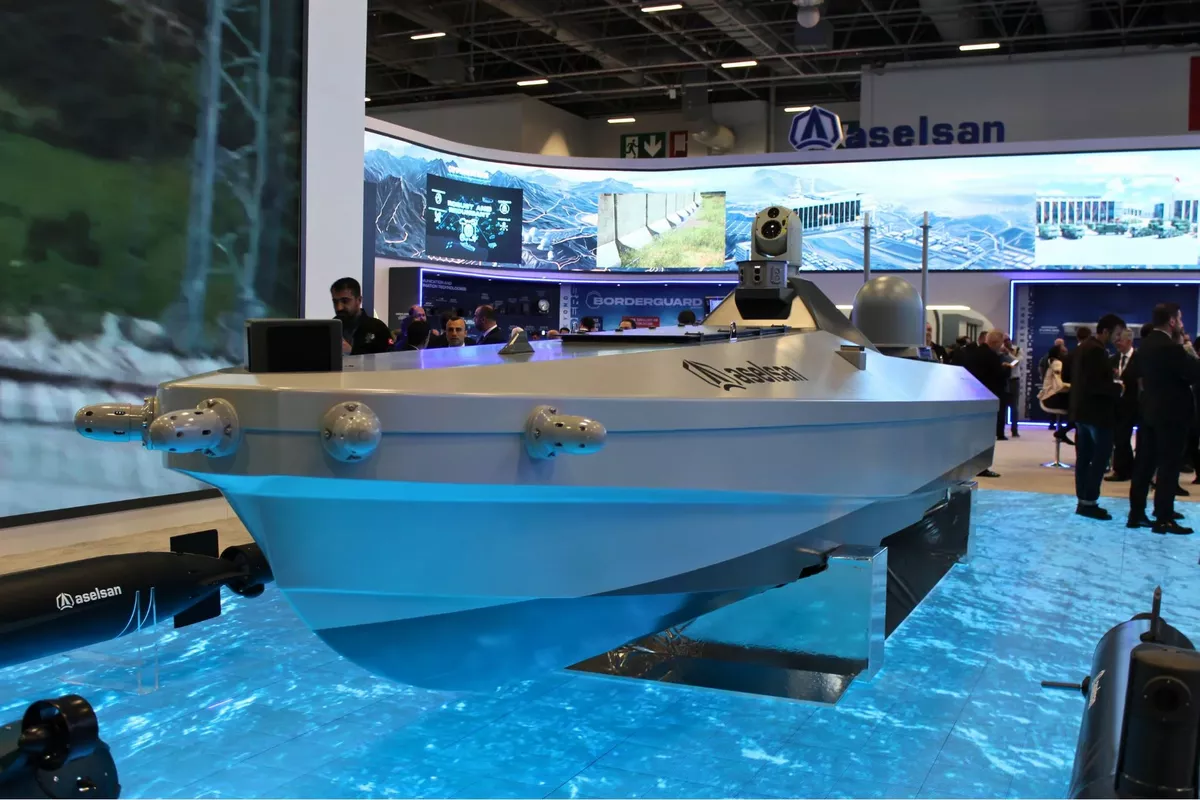
Officially displayed on ASELSAN’s stand during SAHA 2026, TUFAN is described as a kamikaze unmanned surface vehicle capable of operating individually or in coordinated swarms while carrying a high-explosive insensitive munition warhead. The system is built around a low-observable hull design intended to reduce radar cross-section and thermal signature, a growing requirement as modern warships increasingly rely on electro-optical sensors, infrared search-and-track systems, and short-range maritime radars to detect small surface contacts. The overall configuration recalls several Western and Ukrainian concepts that emerged after naval drone operations conducted in the Black Sea between 2022 and 2025, although ASELSAN appears to place greater emphasis on autonomous mission management and distributed swarm coordination.
The vehicle itself remains relatively compact. According to the technical data released during the exhibition, TUFAN measures eight meters in length with a beam of 1.8 meters and can exceed 50 knots through a gasoline engine combined with waterjet propulsion. Its operational range reaches approximately 200 nautical miles, allowing the drone to conduct coastal strike missions, harbor penetration operations, or long-range reconnaissance tasks without requiring a nearby mothership. The use of waterjet propulsion provides improved maneuverability during terminal attack phases while reducing exposed moving components compared with conventional propellers.
ASELSAN also states that the drone complies with STANAG 4817, a NATO standard associated with unmanned maritime systems integration. That detail indicates that the company is positioning TUFAN not only for Turkish naval requirements but also for potential export opportunities among allied and partner navies seeking lower-cost autonomous strike assets. In practical terms, the concept stands between experimental American autonomous surface vessel programs and the explosive naval drones employed by Ukraine against units of the Russian Black Sea Fleet. Unlike larger US systems such as DARPA’s Sea Hunter or the US Navy’s Medium Unmanned Surface Vehicle (MUSV), however, TUFAN prioritizes attrition and saturation effects rather than long-endurance blue-water operations.
The autonomy architecture represents one of the most developed aspects of the program. ASELSAN indicates that TUFAN incorporates sensor fusion, autonomous mission planning, dynamic route optimization, obstacle avoidance, and artificial intelligence-based target engagement functions. The drone is also intended to continue operating in environments affected by Global Navigation Satellite System (GNSS) jamming or communications disruption, a capability that has become increasingly relevant following repeated electronic warfare encounters in the Black Sea and Eastern Mediterranean. Communication methods include line-of-sight radio-frequency links, mesh-network topologies, beyond-horizon satellite communications, and 4G/LTE connectivity.
This communications architecture resembles distributed networking approaches currently explored in several NATO naval innovation programs. The US “Hellscape” concept developed for the Indo-Pacific similarly relies on large numbers of attritable autonomous systems capable of maintaining operational effectiveness despite jamming or partial network degradation. TUFAN appears designed according to comparable assumptions. Rather than functioning solely as a remotely piloted explosive boat, the system is intended to retain a degree of local decision-making capability during terminal attack or reconnaissance phases.
Operationally, the drone is optimized for asymmetric naval warfare. ASELSAN states that multiple TUFAN vehicles can divide into sub-groups and execute coordinated attack formations against defended maritime targets. The system can be launched either from port facilities or from larger vessels before autonomously transiting toward the operational area. Combined operations involving manned and unmanned naval assets are also referenced in the company documentation.
This operational concept directly reflects lessons drawn from recent maritime conflicts. A fast low-observable drone traveling at more than 50 knots compresses the reaction time available to conventional warships, particularly in congested littoral environments where civilian traffic, wave reflections, and coastal interference complicate radar tracking. When employed in coordinated salvos, systems such as TUFAN could force high-value naval assets to expend costly short-range interceptors or large quantities of close-in weapon system ammunition against relatively inexpensive attack vehicles. The concept therefore aligns with broader changes in naval warfare where mass, dispersion, and autonomy increasingly challenge traditional fleet defense models centered on a limited number of large surface combatants.
Türkiye is progressively building an integrated ecosystem of autonomous aerial, land, surface, and subsurface systems while simultaneously developing indigenous sensor, electronic warfare, and command-and-control capabilities. If exported, systems such as TUFAN could accelerate the spread of autonomous maritime strike technologies across the Middle East, the Black Sea region, and parts of Asia where coastal states seek deterrence options against conventionally superior fleets. NATO members are also likely to monitor the program closely because the drone combines alliance interoperability standards with operational concepts influenced by combat experience observed in Ukraine and the Eastern Mediterranean.