Türkiye to Receive First National TF-2000 Air Defense Destroyer by 2027
Istanbul Naval Shipyard confirmed that the lead ship of the TF-2000 destroyer program will be launched by 2027 to provide dedicated area air defense for fleet protection.
Türkiye is significantly advancing its naval air defense capability, as the TF-2000 introduces a high-capacity vertical launch system and advanced sensors, significantly enhancing the Turkish Navy’s ability to counter long-range aerial and missile threats, as new high-value assets, such as an aircraft carrier, will enter service.
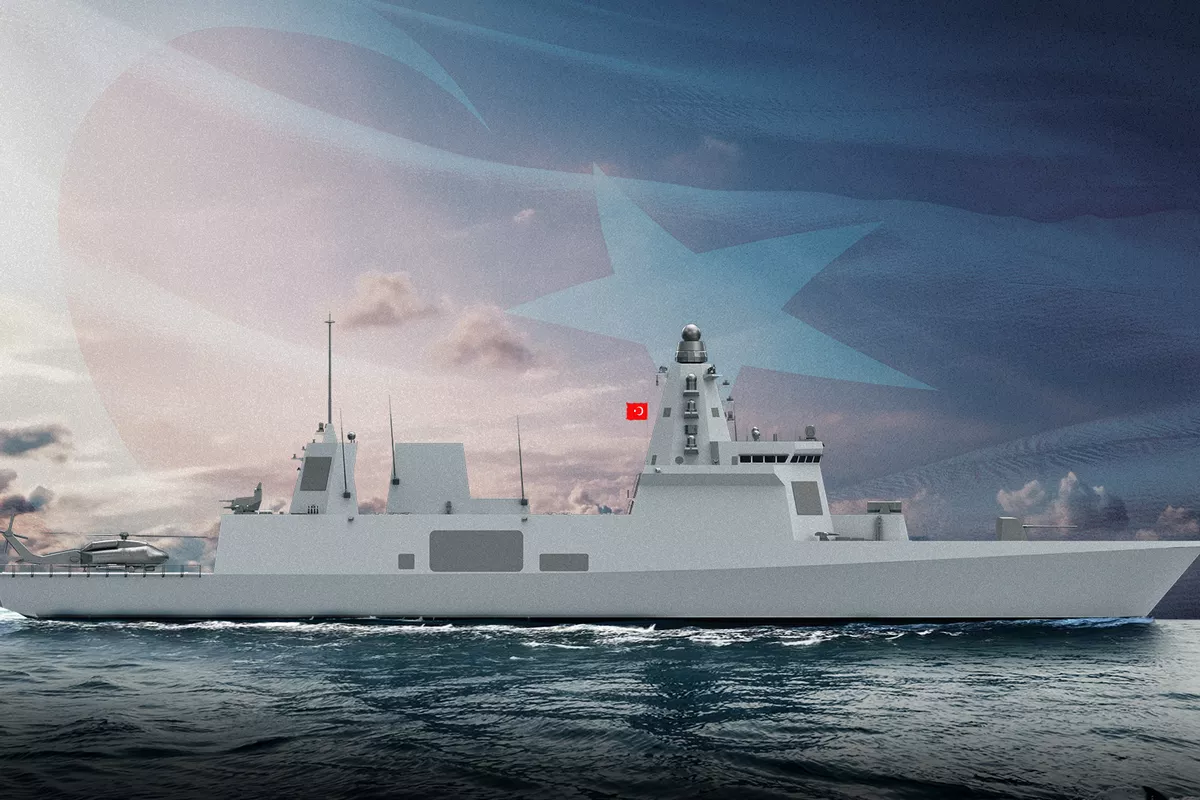
The TF-2000 will introduce a dedicated area air defense capability that is currently absent from the Turkish Naval Forces, fundamentally changing the fleet’s operational structure by adding a ship specifically optimized to detect, track, and intercept long-range aerial threats. (Picture source: ASFAT)
On March 16, 2026, Istanbul Naval Shipyard Commander Rear Admiral Recep Erdinç Yetkin indicated that the lead TF-2000 air defense destroyer is scheduled for launch by the end of 2027, allowing Türkiye to possess its first dedicated air defense destroyer. The vessel is intended to provide regional air defense warfare capability and to integrate into a broader national architecture linking naval and land-based interception systems. Construction milestones show that steel cutting has been completed and that the first hull block is planned for placement on the slipway in March 2026, marking the start of visible assembly. The program follows a modular build approach with approximately 60 structural blocks, enabling parallel production and staged integration.
The destroyer, planned to enter service after launch within the Turkish Naval Forces Command, forms part of a wider modernization effort that also includes an aircraft carrier and a new submarine class. The TF-2000 program reflects a shift from earlier fleet compositions that lacked a dedicated area air defense ship capable of countering long-range missile threats, including cruise and ballistic systems. Initial concepts in the late 1990s envisioned a frigate-class design, but evolving operational requirements led to reclassification as a destroyer with significantly increased size and missile capacity. The number of vertical launch cells expanded from 32 to 96, driving changes in hull dimensions and displacement, which now reach about 8,300 tons
Earlier planning phases referenced higher tonnage and longer hulls up to 166 meters, indicating iterative design adjustments before finalizing the current configuration. The project also underwent interruptions due to economic constraints, including the 1999 financial crisis, which reduced the planned fleet size. Current projections have ranged from four to eight ships, depending on budget and strategic priorities. The cost of initial program phases has been estimated at $3 billion, reflecting the scale of the effort and the integration of domestically produced systems. The vessel, optimized for air defense, now has a length of 149 meters, a beam of 21.3 meters, and a draft of 5.75 meters.
Propulsion is based on a combined diesel and gas turbine configuration, allowing speeds exceeding 26 knots and sustained cruising at 17 to 18 knots. Crew requirements are estimated between 130 and 150 personnel in baseline configurations, though broader operational concepts suggest higher capacity when including aviation and mission specialists. The ship is designed for operations in the Aegean Sea, Eastern Mediterranean, and adjacent waters, with endurance suited for extended deployments without frequent resupply. Structural design considerations include survivability features such as compartmentalization and integration of advanced sensor arrays. However, the combat capability of the TF-2000 remains centered on a 96-cell indigenous vertical launch system, configured to deploy a mix of long-range, medium-range, and potentially specialized interceptors.
Planned missile integration includes Siper long-range surface-to-air missiles, Hisar systems, and additional interceptors for layered defense, enabling engagement of multiple aerial threats at varying distances. Offensive capability is provided by Atmaca anti-ship missiles and Gezgin land-attack cruise missiles, extending strike range beyond naval targets. The destroyer is also equipped with a 127 mm main gun for surface engagements and naval fire support, as well as torpedo systems for anti-submarine warfare. Close-in defense is ensured by systems such as Gökdeniz CIWS, supplemented by electronic countermeasures and potential directed energy systems under development. The expansion from earlier 32-cell configurations to 96 cells represents a significant increase in engagement capacity and defensive depth across air, surface, and subsurface domains.
The destroyer also brings a substantial expansion in sensor capability, particularly through the integration of phased-array radar systems designed to detect and track a large number of targets over extended ranges. These systems are integrated with electronic warfare suites, sonar arrays, and command-and-control networks to provide a comprehensive operational picture. The destroyer is intended to function as a central node within naval task groups, coordinating engagements and sharing data with other units, including land-based systems. Aviation facilities support helicopters such as the Sikorsky S-70B Seahawk and multiple unmanned aerial vehicles, extending surveillance and targeting capabilities beyond the ship’s immediate sensor horizon.
Anti-submarine warfare capabilities include sonar systems and torpedo deployment, enabling operations against submerged threats. The integration of these systems supports multi-domain operations and enhances situational awareness in complex environments. The ship’s design emphasizes interoperability within joint and allied operations while maintaining a high level of domestic system integration. The TF-2000 is intended to operate alongside larger naval assets, particularly the MUGEM national aircraft carrier, which is under development with a similar target timeline for launch by late 2027. The carrier is designed as a STOBAR configuration and is expected to deploy unmanned systems such as the Bayraktar TB-3, Kızılelma derivatives, and ANKA-III, along with a navalized Hürjet aircraft.
Therefore, the TF-2000 will provide area air defense for carrier strike groups, protecting high-value units against aerial and missile threats. The destroyer’s role includes early warning, target tracking, and interception coordination within a layered defense structure. This integration reflects a shift toward expeditionary naval operations and carrier-centered task groups. The combined development of carrier, destroyer, and submarine programs indicates a coordinated effort to build a balanced and modern fleet. The TF-2000 is therefore positioned as a core escort and command asset within this evolving structure. Türkiye’s broader naval strategy also includes export-oriented shipbuilding activities, which contribute to industrial capacity and sustain production lines.
Completed projects include a MILGEM corvette delivered to Ukraine, two naval vessels constructed for Pakistan, and an offshore patrol vessel built for Romania. For now, the Turkish Navy fleet includes 16 frigates divided between 4 Barbaros-class, 8 Gabya-class, and 4 newer Istanbul-class, alongside 4 Ada-class corvettes developed under the MILGEM program. 16 fast attack craft, 30 patrol vessels, and 11 mine countermeasure vessels complement the surface fleet, while submarine forces consist primarily of 12 Type 209 variants, and 6 Type 214 Reis-class submarines enter service progressively. The navy also operates the TCG Anadolu amphibious assault ship, which introduces aviation and expeditionary capabilities not previously present in the fleet. Despite this force, the introduction of the TF-2000 fills a structural gap, as the Turkish Navy does not have a single dedicated air defense destroyer in service.
See the original article here