Tajikistan is rarely seen as a major commercial prize. Its economy is small, mountainous and heavily dependent on remittances.
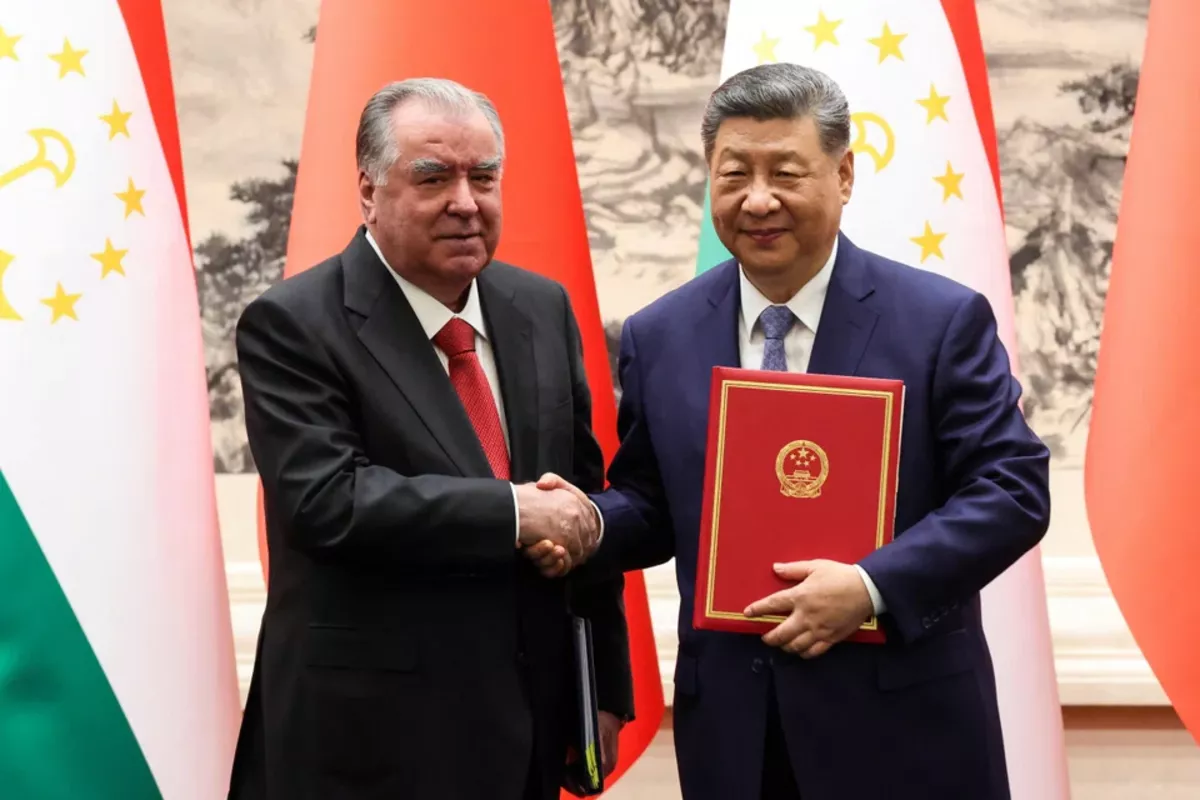
Yet, President Emomali Rahmon’s state visit to Beijing this month, where China and Tajikistan upgraded their 2007 Good-Neighborliness, Friendship and Cooperation Treaty into a permanent framework, shows why smaller Central Asian economies now matter in Asia’s investment geography, The Caspian Post reports via The Business Times.
The treaty should be read as a strategic-economic signal. Dushanbe wants to lock in Chinese capital, technology and infrastructure support. Beijing wants a more stable western neighbourhood for trade, logistics, border security and project protection.
For both sides, political trust is becoming a condition for deeper economic cooperation.
Tajikistan’s growth story looks strong on the surface. It has recorded high growth in recent years, helped by remittances, public spending and domestic consumption.
But the model remains fragile.
The country relies heavily on workers abroad, especially in Russia; imports much of what it consumes; has a narrow industrial base; and faces persistent infrastructure gaps.
Its market is too small to compete with Uzbekistan, its resources are less central than Kazakhstan’s and Turkmenistan’s, and its transport position is weaker than Kyrgyzstan’s emerging role as a corridor state.
That vulnerability explains the urgency behind the treaty. A remittance-driven economy can expand quickly when external conditions are favourable, but it leaves Tajikistan exposed to migration restrictions, currency shocks, labour-market pressure in Russia and weak domestic job creation.
For Dushanbe, China offers a way to reduce that exposure: roads, power, mining, digital systems, industrial parks and access to a broader Asian investment network.
The China-Kyrgyzstan-Uzbekistan railway adds another layer of pressure.
Once completed, the line will connect western China more directly with Kyrgyzstan and Uzbekistan, strengthening a route that can link onward to the Caspian, Iran, Türkiye and Europe.
It gives Kyrgyzstan transit value and reinforces Uzbekistan’s role as Central Asia’s most dynamic reforming market. Tajikistan, however, sits outside the main line.
That does not make Tajikistan irrelevant, but it does make its economic position more difficult. If Kazakhstan anchors the northern corridor, Kyrgyzstan gains rail transit, Uzbekistan becomes a regional market and manufacturing hub, and Turkmenistan supplies gas, Tajikistan needs a sharper proposition.
Dushanbe’s answer is to convert security geography into investment relevance.
Tajikistan’s Value to China
This is where the treaty matters. Tajikistan can offer China something the railway cannot: a long-term partnership on China’s sensitive western flank. It borders China through the Pamir region, sits near Afghanistan, and matters for stability facing Xinjiang and Afghanistan.
In commercial terms, that geography can support border infrastructure, energy projects, mining, logistics, telecommunications and security services around Chinese-backed projects.
The competition with Kyrgyzstan should therefore be understood less as a return to border tension and more as a contest for position in China’s regional allocation of capital and attention. The Tajik-Kyrgyz border dispute has eased after years of deadly clashes, but the two countries now compete in another way.
Kyrgyzstan offers corridors, re-export trade and railway access. Tajikistan offers security depth, hydropower potential, minerals and a direct role in managing Afghanistan-related risks.
For Beijing, these roles are complementary; for Central Asian governments, they are competitive.
Chinese money is not unlimited. Each state is trying to show that it deserves priority in Beijing’s next phase of regional engagement. Tajikistan’s permanent treaty is a bid to move from the margins of China’s economic map to the centre of its western risk-management strategy.
China’s Central Asia Framework
China’s wider Central Asia policy is also changing. Beijing’s role is moving beyond trade volumes and infrastructure loans into legal and institutional consolidation.
In 2025, China and the five Central Asian states signed a collective Permanent Good-Neighborliness and Friendly Cooperation Treaty, locking in a regional framework for political trust, connectivity, energy, trade and security cooperation.
The new bilateral treaty with Tajikistan takes that collective framework and applies it more deeply to one strategically sensitive country.
China is building a regional framework while tailoring bilateral bargains.
Kazakhstan is central for energy, minerals and northern connectivity. Uzbekistan offers market scale and industrial potential. Kyrgyzstan matters for transit and border trade. Turkmenistan remains crucial for gas. Tajikistan’s value lies in security geography, hydropower, minerals and proximity to Afghanistan.
The treaty formalises that differentiated approach.
Russia still matters. Tajikistan remains tied to Russia through labour migration, military links, language, post-Soviet institutions and security habits.
Moscow’s role has not disappeared, but it is being repriced.
Russia provides legacy networks and a security umbrella. China increasingly provides the future-facing assets that Tajikistan needs for development: finance, infrastructure, technology, market access and long-term economic planning.
Dushanbe is using Beijing to reduce the risks of relying too heavily on Moscow, not choosing China against Russia.
Implications for Business
For business audiences, the security clauses in the treaty deserve attention because they reveal how investment conditions are changing in emerging corridors.
Chinese companies and workers in Central Asia face risks from border instability, organised crime, terrorism, weak state capacity and Afghanistan-related spillovers.
As projects move into more difficult geographies, security cooperation becomes part of the investment architecture.
Infrastructure corridors need more than capital. They need legal certainty, political commitment, project protection, border management and host-state capacity. China’s approach in Tajikistan suggests that Beijing increasingly sees these issues as part of the deal structure, especially where projects touch sensitive frontiers.
For Singapore and other Asian business centres, Central Asia remains a distant market, but it is becoming harder to ignore.
The region sits at the intersection of China-Europe connectivity, sanctions-sensitive Eurasian trade, critical minerals, energy flows, digital infrastructure and alternative logistics routes.
Singapore is unlikely to play a direct geopolitical role in Central Asia, but it has potential relevance in infrastructure finance, arbitration, risk advisory, logistics planning and project structuring.
The China-Tajikistan treaty points to a broader shift in Asia’s economic map. Central Asia is moving from buffer zone to business platform. Its value lies in corridors, minerals, energy, data, security and strategic capital.
Tajikistan wants to turn a difficult location into a source of leverage. China wants to secure the partnerships behind its westward connectivity.
The result is a more institutionalised Chinese presence in Central Asia, built through treaties, infrastructure, finance and security cooperation rather than formal alliances.
For investors and policymakers, the next phase of Central Asia’s opening will be shaped as much by risk management as by opportunity. Tajikistan is small, but its treaty with China shows where the region is heading.