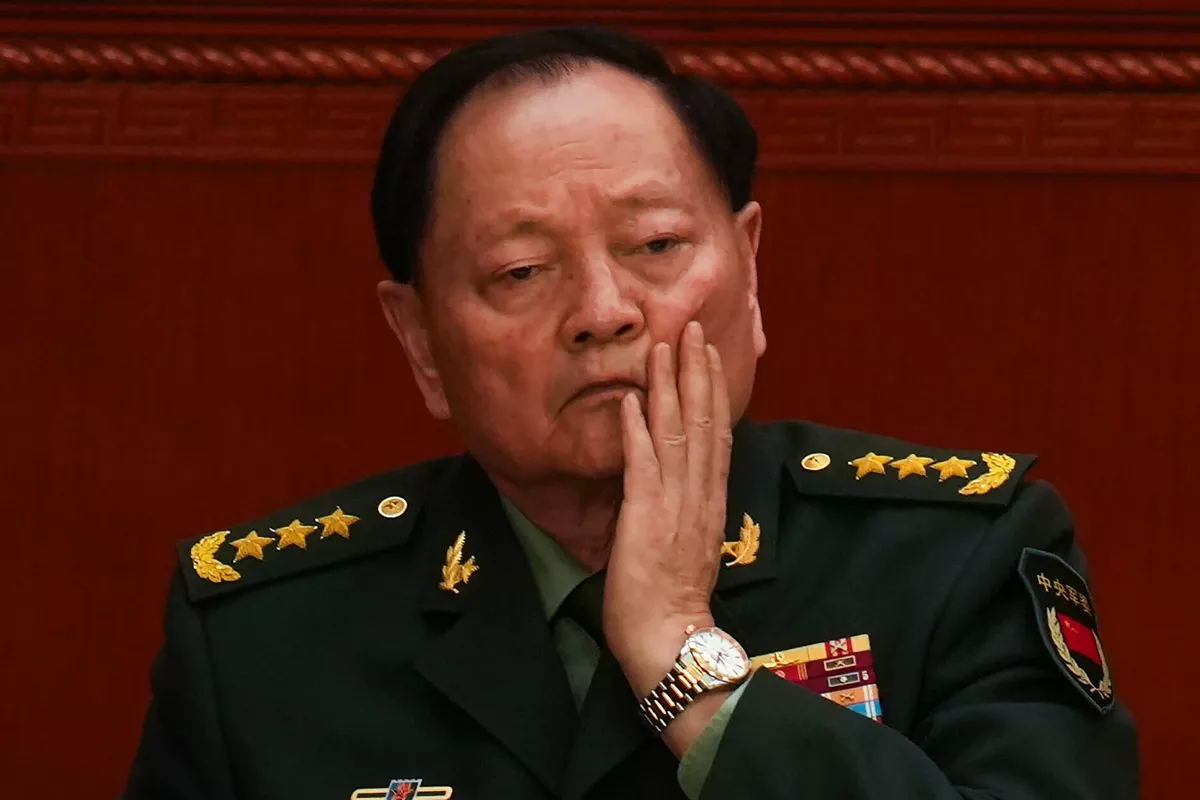
China has purged senior military figures before, but the announcement that General Zhang Youxia, vice-chairman of the powerful Central Military Commission (CMC), is under investigation for corruption has sent shockwaves through defence and security circles. Zhang is one of the most senior uniformed officers in the People’s Liberation Army (PLA) and has long been regarded as a trusted figure within President Xi Jinping’s inner circle.
The downfall of such a high-profile veteran illustrates the extraordinary scope of Xi’s military anti-corruption campaign and highlights the extent to which he continues to consolidate personal control over China’s armed forces.
What are the Allegations?
General Zhang, 75, serves as vice-chairman of the Central Military Commission, the body that exercises supreme command over the PLA and is chaired by Xi Jinping himself.
On January 24, China’s Ministry of National Defense stated that Zhang and another senior CMC member, General Liu Zhenli, are “suspected of serious violations of discipline and the law” - language commonly used by Chinese authorities as a euphemism for corruption.
An editorial in the PLA Daily went further, accusing both men of having “seriously trampled on and undermined the system of ultimate responsibility resting with the CMC chairman”, an implicit reference to Xi’s authority over the military.
The whereabouts of Zhang and Liu remain unknown, and Beijing has provided no specific details about the nature of the accusations.
Adding to the intrigue, The Wall Street Journal, citing people familiar with a high-level internal briefing, reported that Zhang is suspected of leaking information about China’s nuclear weapons programme to the United States. The claim has not been independently verified.
Why is Zhang’s Fall so Significant?
Since coming to power, Xi Jinping has pursued an aggressive campaign against corruption across China’s political system, including the military. Yet analysts say the investigation into Zhang represents one of the most consequential moves yet.
Independent Beijing-based analyst Hua Po described the announcement as “a bombshell with far-reaching and profound impact”.
Steve Tsang, director of the SOAS China Institute in London, said Zhang’s case sends a powerful message across the PLA: no general, regardless of rank or past service, is beyond scrutiny.
Zhang and Liu have not yet been formally removed from the CMC. However, precedent suggests such a step is likely. Former defence ministers Wei Fenghe and Li Shangfu were both dismissed after facing similar accusations, while senior generals He Weidong and Miao Hua were ousted in 2025.
If Zhang and Liu are eventually removed, a commission meant to have seven members would be left with only two publicly confirmed figures: Xi Jinping and CMC anti-corruption chief Zhang Shengmin.
Niklas Swanstrom, director of the Institute for Security and Development Policy (ISDP) in Stockholm, says this would amount to “maximal personal control over China’s armed forces, at least in theory”.
Tsang believes future CMC appointments will likely go to officials who are highly loyal and unwilling to challenge Xi’s decisions.
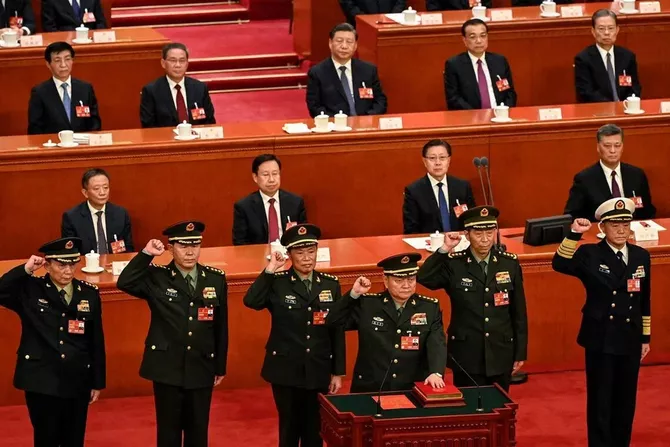
photo: The Straits Times
What does This Mean for China’s Military?
Despite the upheaval, experts argue that the PLA’s overall operational readiness has not been seriously degraded.
James Char of Singapore’s Nanyang Technological University says China’s military “can carry on largely as normal” despite leadership turmoil.
Still, Swanstrom notes that there will be “immediate harm to command cohesion”, as networks of trust and cooperation among senior officers are disrupted. Over the long term, however, if corruption is genuinely reduced, the military could become more professional and disciplined.
At the same time, excessive centralisation carries risks. Tsang warns that advice which might be strategically sound for China or the PLA but politically inconvenient for Xi is now less likely to be voiced.
Hua Po put it more bluntly: “From this point on, the military will heed only Xi - where he points, they will strike.”
Strategically, China’s core military objectives remain unchanged. Beijing continues to pursue Xi’s twin goals: largely completing PLA modernisation by 2035 and transforming it into a “world-class” force by mid-century.
Will it Affect China’s Taiwan Strategy?
The PLA has significantly expanded the frequency and scale of military drills around Taiwan in recent years. Beijing claims the self-governed island as part of its territory and says it seeks peaceful reunification, while reserving the right to use force.
Most analysts, however, believe a full-scale invasion in the near term remains unlikely.
Neil Thomas of the Asia Society argues that major leadership disruptions increase operational risk, especially when complex joint operations require experienced commanders who have worked together for years.
Swanstrom adds that many of the purged generals were considered among those with the deepest expertise in preparing for a potential Taiwan operation.
Practical constraints also remain. According to James Char, the PLA still lacks sufficient numbers of amphibious combined-arms brigades for a large-scale cross-strait assault.
A failed invasion would be a political catastrophe for Xi Jinping, says Su Tzu-yun of Taiwan’s Institute for National Defense and Security Research.
For that reason, many experts conclude that consolidating control at home currently appears more rational for Beijing than launching a war with an uncertain outcome.