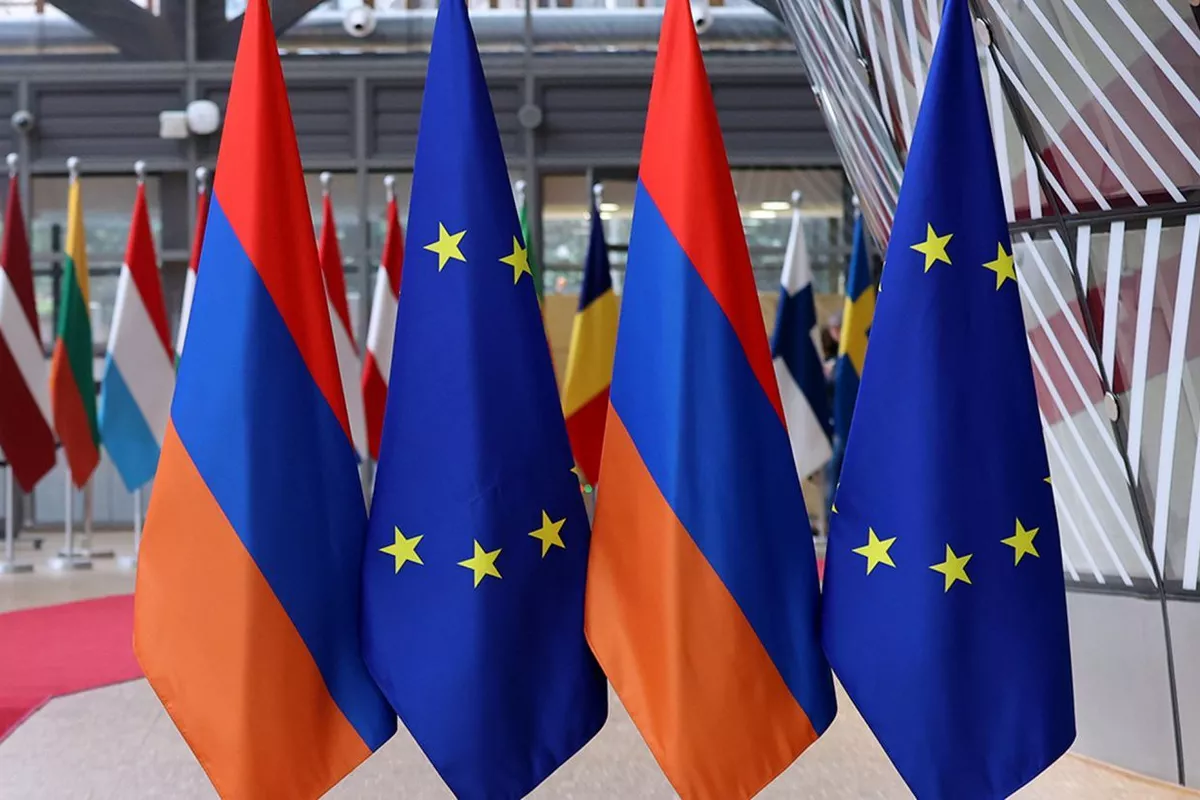
The European Union and Armenia signed a new policy document, the “Armenia-EU Strategic Agenda for Partnership,” on December 2, setting out an ambitious framework for deepening ties across political, economic, and security spheres. The 64-page agenda, announced by Armenia’s Foreign Ministry, lays out mechanisms for cooperation and sketches the geopolitical vision that will guide relations in the coming years.
While the document highlights priorities such as economic reform, democratic governance, and closer political integration, several of its provisions raise concerns about their potential impact on the region’s fragile peace efforts.
One early point of contention appears on page four, where the voluntary relocation of Armenians from Karabakh to Armenia is characterized as “being displaced.” Baku rejects this terminology as inaccurate, arguing that the departures were voluntary and encouraged by leaders of the illegal separatist structure in Karabakh, supported through Armenia’s state budget.
The document’s wording further reflects the EU’s apparent uncertainty over how to characterize the issue, alternating between the terms “displaced” and “refugee.” This hesitation effectively frames a voluntary movement as a forced one, casting the situation in geopolitical terms and creating a distorted narrative. In doing so, it risks generating a biased perception of Azerbaijan’s legitimate military actions, downplaying Armenia’s responsibility, and paving the way for future manipulative interpretations.
Such language amounts to an unfounded accusation and a form of political pressure directed at Azerbaijan. Baku’s position remains clear: no international institution or partner country has the authority to adopt an ultimatum-like or accusatory tone toward Azerbaijan. Any approach that disregards principles of sovereignty, mutual respect, and international law, including from the EU and its leadership, is wholly unacceptable.

Photo credit: Trend
The EU’s role in the South Caucasus has long been clouded by questions of bias, and the record of its senior officials has done little to dispel those concerns. Throughout his tenure as the EU’s High Representative for Foreign Affairs and Security Policy, Josep Borrell repeatedly issued statements about Azerbaijan that critics say were detached from facts and shaped instead by political pressure. Far from supporting diplomatic efforts, this approach weakened the EU’s credibility as a neutral mediator and eroded trust at a sensitive moment in the peace process.
That pattern, critics argue, has not changed. If Brussels is genuinely committed to meaningful dialogue, its leadership will first need to abandon its increasingly one-sided rhetoric on Azerbaijan and adopt a stance grounded in international law and mutual respect.
One of the most contentious elements in the new EU-Armenia document is the proposal to integrate into the EU’s training and education network a military school in Armenia named after Monte Melkonyan - a figure widely recognized as a terrorist responsible for serious war crimes. The rationale behind this move remains unexplained, raising concerns about its political intent and strategic consequences. Any gesture that appears to legitimize such a figure stands in clear contradiction to the EU’s own values and threatens to destabilize an already fragile security environment.
Equally troubling is the document’s use of the term “Nagorno-Karabakh,” a designation that no longer has any legal or administrative status. The reintroduction of this terminology undermines the EU’s claims to objectivity and signals a political tilt that Azerbaijani officials view as unmistakably biased.
The contradiction runs deeper: while the EU reiterates its support for territorial integrity, the same document contains language that calls Azerbaijan’s sovereignty into question. For Baku, this amounts to diplomatic inconsistency and raises doubts about the EU’s reliability as a partner.
With tensions heightened, a formal response from Azerbaijan’s Foreign Ministry is expected. But observers note that the onus is now on the EU to clarify its position - openly, consistently, and impartially - if it intends to play a constructive role.
Despite dedicating extensive space to Armenia’s humanitarian claims regarding Karabakh, the document makes no mention of Azerbaijan’s core concerns, including the historical presence of Armenian armed groups in the region, longstanding threats to its territorial integrity, and ongoing security risks. This imbalance casts doubt on the EU’s ability to act as an impartial mediator. By overlooking Azerbaijan’s legitimate security concerns, the document risks emboldening revisionist elements in Armenia and complicating progress toward a sustainable peace.
The document states: “Supporting the release of Armenian detainees and other held persons…” Yet it remains unclear which detainees are being referenced or why the EU considers this its obligation. The wording gives the impression of a political directive rather than a legal mechanism, ultimately reinforcing Armenia’s diplomatic rhetoric.
This approach politicizes humanitarian issues, weakens mutual trust, and increases the risk that the matter will be used as a political pressure tool against Azerbaijan.
The document also includes a vague call for the “full, immediate, and effective” implementation of International Court of Justice decisions: “Supporting the full, immediate and effective implementation of all relevant International Court of Justice decisions…” Without specifying which rulings are meant, the wording leaves ample room for manipulation. Armenia could exploit this ambiguity in pursuit of its own interests, adding tension to the peace process and diverting both sides from a clear legal framework toward political interpretation.
While the document references the rights of Karabakh Armenians who voluntarily relocated to Armenia, it makes no mention of the more than 300,000 Azerbaijanis deported from Armenia. This imbalance appears not only in this text but in all EU-Azerbaijan documents. Such an omission suggests that equal principles are not being applied. If the EU chooses to address the “social integration” of Armenians who left Karabakh voluntarily, Azerbaijan is justified in calling for a clause on the rights of Western Azerbaijanis. The EU’s silence on this issue reflects a one-sided humanitarian approach.
The signed document contains several risks for efforts to establish peace and stability in the region. Although the EU-Armenia strategic agenda is presented as a framework for cooperation, its inaccurate humanitarian assessments, disregard for Azerbaijan’s security concerns, legally unfounded demands, ambiguous references under international law, and one-sided political evaluations could negatively affect the peace process.
The Joint Statement signed in Washington after the meeting between the President of Azerbaijan and the Prime Minister of Armenia had created a genuine prospect for peace.

Photo credit: president.az
In conclusion, the “strategic agenda” signed on December 2 between the EU and Armenia amounts to interference in the fragile peace process underway in the region. Rather than building trust between Armenia and Azerbaijan, certain provisions risk undermining it and providing Armenia with new opportunities for manipulation in negotiations.
The progress achieved in Washington on August 8 - under the mediation of President Donald Trump - on initialing the peace treaty text and opening communications had strengthened hopes for stability in the South Caucasus. However, the new EU-Armenia document appears intended to cast a shadow over this positive momentum.