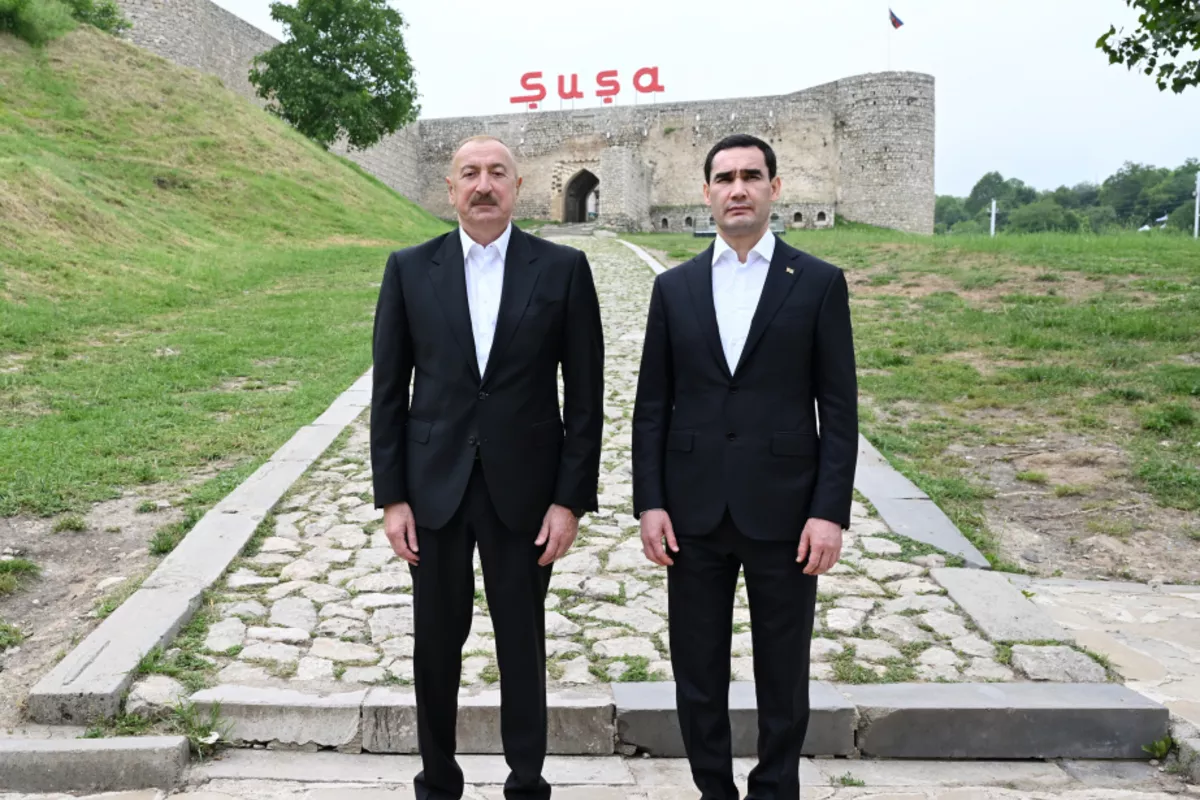
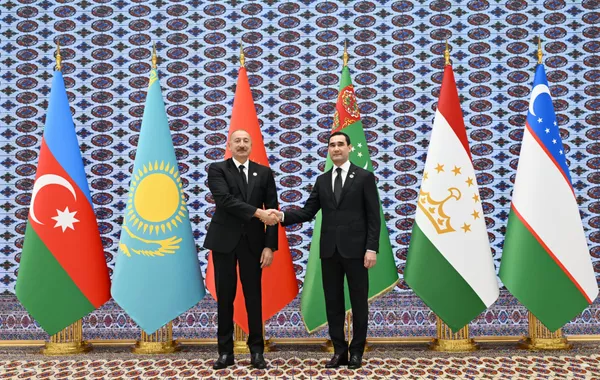
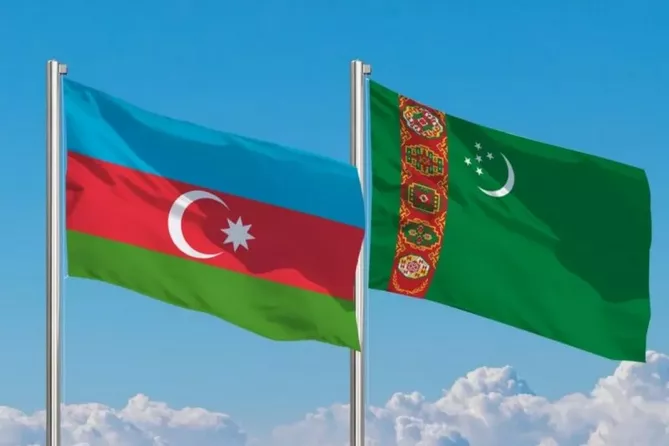
The state visit of Turkmen President Serdar Berdimuhamedow to Baku took place under fundamentally different geopolitical conditions than similar meetings five years ago.
Today, global logistics is undergoing tectonic shifts: traditional trade routes are being disrupted by wars, sanctions, and geopolitical fragmentation; Europe is urgently seeking alternative energy sources; and Asia is striving to diversify its export corridors. Against this backdrop, the Caspian region-and, above all, the sphere of Azerbaijani-Turkmen cooperation-is transforming from a peripheral area of world politics into one of its key hubs.
For a long time, relations between Baku and Ashgabat remained overshadowed by more prominent regional issues. Historical disagreements over the status of the Caspian Sea, the Turkmen side’s caution stemming from its doctrine of permanent neutrality, and the lack of sufficient infrastructure connectivity kept the partnership in a state of “warm freeze”-friendly in form, but limited in substance.
Today, however, this formula is being reconsidered. The clearest evidence of a qualitative shift in bilateral relations is not the rhetoric of official statements but the frequency and level of contacts. Between May and June 2026 alone, the two sides held two high-level engagements between heads of state and government: Azerbaijani Prime Minister Ali Asadov’s visit to Ashgabat on May 22 and the current state visit of Serdar Berdimuhamedow to Baku. This pace is unusual even for rapidly developing bilateral partnerships.
The sequence of diplomatic gestures is also noteworthy. The invitation, personally extended by the Azerbaijani prime minister in Ashgabat-to “visit Azerbaijan at any convenient time”-was accepted with minimal delay. In Turkmen political culture, where every diplomatic step is weighed with exceptional caution, such promptness is in itself a signal.
At the same time, trade statistics present a mixed picture. On the one hand, growth is evident: in 2024, bilateral trade reached $383.7 million, demonstrating steady positive momentum. The structure of this trade is asymmetrical, with $303.5 million accounted for by imports of Turkmen goods into Azerbaijan, compared with $80.2 million in Azerbaijani exports. This reflects the larger share of Turkmen hydrocarbons and raw materials in bilateral trade flows.
Credit: Getty Images
On the other hand, $384 million is a modest figure for two countries whose combined GDP is around $110 billion. For comparison, Azerbaijan’s trade turnover with Türkiye exceeded $1.8 billion during the same four months of 2026. The gap is primarily explained by infrastructure constraints: the absence of a direct land connection, limited ferry links across the Caspian Sea, and the relatively low diversification of both economies. As a result, the two countries often find themselves competing for the same export markets rather than complementing one another economically.
It is noteworthy that 75 companies with Turkmen capital are already operating in Azerbaijan, a figure that points to a tangible, albeit low-profile, business presence and a foundation for deeper economic engagement in the future.
Although the potential for developing economic ties between the two countries is quite significant.
Turkmenistan possesses some of the world’s largest natural gas reserves-ranking fourth globally in proven reserves. The “Galkynysh” field (formerly “Dovletabad”) contains, according to various estimates, between 13 and 26 trillion cubic meters of gas. The country produces around 75-80 billion cubic meters annually, of which about 35 billion is consumed domestically, 40 billion is exported to China, and the remaining minor volumes are supplied via Iran to Azerbaijan through a swap arrangement.
Dependence on a single export direction-China-is an existential vulnerability for the Turkmen economy. Ashgabat is fully aware of this. Any disruption in negotiations with Beijing, a decline in purchase prices, or a technical failure in the “Turkmenistan-China” pipeline system could severely impact the state budget, which is critically dependent on gas revenues. For this reason, export diversification has been elevated to a strategic national priority, with the western route-through the Caspian Sea and Azerbaijan toward Europe-becoming a central pillar of this strategy.
European demand in this equation is not abstract. Since 2022, the European Union has lost around 150 billion cubic meters of annual Russian gas supplies and is urgently seeking alternatives. Azerbaijan has undertaken a political commitment to double its gas exports to Europe to 20 billion cubic meters by 2027. This makes Turkmen gas not just desirable but necessary for realizing Azerbaijan’s energy ambitions. Thus, for Baku, Turkmenistan is a potential supplier of natural gas; for Ashgabat, Azerbaijan is an indispensable transit corridor to the European market.
At present, Turkmen gas reaches Azerbaijan exclusively through Iran via a swap mechanism: Turkmenistan injects gas into Iran’s northern pipeline system, and Iran delivers an equivalent volume to Azerbaijan in the south. The scheme works, but its potential is fundamentally limited-both by the capacity of Iranian pipelines and by the political and sanctions risks associated with Tehran. Any escalation in tensions surrounding Iran could instantly disrupt this route.
At the three-way Türkiye-Azerbaijan-Turkmenistan summit held in Avaza in December 2022, a memorandum of understanding was signed, creating a legal framework for transporting Turkmen gas to Europe via TANAP. It was a politically important document; however, the distance from a memorandum to commercial contracts and actual flows is enormous.
In April 2026, Turkmen Foreign Minister Rashid Meredov publicly confirmed that the European direction remains a key priority, signaling that the negotiation process is ongoing and gaining momentum.
At the core of this potential cooperation lies the construction of the Trans-Caspian Gas Pipeline. Technically, the task appears feasible: it would involve a pipeline approximately 300 km long along the seabed of the Caspian Sea, connecting to the existing Southern Gas Corridor system on the Azerbaijani shore. The project is estimated to cost around $5-8 billion-significant, but manageable for a consortium with European participation.
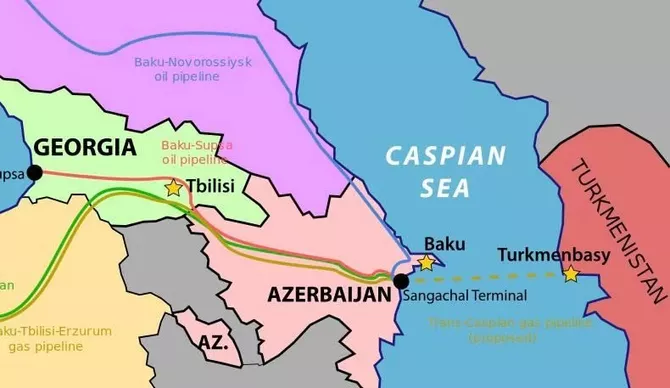
Credit: blacksea-caspia.eu
Legal obstacles were partially removed after the signing of the 2018 Convention on the Legal Status of the Caspian Sea, which established that pipeline construction on the seabed requires the consent of only the two adjacent states (in this case, Azerbaijan and Turkmenistan), rather than all five Caspian littoral countries. This effectively removed the long-standing argument used by Moscow and Tehran regarding the need for their veto.
The main question, however, is financial. Azerbaijani President Ilham Aliyev formulated it with a rare level of bluntness for a head of state: “Who will finance these important projects? We do not have the answer.” The European Investment Bank, the EBRD, the U.S. DFC, and private oil and gas majors were all considered as potential participants. But the formation of a concrete financial consortium is still far away. It is the search for an investment model-rather than the political will of the parties-that remains the central issue of discussion today.
Experts propose an intermediate solution-a so-called interconnector: a short pipeline linking Turkmen and Azerbaijani offshore platforms in the Caspian Sea, without laying a full-length main export pipeline. This would allow supplies to begin much faster and more cheaply, while also creating a commercial basis for attracting investors to a full-scale Trans-Caspian Gas Pipeline.
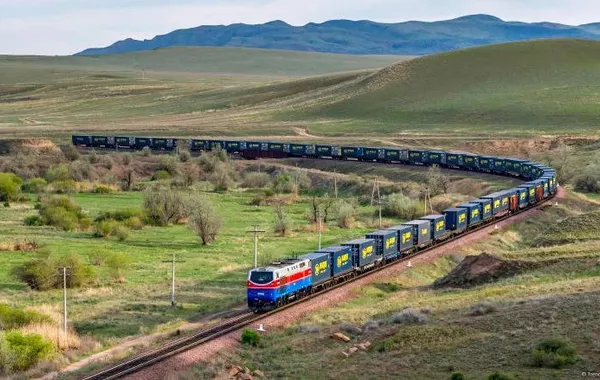
Beyond energy cooperation, there are prospects for expanding transport links. The 2022 Russian invasion of Ukraine triggered a chain reaction that fundamentally reshaped Eurasian transport geography. The northern route via Russia has become de facto blocked for westbound trade. The Suez Canal has been destabilized by Houthi attacks in the Red Sea. In this context, the Trans-Caspian International Transport Route (TITR), known as the Middle Corridor, has evolved from a regional logistics project into a globally significant artery.
In addition, the opening of the Zangezur Corridor adds a critically important link to this architecture: direct overland connectivity between mainland Azerbaijan, Nakhchivan, and Türkiye via Armenian territory. For Turkmenistan and other Central Asian states, this opens a fundamentally new option-a land route to European markets without a maritime segment, significantly reducing transport costs.
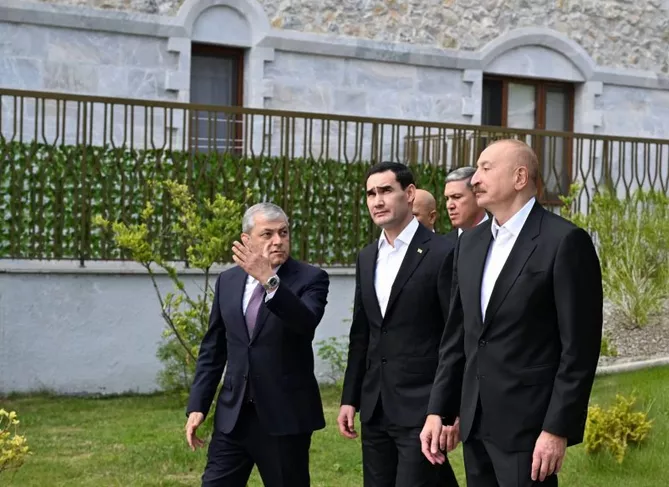
Notably, during Serdar Berdimuhamedow’s visit to Baku, Azerbaijan gifted Turkmenistan the oil tanker “Dostlug,” which translates as “Friendship” in both Azerbaijani and Turkmen. With this symbolic gesture, the Azerbaijani side expressed its intentions.
Credit: president.az
The Azerbaijan-Turkmenistan relations have reached a point where rhetoric about “brotherly partnership” must be converted into concrete infrastructure solutions-otherwise the current diplomatic intensity risks remaining a beautiful but hollow gesture.
The objective logic of rapprochement is exceptionally strong. Both countries need each other: Azerbaijan needs Turkmen gas to fulfill its European commitments, while Turkmenistan needs Azerbaijan’s transit infrastructure to move beyond dependence on the Chinese market. The Middle Corridor creates strong transport and logistics incentives for cooperation on both sides. Turkmenistan’s neutral status removes political barriers that would otherwise complicate such cooperation.
The main obstacle is not political will or legal frameworks, but the investment model for the Trans-Caspian Gas Pipeline. Whoever finds the answer to the question “who pays” will unlock one of the most significant energy corridors of the 21st century. And this is the implicit but real subject of negotiations in Baku between the leaders of Azerbaijan and Turkmenistan.