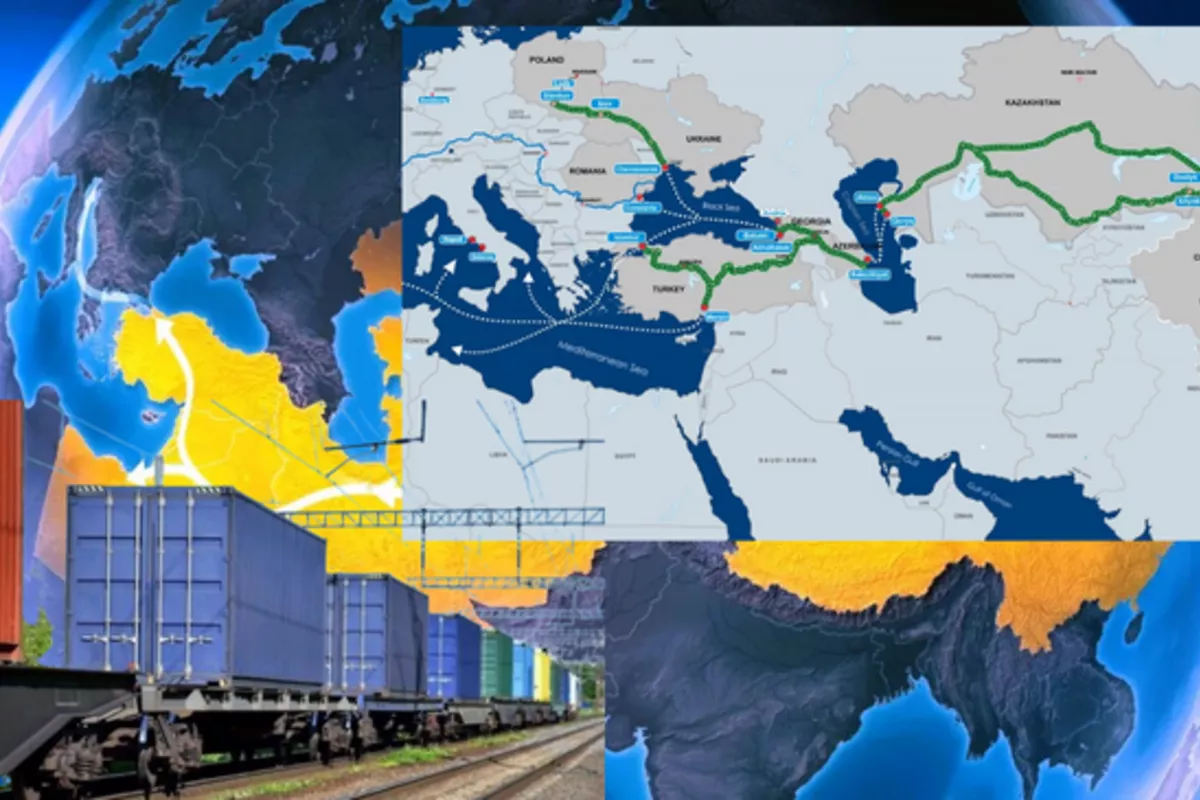
The Middle Corridor has emerged as one of the key connectivity corridors between China, Central Asia, the Caspian region, the South Caucasus, Türkiye and Europe. In the face of evolving geopolitical and economic conditions, this route has become increasingly important as a dependable alternative for East-West trade and transit. Nevertheless, the Middle Corridor’s future competitiveness will be determined by the speed, transparency, and predictability of the procedures that govern the movement of goods across borders, as well as the development of physical infrastructure, including railways, ports, roads, and logistics terminals.
In this context, digitalization is emerging as the next essential phase in the Middle Corridor’s development. Its effectiveness is increasingly dependent on the speed at which customs processes are completed, the ease with which permits are granted, the transparency of cargo tracking, and the efficiency with which data is transferred between the participating countries. Therefore, lowering administrative barriers, streamlining border crossings, and enhancing the route’s overall dependability all depend on the development of a digital ecosystem for the Middle Corridor.
Azerbaijan is a critical component of the Middle Corridor, serving as the Caspian connection between Central Asia and the South Caucasus. Through the Port of Baku, rail and road connections, Azerbaijan links the eastern and western shores of the Caspian Sea and provides further access to Türkiye and European markets. Nevertheless, Azerbaijan’s importance in the corridor should be interpreted in terms of its capacity to facilitate the integration of maritime, rail, road, customs, and digital infrastructure into a more cohesive transit system, rather than its geographic location.
The informal summit of the Organization of Turkic States, which was held in Turkistan on 15 May 2026 under the theme “Artificial Intelligence and Digital Development,” is of particular significance in this context. In the areas of digital transformation, innovation, artificial intelligence, connectivity, and sustainable economic development, the summit prioritized the enhancement of collaboration between OTS member and observer states. This indicates that digitalization is becoming part of the organization’s general connectivity agenda.
The Turkistan agenda is particularly relevant for the Middle Corridor, as the route’s competitiveness increasingly depends on faster, more transparent and more predictable cargo movement across the Trans-Caspian route, supported by harmonized procedures and reduced administrative barriers.
The Turkistan Declaration directly reflects this logic by approving the full-scale launch of the e-Permit system and advocating for the integration of the National Single Window, which includes the e-Permit, e-CMR, and e-government systems of member states. The significance of these mechanisms lies in their ability to digitalize the primary stages of cargo movement. In particular, e-Permit facilitates the electronic issuance and verification of transport permits, e-CMR enables the use of digital consignment notes in place of paper documents, and integrated e-government and single-window systems facilitate the exchange of essential information between customs, transport, and border agencies through interoperable platforms. Consequently, these tools can assist in the simplification of cross-border documentation, the reduction of administrative barriers, the facilitation of real-time cargo tracking, and the enhancement of the overall efficiency and transparency of transportation along the Middle Corridor.
Among the most critical components of the digitalization agenda is the relationship between data infrastructure and transport infrastructure. The Middle Corridor is typically referred to as a multimodal route that connects China, Central Asia, the Caspian region, the
South Caucasus, Türkiye, and Europe via rail, maritime, and road networks. However, its long-term competitiveness will also depend on stronger digital connectivity, including cross-border information exchange, digital platforms and high-speed data transmission.
A new layer is added to the Middle Corridor by the Digital Silk Way project in this context. While the Middle Corridor connects markets through physical transport infrastructure, the Digital Silk Way can complement this process through digital infrastructure. A later phase of the project envisions a similar connection between Azerbaijan and Turkmenistan across the Caspian Sea, in addition to the development of a Trans-Caspian fiber-optic cable line between Azerbaijan and Kazakhstan. This provides the overarching Trans-Caspian route with a data-connectivity dimension in addition to a logistical one.
During the informal summit of the Organization of Turkic States in Turkistan on May 15, 2026, President Ilham Aliyev also addressed this matter. In his remarks, President Aliyev linked the Digital Silk Way project, the Trans-Caspian fiber-optic cable, the Middle Corridor and the e-Permit system as part of a broader agenda of digital and transport connectivity. He observed that the Trans-Caspian fiber-optic cable line between Azerbaijan and Kazakhstan was scheduled to be operational in the near future.
The digitalization of the Middle Corridor represents a new era in Eurasian connectivity, as physical infrastructure is increasingly supported by tools such as e-Permit, e-CMR, e-TIR, cargo tracking systems, and the Digital Silk Way. This reinforces Azerbaijan’s position as a digital-transport bridge between Central Asia, the South Caucasus, Türkiye, and Europe. Meanwhile, the Organization of Turkic States offers a critical platform for the coordination of transport connectivity, customs procedures, and cross-border data exchange throughout the Turkic region.
Consequently, the future of the Middle Corridor will depend not only on logistics terminals, roads, railways and ports, but also on whether participating states can build a shared digital environment for trade and transit. By facilitating the harmonization of digital tools, reducing administrative barriers, and fostering practical cooperation among member states, the
OTS can play a more significant role in this transformation. This creates an opportunity for Azerbaijan to strengthen its position as a central actor in the digitalization of the Trans-Caspian route, in addition to its important role as a key transit country.