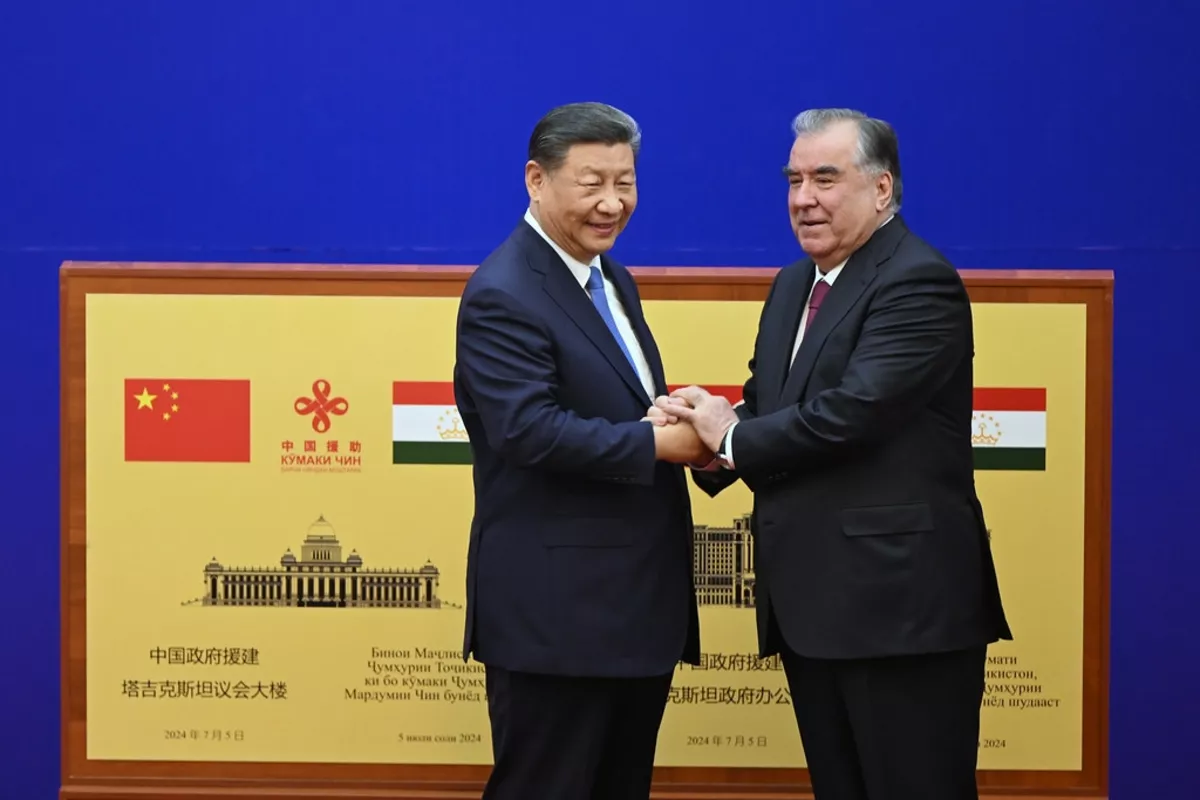
China has sharply reduced its humanitarian assistance to Tajikistan, marking a notable shift in Beijing’s engagement with one of Central Asia’s most aid-dependent economies. In an analysis published by Eurasianet, journalists Carly Brant and Sean Kearin examine how the scale-back reflects broader changes in China’s regional priorities, evolving financial strategy, and growing expectations that partner states move from aid reliance toward debt servicing and investment-based cooperation.
International humanitarian aid to Tajikistan plummeted to $61.7 million overall in 2025, compared to $109.2 million the previous year. China, the largest single provider of humanitarian aid, cut its assistance by nearly half to just under $22 million in 2025, down from $42.9 million the previous year. Even so, Beijing still accounted for the largest share of assistance sent to Tajikistan in 2025, 35.6 percent. In 2024, China’s share was close to 40 percent. The Asia-Plus report did not offer any explanation for the precipitous decline. Most other top donor nations cut back too. The United States, the second largest provider of Tajik aid in dollar terms, gave $15 million in 2025, down from $17 million the previous year. Meanwhile, Kazakhstan cut its allocation from $15 million in 2024 to $3.6 million the previous year, and Russia from about $8 million to $5 million. Overall, humanitarian aid donations to Tajikistan decreased by 43.5 percent in value and by 26.5 percent in weight in 2025, compared to the previous year. The number of donor states also dipped last year to 47 from 51 in 2024, The Caspian Post republishes the article.
Central Asia
Central Asia has attracted $68 billion in investment from Asian states over the past decade, according to the Eurasian Development Bank. Uzbekistan was the top recipient ($22.6 billion), followed by Turkmenistan ($20.6 billion) and Kazakhstan ($19.3 billion). Kyrgyzstan and Tajikistan shared the remainder.
The Asian Development Bank (ADB) is considering providing a $50 million loan for a regional project called “Modernization of Border Crossing Points for Integration, Logistics, and Development.” The project would cover all five Central Asian states, as well as China, Pakistan, Mongolia, Azerbaijan, and Georgia. A decision on the project concept is expected to be made 2027.
China’s Xinjiang Pedagogical University held a week-long training seminar to enhance digitalization and technology skills for education-sector administrators and teachers from Uzbekistan. The university also plans to launch a similar training course for educators from Kazakhstan in 2026 and organize a summer camp for international students.
Kazakhstan
Kazakh Invest and the Chinese oil and gas company Geo Jade Petroleum Corp. signed a preliminary agreement, under which the Chinese partner is expected to invest up to $7.8 billion for further exploration and subsequent development of the Sozak shale natural gas field in Kazakhstan. The field is believed to hold up to 1 trillion cubic meters of extractable gas, Kazakh Invest Board Chair Sultangali Kinzhakulov said.
Kazakhstan and China are conducting a feasibility study to expand the Shymkent Oil Refinery’s capacity to 12 million tons of oil per year.
Total annual cargo turnover through the China-Kazakhstan logistics base in Lianyungang (Jiangsu Province, eastern China) amounted to just over 5.1 million tons, an increase of about 14 percent from 2024’s total. Meanwhile, the Khorgos-Eastern Gate land port on the Chinese-Kazakh border handled a total of 340,000 standard containers, representing a 5 percent increase over the number in 2024.
Feed meal exporters reported train delays and cargo returns at the Chinese border under the pretext of non-compliance with quality and sanitary standards, Kazakhstan’s leading outlet covering the agricultural sector. The report cited information provided by KazGrain, Kazakhstan’s national association of grain exporters. Reacting to the publication, representatives of Kazakhstan’s Agriculture Ministry said that the matter had been resolved, with all products cleared for entry into China. In the meantime, a shipment of 1,767 tons of flaxseed from Kazakhstan arrived in China’s Yinchuan.
Seeking to build ties through music, China’s CCTV-15, a prominent state-run music TV channel, aired the finale of the international vocal competition Silk Way Star. Silk Way Star is a joint project of the Television and Radio Broadcasting Complex of the President of Kazakhstan and China Media Group. Similarly, international music project Voice Beyond Horizon, filmed in six regions of Kazakhstan, premiered on February 5 on China’s Hunan TV.
Uzbekistan
Beijing is pressing ahead with efforts to exert influence on Uzbekistan’s domestic political and economic agenda. The Chinese Academy of Social Sciences (CASS) recently teamed up with Uzbekistan’s government-affiliated International Institute for Central Asia (IICA) to organize an event in Tashkent called Global Transformation and State Governance. The event focused on making the work of state agencies more efficient, as well as deepening Uzbek-Chinese efforts to coordinate development strategies, regional integration and digital development. The deputy head of the Institute for Strategic and Regional Studies under the President of Uzbekistan (ISRS), speaking at the event, said that China serves as a “major role model for successful state governance, technological development and long-term strategic planning.” China’s Counsellors’ Office of the State Council and the National Development and Reform Commission recently organized similar events and meetings with top Uzbek government officials.
A delegation of farmers from Uzbekistan, headed by the leadership of the Council of Farmers and the Fund for the Support of Farming, visited the PRC to study Chinese agricultural practices, specifically growing cotton and grains.
A video conference on desertification prevention and control was organized by Uzbekistan’s Ministry of Economy and Finance, the Chinese Embassy in Uzbekistan, and agencies of central China’s Ningxia Hui Autonomous Region. An agreement was reached under which delegations from Ningxia will visit Uzbekistan to explore opportunities for joint projects to combat desertification, promote green development, and introduce efficiencies in agriculture.
Uzbekistan is creating a position of advisor on culture and tourism at its embassies in seven countries: China, Russia, the United States, UAE, UK, France, and Indonesia, according to a decree issued by Uzbek President Shavkat Mirziyoyev. The advisors will have a diversified portfolio, including facilitating the Uzbek government’s work to attract investments, opening new export markets, promoting tourism, creating opportunities for legal labor migration, and defending the legal rights of Uzbek citizens in those countries.
Chinese automaker NIO is making cars manufactured under its sub-brand, Onvo, available for sale internationally. Uzbekistan is the first country to open Onvo dealerships outside of China. NIO created the Onvo sub-brand in 2024.
China’s Sinohydro Co., Ltd. obtained a contract to modernize the Shakhrikhan cascade of two hydroelectric power plants, HPP-5A and HPP-6A, in the Andijan region. The upgrade will increase the two plants’ total annual generating capacity from the current 7.6 megawatts to 16.4 megawatts.
Uzbekistan’s state-owned oil and gas company Uzbekneftegaz is close to signing a deal with China’s BGP to start seismic surveys in a 3,000-square-kilometer area around Mubarek, and a 1,300-square kilometer section of the Ustyurt Plateau region.
Kyrgyzstan
Following a meeting that explored projects focusing on digitalization and the sustainable development of Kyrgyz cities, Kyrgyzstan’s National Investment Agency signed an MoU with the Shanghai Minghou Xufu Business Consulting Management Co., Ltd. and Anté Lingkun Technology Co., Ltd. The memo covers “investment and technological cooperation, as well as support promising joint projects”.