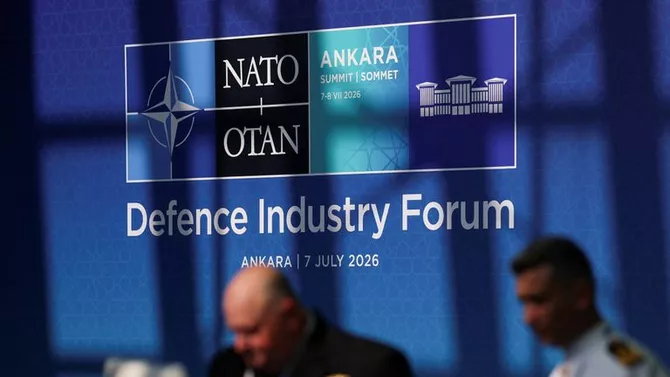
The 36th NATO Summit opened in Ankara on Tuesday (July 7) with Ukraine pressing for more than declarations of political support. Kyiv is seeking concrete decisions to accelerate military assistance, particularly the delivery of Patriot air defence systems and interceptor missiles, as Russia continues to intensify its ballistic missile attacks.
In an interview with The Caspian Post, Ukrainian political scientist and military expert Oleksandr Kovalenko discussed Ukraine's expectations for the summit, President Volodymyr Zelenskyy's recent remarks on Ukraine's future in the Alliance, the urgent need to expand the production of air and missile defence systems across Europe, and the anticipated meeting between US President Donald Trump and President Zelenskyy.
- Mr Kovalenko, what are Ukraine's main expectations for the NATO Summit in Ankara?
- First and foremost, we expect the 36th NATO Summit in Ankara to deliver not only declarations of support from the Alliance but also concrete action on the most pressing security challenges facing Ukraine today. In particular, we hope to see decisions to accelerate the delivery of ballistic missile defence systems and interceptor missiles, especially Patriot systems. Such deliveries depend primarily on the political will of NATO leaders, including those in the United States and the European Union.
Source: AA
Unfortunately, Russia continues to intensify its ballistic missile attacks against Ukraine. While we have developed our own solutions to counter low-flying aerial threats and the subsonic cruise missiles used by Russia, we remain dependent on our Western partners for protection against ballistic missile strikes.
Therefore, I believe the Alliance should, at the very least, prioritise and expedite decisions that strengthen Ukraine's ability to defend itself against Russia's ballistic missile attacks.
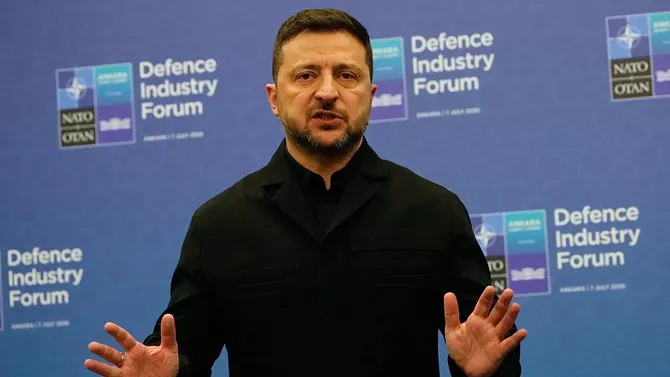
- Can President Volodymyr Zelenskyy's statement that "together with Ukraine, NATO is the alliance of the future" be seen as a new political signal regarding Ukraine's NATO membership?
- Certainly. President Zelenskyy's statement can be interpreted as a message that NATO cannot become a complete and truly capable alliance in Europe without Ukraine.
Not all NATO members share this view. Some countries support Ukraine's position and recognise its strategic importance, while others continue to take a more cautious approach, despite acknowledging that Ukraine has become one of Europe's strongest military powers over the past several years. Ukraine is not only one of the continent's most capable armed forces, but also a country shaping new trends in military doctrine, the development of different branches of the armed forces, and even the global defence industry.
Nevertheless, some countries remain reluctant to fully acknowledge this reality. Instead, they continue to look for bureaucratic procedures and political obstacles that delay Ukraine's accession to the Alliance.
Source: euronews
Overall, however, the message is clear: NATO remains incomplete without Ukraine. Today, Ukraine is the only European country capable of effectively controlling the Black Sea without possessing a conventional navy. It has also demonstrated the ability to dominate the airspace against an adversary that, until recently, was believed to possess one of Europe's most advanced air defence systems.
Moreover, Ukraine has become one of the world's leading sources of practical combat experience. In terms of adaptability, battlefield innovation and the evolution of modern warfare, Ukraine has invaluable lessons that NATO forces and the Alliance as a whole can learn from.
President Zelenskyy's remarks therefore suggest that Ukraine's rapidly evolving military capabilities make it an increasingly valuable partner for NATO - perhaps even more valuable to NATO than NATO is to Ukraine at this stage. In some respects, it is no longer Ukraine knocking on NATO's door; rather, NATO should be knocking on Ukraine's. While there is still an opportunity to build a truly balanced partnership, Brussels should seize it. That, I believe, is precisely the message President Zelenskyy intended to convey.
- Could President Zelenskyy's call to accelerate the production of European missile defence systems influence NATO countries' defence policies?
- Absolutely. Ukraine's experience clearly demonstrates that Russia has identified a major vulnerability - not only within NATO, but across the Western world as a whole - when it comes to defending against ballistic missiles.
Western countries have only limited capabilities to intercept ballistic missiles. Even advanced systems such as the Patriot rely on PAC-3 interceptor missiles, whose production remains relatively limited.
Today, for example, the American company Lockheed Martin manufactures around 650 to 700 PAC-3 interceptor missiles each year, while Russia reportedly produces more than 1,000 9M723 ballistic missiles annually. Intercepting a single ballistic missile generally requires at least two interceptor missiles, while three interceptors provide the highest probability of a successful engagement.
Source: nato.int
Consequently, if the West intends to achieve genuine strategic parity with Russia in ballistic missile defence, annual production of interceptor missiles should exceed 3,000.
At present, however, the United States produces only around 650 interceptor missiles a year. Russia understands this imbalance very well and continues expanding its ballistic missile capabilities accordingly.
That is why Ukraine is seeking not only additional supplies of interceptor missiles from its partners but also the capability to develop its own missile defence systems. We already have the missile itself. What we now require from our Western partners are the supporting technologies, including radar and advanced detection systems.
Once the entire system has been assembled, testing can begin. Even now, it is possible to say that this future Ukrainian air defence system - sometimes described as an analogue of, or competitor to, the Patriot system - could cost three to four times less than the Patriot. That would make it highly competitive and, with sufficient investment and procurement orders, it could quickly enter mass production.
This is where future efforts should be focused, especially given that the United States alone cannot fully meet the growing demand for interceptor missiles, while ballistic missile arsenals continue to expand - not only in Russia, but also in countries such as North Korea and Iran, both of which NATO regards as hostile to the West.
For these reasons, the development of such an air defence system could significantly influence NATO's defence policy in the years ahead.
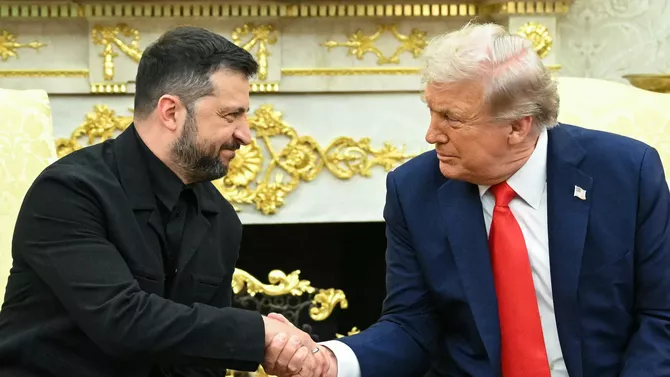
- What key outcomes do you expect for Ukraine and NATO from the upcoming meeting between Donald Trump and Volodymyr Zelenskyy?
- I believe Donald Trump now takes a more pro-Ukrainian position than he did previously. Therefore, any decisions or proposals emerging from this meeting are likely to reflect a greater level of support for Ukraine.
At the same time, we have witnessed what I consider to be a setback for President Trump following Operation Epic Fury in the Middle East. Frankly speaking, the United States failed to achieve its objectives in its confrontation with Iran.
Source: BBC
Washington now has an interest in portraying the current ceasefire with Iran as a success while simultaneously shifting attention towards developments that cast President Trump in a more favourable light. One such development is Ukraine's growing momentum on the battlefield.
Ukraine has significantly increased pressure on Russia by conducting long-range strikes deep inside Russian territory, targeting military facilities more than 2,500 kilometres from the border. It can now be argued not only that Russia has failed to achieve decisive success on the battlefield, but also that it has been unable to effectively counter Ukraine's growing ability to strike deep inside its own territory.
For President Trump, Ukraine's military successes provide an opportunity to strengthen his political standing following the disappointing outcome of Operation Epic Fury. Domestically, that operation has already begun to affect not only his personal approval ratings but also broader support for the Republican Party ahead of the autumn election campaign.
As a result, President Trump now has a greater political incentive to associate himself with Ukraine, whose military position currently appears considerably stronger than that of the United States in the Middle East and the Persian Gulf following Operation Epic Fury.
Naturally, we hope President Trump will announce that the United States intends to accelerate deliveries of Patriot interceptor missiles to Ukraine. This remains our most urgent defence requirement.
Our greatest challenge this year extends beyond developments on the battlefield. The primary threat is Russia's intensifying ballistic missile campaign. We therefore hope that the meeting between Presidents Zelenskyy and Trump will produce tangible progress on this issue above all others.
Naturally, other subjects, including diplomacy and possible pathways towards ending the war, will also be discussed. However, I personally see no realistic prospect of meaningful peace negotiations resuming during 2026. In my view, 2026 will remain a year of war. The first half of 2027 may offer more favourable conditions for diplomatic progress.
For that reason, I have little expectation that a genuine diplomatic peace process will resume during 2026, although the issue will undoubtedly be raised during the bilateral meeting between the two presidents.