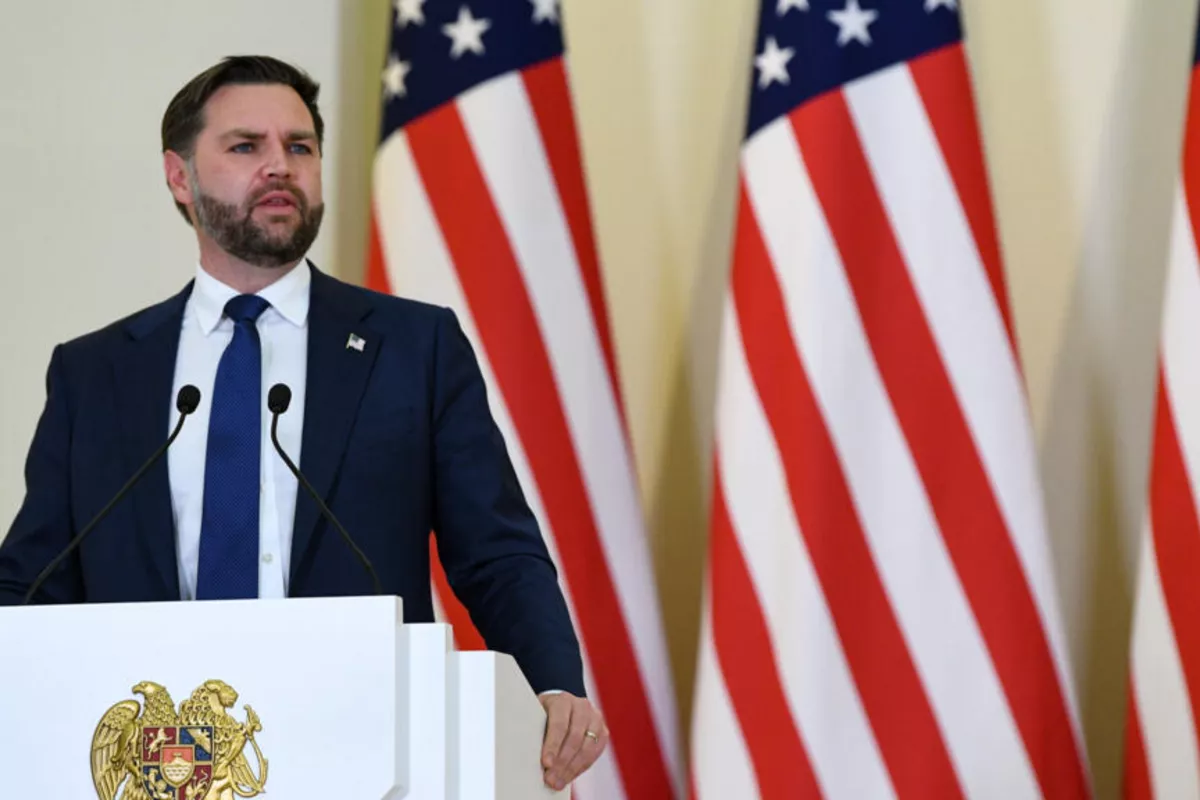
US Vice President J.D. Vance’s decision to visit Baku and Yerevan, while bypassing Tbilisi, reflects Washington’s current strategic priorities in the South Caucasus. The visits underscore US engagement in the post-conflict normalization process between Azerbaijan and Armenia, including corridor arrangements, regional connectivity, and energy security. Analysts note that Georgia’s absence from the itinerary is linked to unresolved political and diplomatic issues, as well as Washington’s focus on negotiations related to the Zangezur corridor. The move highlights a targeted US approach aimed at shaping a new regional security and economic architecture, rather than engaging in broad, symbolic diplomacy.
The Caspian Post analytical website discussed the issue with Georgian political scientists to gain deeper insight into the regional and geopolitical implications.
Vakhtang Maisaia, a Georgian political scientist and military expert, told The Caspian Post that US President Donald Trump has clearly delineated responsibilities within his new administration, assigning Vice President Vance a central role in shaping Washington’s foreign policy and geopolitical posture.

Photo: Vakhtang Maisaia, Georgian political scientist and military expert
According to Maisaia, this redistribution of authority explains why such a high-level visit to the South Caucasus did not take place earlier. “This division of responsibilities did not exist before. Trump introduced it, and that is why Vance is now actively traveling to the region,” he said. Vance, Maisaia noted, has been given a mandate to implement the Trump administration’s foreign policy course on its behalf.
Maisaia emphasized that the United States has already identified the Black Sea-Caspian region as a strategically significant geostrategic space. He described Washington’s approach as selective and targeted, driven not only by geopolitical considerations but also by Trump’s personal motivations.
“Trump is seeking to secure the Nobel Peace Prize, and facilitating peace in our region could become a strong incentive for his nomination and eventual award,” Maisaia said, describing this as the first key factor behind increased US engagement.
The second factor, he noted, is economic. “Trump is a pragmatic politician. Back in 2020, in New Delhi, then-President Joe Biden announced the creation of a new economic project, the so-called West-South corridor, which would connect Antwerp with the Indian port of Mumbai,” he recalled. According to Maisaia, Trump has effectively adopted this initiative from the previous administration because of its economic potential.
He said the corridor is expected to pass through the Black Sea and Caspian regions, offering the United States significant economic benefits and further intensifying its interest in the area.
Maisaia also pointed to China as the United States’ main geoeconomic rival. “Control over our region allows Washington to balance China’s interests, especially given Beijing’s active implementation of the One Belt One Road project,” he said, adding that the Middle Corridor effectively complements that initiative.
In addition, the expert identified Washington’s desire to expand its influence in Central and South Asia as another motivating factor. “Dominance and hegemony in our region create such an opportunity for the United States,” he said.
Another critical element, Maisaia argued, is Iran. “Given the extremely tense state of US-Iran relations, the South Caucasus becomes a key area for exerting pressure and influence toward Iran through our territory,” he said.
Summing up, Maisaia stressed that these strategic, economic, and geopolitical considerations together explain Vice President Vance’s visits to Armenia and Azerbaijan. “This trend will continue,” he concluded.
Levan Mamaladze, Doctor of Political Science, political technologist, and Director of the Georgian Center for Strategic Planning, told The Caspian Post that a significant geopolitical process is unfolding in the South Caucasus, reflected in Vice President Vance’s visit to Baku and Yerevan and his meetings with Azerbaijani and Armenian leaders.
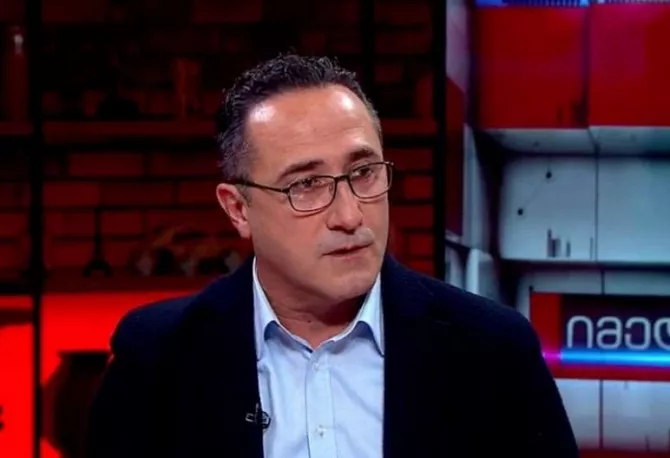
Photo: Levan Mamaladze, Doctor of Political Science, political technologist, and Director of the Georgian Center for Strategic Planning
According to Mamaladze, the visit demonstrates the close attention the United States is paying to the South Caucasus. He recalled that this focus was already evident last year, when, at President Trump’s initiative, a meeting was organized between Azerbaijani President Ilham Aliyev and Armenian Prime Minister Nikol Pashinyan. This resulted in the signing and formalization of a peace agreement, followed by additional cooperation frameworks.
“This is extremely important because the so-called corridor issue became particularly acute after the Karabakh war, when Azerbaijan restored its territorial integrity,” Mamaladze said, noting that US involvement produced tangible results.
He stressed that a key development was the United States assuming an active role in shaping the corridor framework. “The Armenian side received additional guarantees related to sovereignty and territorial concerns connected to Zangezur, while Azerbaijan gained substantial preferences,” he explained.
According to Mamaladze, previous US sanctions imposed on Azerbaijan were lifted, allowing the country to trade freely worldwide, including with states that had earlier maintained restrictions. “This cooperation is already yielding results,” he said.
The expert emphasized that Vance’s visit signals that these are not merely declarations or signed documents, but concrete steps toward building a new operational architecture for cargo transportation, corridor usage, and regional cooperation. “The United States has demonstrated that it does not intend to retreat from or relinquish strategically important regions to other powers,” he noted.
Mamaladze argued that this reflects a broader transformation of the international system. “Many of the previous rules of international law and international relations have effectively been eroded. Trump withdrew the United States from nearly 70 international organizations, and even the role of the United Nations is increasingly perceived as symbolic,” he said.
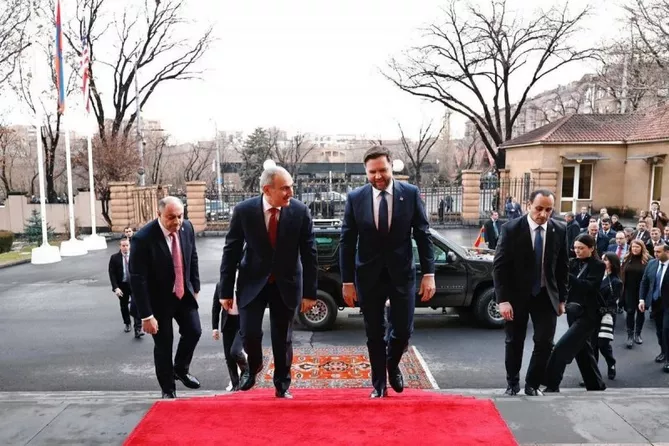
Photo: US Vice President J.D. Vance in Yerevan
From the perspective of Azerbaijan and Armenia, US involvement carries not only economic significance but also an existential dimension. “The presence of the United States serves as a balancing factor against other powers,” Mamaladze stressed, adding that the world is increasingly divided into spheres of influence.
He noted that historically the South Caucasus was influenced first by the Soviet Union and later by Russia, alongside regional actors such as Türkiye and Iran. “China is now entering the Caucasus very actively, particularly in Azerbaijan and Georgia,” he added.
In this context, Mamaladze said Trump’s declaration that “America is back” signals a restoration of American influence. However, he emphasized that no major power acts out of altruism. “Empires pursue their own interests, and the primary US interest lies in controlling key routes, especially energy flows,” he said.
He pointed to the United States’ public debt, estimated at around $38 trillion, and argued that maintaining the dominance of the dollar through energy leverage remains a core strategic objective. “Energy, primarily oil, has always been a pillar of American power,” Mamaladze said, citing US policy toward Venezuela and ongoing efforts to bring Iranian oil exports under dollar-based mechanisms.
The South Caucasus, he added, is part of this broader equation, with Azerbaijan playing a central role as an energy supplier. “Azerbaijan’s agreement to trade energy in dollars forms the foundation of its partnership with the United States,” he said, highlighting President Aliyev’s strategy of balancing competing powers.

Photo: US Vice President J.D. Vance
Mamaladze also noted that Vance did not visit Georgia, linking this omission to the Zangezur corridor issue and Georgia’s internal political complexities. He said that while relations with the United States have cooled, recent diplomatic contacts involving Georgian President Mikheil Kavelashvili, Vance, and US Secretary of State Marco Rubio suggest a possible reassessment.
“The presence of the United States in the South Caucasus serves as a counterbalance,” Mamaladze stressed, warning that after the war in Ukraine, Russia will inevitably refocus on the region. “Without balancing forces, regional states could face ultimatums rather than partnerships,” he said.
He also highlighted China’s growing role in infrastructure and energy projects, including major roads, tunnels, and the Anaklia deep-water port in Georgia, as further evidence of the need for strategic balance.
Mamaladze cautioned that playing major powers against one another carries significant risks. However, he argued that if Azerbaijan, Armenia, and Georgia coordinate their actions, particularly within the framework of the Middle Corridor, such cooperation could be highly effective.
“The Zangezur corridor should not be viewed as a competitor to Georgia’s Black Sea route,” he said, noting that rising cargo volumes from China, Europe, the Americas, and Africa make the Middle Corridor one of the fastest and most cost-effective routes, with transit times of around two weeks, compared with months by sea.
He concluded by proposing the establishment of a joint commission among Azerbaijan, Georgia, and Armenia to regulate tariffs and logistics conditions. “By acting prudently and learning from history, the South Caucasus can remain a region of free, sovereign states that provide valuable services and continue to develop,” Mamaladze said.