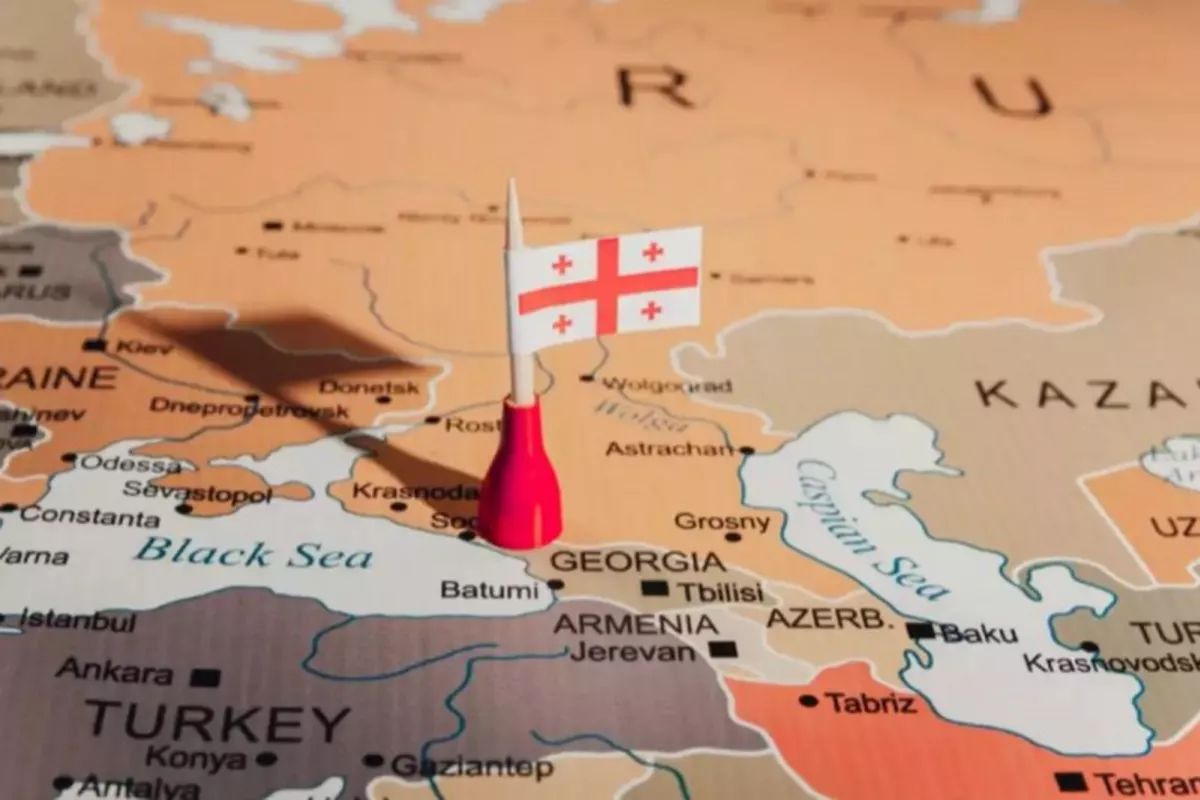
For years, Georgia's geographical position was described as its greatest strategic asset.
Today, Tbilisi is trying to turn that geography into something more tangible: ports, railways, highways, logistics centres and digital infrastructure capable of making Georgia one of the key gateways between Central Asia and Europe.
The Middle Corridor is at the centre of that strategy.
And Georgia is putting real money behind it.
The Georgian government says it plans to mobilise approximately $7 billion by 2032 for strategic transport infrastructure, including the development of the Anaklia deep-sea port, modernisation of Georgian Railways and major highway projects. (economy.ge)
At the same time, international financial institutions are committing hundreds of millions of dollars to improve Georgia's part of the Trans-Caspian route.
The objective is increasingly clear: Georgia does not want to remain simply a country that cargo passes through.
It wants to become a logistics and connectivity hub linking Azerbaijan and the Caspian Sea with the Black Sea, Türkiye and European markets.
The numbers show why Georgia is moving now
Georgia's transport sector is already experiencing a substantial increase in activity.
During the first eight months of 2026, Georgian seaports and maritime terminals handled 13.7 million tonnes of cargo, an increase of 24% compared with the same period of 2025.
Container traffic reached 554,174 TEU, up 9% year-on-year and the highest January-August figure in a decade.
Rail freight reached 9.7 million tonnes, an 11% increase, while direct transit shipments rose by 14%.
Air cargo also reached a decade-high, with Georgian airports handling approximately 29,300 tonnes, 30% more than a year earlier. (BM.GE)
These numbers are important because they show that Georgia's infrastructure strategy is developing against the background of actual growth in transport demand.
The country is not simply preparing for a hypothetical future corridor.
Cargo is already increasing.
And that creates a capacity problem.
Georgia's government says port infrastructure is approaching maximum operational capacity, while freight turnover in January-April 2026 increased by 21% year-on-year. (economy.ge)
That is where Anaklia enters the picture.
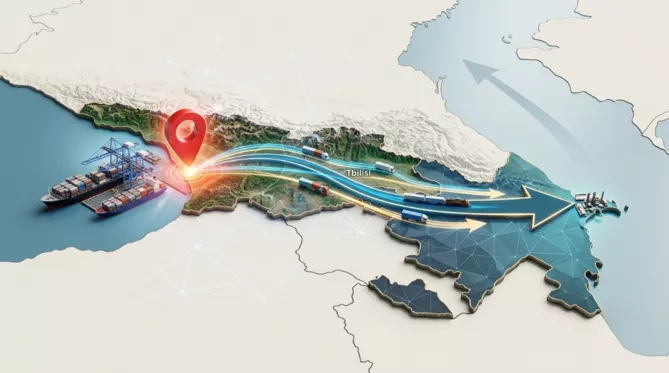
photo: getty images
Anaklia is the centrepiece
The most important project in Georgia's Middle Corridor strategy is the Anaklia Deep Sea Port on the Black Sea.
The project has been discussed for years, but in 2026 it finally moved into visible physical construction.
Dredging began in August, with the harbour basin and approach channel being deepened to 17.5 metres. A breakwater of approximately 1.38 kilometres is also being constructed. (AnewZ)
The first phase is scheduled for completion in 2029.
Its planned capacity is at least 600,000 TEU per year.
The second phase is expected to increase capacity to at least 1 million TEU by 2035. (traceca.ge)
That would give Georgia a deep-water container port capable of receiving much larger vessels than the country's existing facilities.
But Anaklia is important for another reason.
It changes the logic of the Middle Corridor.
At present, cargo moving westward from Central Asia crosses the Caspian Sea and reaches Azerbaijan before continuing through Georgia.
The Black Sea is then the gateway toward Europe.
Anaklia could provide an additional high-capacity maritime outlet at precisely this point in the chain.
In other words:
Central Asia → Caspian Sea → Azerbaijan → Georgia → Black Sea → Europe.
If Anaklia reaches its planned capacity, Georgia could become one of the most important maritime interfaces between the Caspian and European transport systems.
Tbilisi is changing the way Anaklia will operate
There is another interesting development.
Georgia has decided to develop Anaklia according to a landlord port model.
The state will retain ownership of the core infrastructure while private operators can develop and operate individual terminals.
The government says this approach will allow Georgia to work simultaneously with several countries and companies rather than relying on a single strategic investor.
Tbilisi has specifically identified China, Central Asian countries and Azerbaijan as potential partners for investment and cargo generation at Anaklia. (economy.ge)
This is strategically significant.
Georgia is effectively trying to make Anaklia an international platform rather than simply another national port.
The idea is to bring together cargo owners, shipping companies, logistics operators and investors from across the Middle Corridor.
But a port is useless without rail
The biggest mistake would be to view Anaklia as an isolated project.
Its success will depend on the railway connecting the port to Georgia's wider transport network and, ultimately, Azerbaijan and Türkiye.
This is why modernisation of Georgian Railways is another major element of Tbilisi's strategy.
The government says the railway modernisation programme has already improved operational efficiency and reduced transit times, while the upgraded Baku-Tbilisi-Kars railway has strengthened the East-West connection. (economy.ge)
The logic is straightforward.
A container arriving from Kazakhstan or China cannot create a meaningful European route if it spends days waiting at a port, border or railway interchange.
The competitiveness of the Middle Corridor depends on the entire chain.
That means:
Caspian shipping + Azerbaijani rail + Georgian rail + Georgian port + Black Sea shipping + European logistics.
If one part of that chain is significantly slower or more expensive, the entire corridor becomes less competitive.
$372 million from the World Bank
Georgia's strategy is also attracting major international financial support.
In June 2026, the World Bank approved a $372 million project specifically designed to improve Georgia's section of the Trans-Caspian Transport Corridor.
The total project is worth more than $750 million, with co-financing from the Asian Infrastructure Investment Bank and the Asian Development Bank. (Dünya Bankı)
The programme includes railway modernisation, new energy-efficient electric locomotives and improvements to strategically important roads.
The World Bank expects the railway component to increase locomotive availability to 95% and support a 20% increase in Georgian Railway revenues.
The road component will also reduce travel time between eastern Georgia and Poti by approximately 43 minutes.
The project is expected to directly benefit more than 900,000 people. (Dünya Bankı)
That is more than a conventional transport investment.
It is an attempt to turn Georgia into a more reliable component of a multinational supply chain.

photo: www.economy.ge
Georgia is also thinking about the next decade
Tbilisi is not stopping at 2030.
At the Georgia International Maritime Forum in Batumi, Economy Minister Mariam Kvrivishvili said the government had developed a 10-year transport strategy aimed at doubling the capacity of Georgia's railway and seaport systems by 2036. (1TV)
That target reveals the scale of the government's expectations.
Georgia is effectively betting that today's Middle Corridor growth is not a temporary response to geopolitical disruptions, but part of a longer-term restructuring of Eurasian trade.
The World Bank is making a similar assessment.
Its September 2026 report estimates that investments and reforms along the Trans-Caspian Transport Corridor could more than triple trade volumes by 2040 and halve travel times.
If countries combine infrastructure investment with deeper institutional reforms, corridor volumes could potentially quadruple and travel times could fall by two-thirds.
The World Bank estimates that the corridor could contribute to a 3.3% increase in GDP and create around 2 million additional jobs by 2040 across participating countries. (Dünya Bankı)
The scale of these estimates explains why Georgia is investing now.
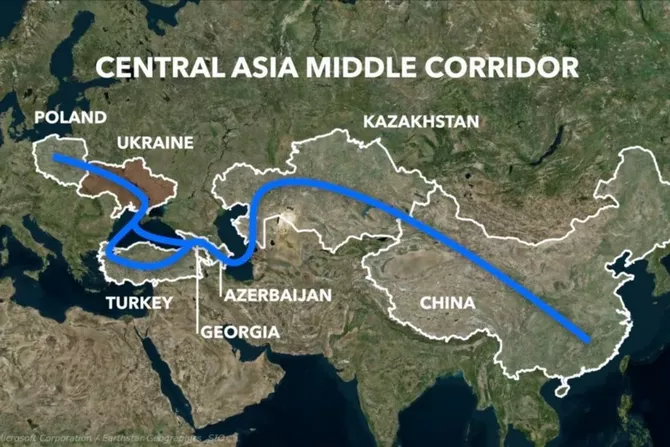
photo: getty images
The digital side may become just as important
There is another part of the strategy that receives less attention.
The Middle Corridor is not only about physical infrastructure.
It is also about digital connectivity.
A container crossing several countries has to pass through different customs systems, railway operators, ports and regulatory regimes.
Every additional document, inspection and handover creates another potential delay.
Georgia therefore wants to improve digital management of transport and logistics.
The World Bank's TC-GATE project includes the digitalisation of road asset management and the development of intelligent transport systems, including a National Highway Control Center. (Dünya Bankı)
This may sound less impressive than a new deep-water port.
But for international logistics companies, predictability can be as important as infrastructure.
A corridor that is slightly longer but predictable can be more attractive than a theoretically shorter route plagued by uncertainty.
Georgia's Black Sea position gives it another advantage
Georgia's geographic position gives it something that Central Asian countries do not have: direct access to the Black Sea.
And that means access to European maritime networks.
This is increasingly important as Central Asian countries search for additional export routes.
Kazakhstan, Uzbekistan and other states have traditionally relied heavily on routes through Russia and other northern networks.
The Middle Corridor gives them another option.
Georgia sits near the western end of that alternative.
That creates a strategic relationship between Kazakhstan, Azerbaijan and Georgia.
Kazakhstan provides access to Central Asian cargo.
Azerbaijan controls the key Caspian gateway.
Georgia provides the Black Sea connection.
Türkiye then provides the land bridge into Europe.
The corridor therefore depends on the four countries functioning increasingly as a single logistics ecosystem.

Yaorusheng | Moment | Getty Images
China is watching
China is another important part of the equation.
In September, Georgian officials again emphasised their willingness to deepen cooperation with China and other countries participating in the Middle Corridor.
Georgia's Economy Minister described China as a major driving force behind the corridor and said Tbilisi wanted closer cooperation to translate strategic decisions into practical results along the route.
The Chinese dimension is important because the Middle Corridor's ultimate prize is not simply regional trade.
It is a share of China-Europe trade.
The more cargo can be moved from Chinese production centres through Central Asia and the Caspian Sea toward Europe, the greater the economic importance of the corridor's western gateway.
For Georgia, that could mean much more than transit fees.
It could mean logistics centres, warehousing, distribution, manufacturing and other services developing around the corridor.
That is how a transit route can become an economic ecosystem.
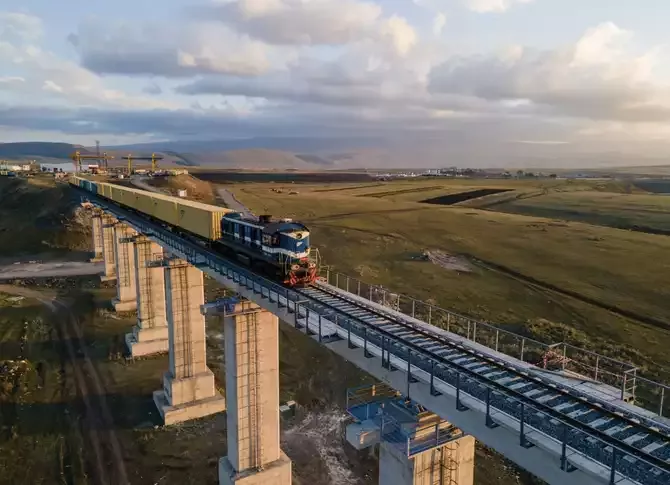
photo: getty images
But Georgia still has a major challenge
There is an important distinction between building capacity and filling capacity.
Anaklia can eventually handle 600,000 or even 1 million TEU.
But Georgia still needs shipping lines, logistics companies, cargo owners and international investors to use that capacity.
The Middle Corridor also remains operationally more complicated than established routes.
Cargo must cross the Caspian Sea, pass through multiple countries and interact with several transport systems.
The World Bank itself stresses that infrastructure investment alone will not be enough.
Countries must also reduce border delays, simplify documentation, improve coordination between operators and make logistics services more reliable. (Dünya Bankı)
That may ultimately determine whether Georgia succeeds.
The bigger geopolitical picture
Georgia's infrastructure strategy is therefore about more than transport.
It reflects a broader change in Eurasian geography.
The old model was relatively simple:
China → Russia → Europe.
The emerging model is more diversified:
China → Central Asia → Caspian Sea → Azerbaijan → Georgia → Black Sea → Europe.
Other branches may eventually develop through Armenia and additional regional connections.
This does not mean that the Middle Corridor will replace every other Eurasian route.
It does mean that Georgia is positioning itself for a world in which companies and governments increasingly value route diversification, supply-chain resilience and access to multiple markets.
For Tbilisi, the opportunity is unusually clear.
Geography gave Georgia the location.
Now the government is trying to build the infrastructure that can monetise it.
Georgia's bet
The most revealing number may therefore not be the current 13.7 million tonnes of cargo or the planned 600,000 TEU capacity at Anaklia.
It is the $7 billion Georgia plans to invest in strategic transport infrastructure by 2032.
That is a declaration that Tbilisi sees the Middle Corridor not as a temporary geopolitical project, but as part of the country's long-term economic strategy.
The test will come in the next several years.
Can Georgia finish Anaklia?
Can it expand railway and road capacity?
Can it reduce border and customs delays?
Can it attract international terminal operators and shipping companies?
And, most importantly, can it persuade Central Asian and Chinese cargo owners that the route is not only politically attractive, but commercially competitive?
If the answer is yes, Georgia could move from being a transit country on the map to becoming one of the key logistics platforms of the new Eurasian economy.
That would make the Middle Corridor not simply a route passing through Georgia.
It would make Georgia one of the countries shaping the route itself.
By Anar Musayev