Vance in Yerevan: What Armenia Gains — and What It Risks
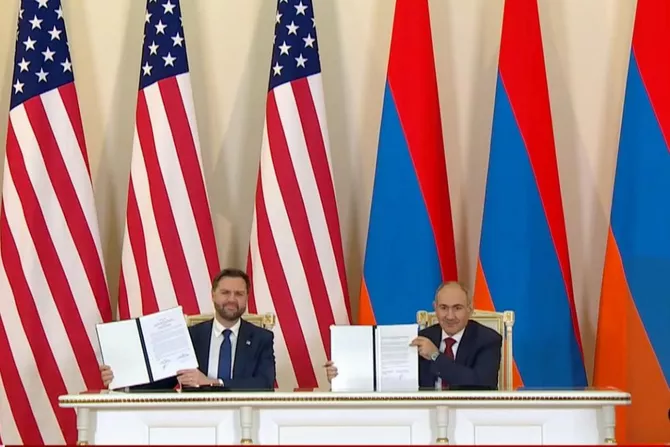
U.S. Vice President J.D. Vance's visit to Armenia was a rare example of a diplomatic event where form mattered almost as much as substance. The arrival of one of Washington’s key figures in Yerevan was itself a political signal. Yet the visit’s outcomes point to a deeper process: a concerted effort by the United States to entrench itself institutionally and economically in Armenia through agreements, investment benchmarks, and technological initiatives designed not for years, but for decades.
The main formal outcome was the signing of a joint statement concluding negotiations on an agreement for peaceful nuclear cooperation. While not a commercial contract and not triggering immediate equipment deliveries, the document is significant: it establishes the legal and political framework necessary for any U.S.-Armenian civilian nuclear projects. Practically, it represents strategic authorization for American technologies to enter one of Armenia’s most sensitive and critical economic sectors - energy, historically tied to external centers of influence.
The statement’s importance extends beyond energy. It formally records Armenia’s readiness to adopt U.S. regulatory standards in nuclear energy, covering safety, non-proliferation, fuel-cycle control, and technical maintenance. Cooperation, therefore, is not limited to one-off equipment purchases but involves deep institutional integration, giving the United States key influence over the operation, modernization, and long-term development of Armenia’s energy facilities.
Against this backdrop, it is no coincidence that immediately after the signing of the statement, potential investment benchmarks were referenced, which Armenian and Western sources estimate at around $9 billion. These figures do not represent signed contracts or guaranteed funding, but they indicate the scale of ambitions and the projected architecture of future deals. Central to these plans are U.S.-produced small modular reactors - a technology Washington promotes as a more flexible and politically manageable alternative to traditional nuclear power plants. For Armenia, with its limited energy base and high dependence on imports, such projects are attractive, yet they also create long-term financial, technological, and foreign policy obligations.
It is important to note that nuclear energy projects extend far beyond construction or reactor delivery. They inevitably include contracts for fuel supply, maintenance services, personnel training, security system upgrades, and regulatory compliance over several decades. In this sense, the declared $9 billion represents less a classical investment than the cumulative cost of a long-term partnership, effectively integrating Armenia into the American energy ecosystem.
Alongside the energy agenda, Vance’s visit featured targeted yet symbolically significant developments in the security sphere. The announcement of U.S. reconnaissance drone sales to Armenia, valued at approximately $11 million under the Foreign Military Sales program, does not alter the regional military balance. Politically, however, it signals a clear shift: the United States is moving from declarative support toward limited but concrete military-technical cooperation, with inevitable implications for the broader security landscape.
Particular attention should be paid to announcements in the high-technology sector. During the visit, statements highlighted the granting of export licenses and the facilitation of Armenia’s access to U.S. technological components, including microelectronics and specialized equipment. Combined with earlier plans to establish elements of technological production in the country, these developments outline a new economic model in which Armenia is positioned not only as a political partner but also as a potential hub for specific segments of global value chains.
It is precisely here that the most serious risks emerge. For Russia, the expansion of U.S.-Armenian cooperation in nuclear energy, technology, and security represents a gradual erosion of its traditional sphere of influence. Russia’s long-standing involvement in Armenia’s energy sector and security architecture has been systemic for decades, and the rise of alternative centers of power weakens Moscow’s position. This shift could prompt a harsher reassessment of interaction formats, spanning economic measures to political signals - issues that remain highly sensitive for Armenia, which continues to rely on external security guarantees.
Source: arkatelecom
No less significant is the Chinese factor. In the context of global technological competition, China closely monitors the expansion of U.S. influence in high-tech sectors of third countries. Armenia’s integration into American technological chains and export-control regimes may limit opportunities for cooperation with Chinese companies, particularly in electronics, digital infrastructure, and industrial equipment. Consequently, a strategic choice in favor of one partner could automatically constrain Armenia’s flexibility with the other.
J.D. Vance’s visit to Yerevan and the documents signed during it thus represent more than a new stage in bilateral relations - they signal a strategic shift with long-term implications. The United States has offered Armenia not one-off assistance, but a model of inclusion in its economic and technological orbit, granting access to investment while imposing strict institutional commitments.
For Armenia, this creates opportunities for modernization and diversification, but also heightens vulnerability to external pressures and underscores the need to carefully balance the interests of major global players. In this sense, Vance’s visit was not a conclusion, but the opening move in a complex and potentially risky long game.