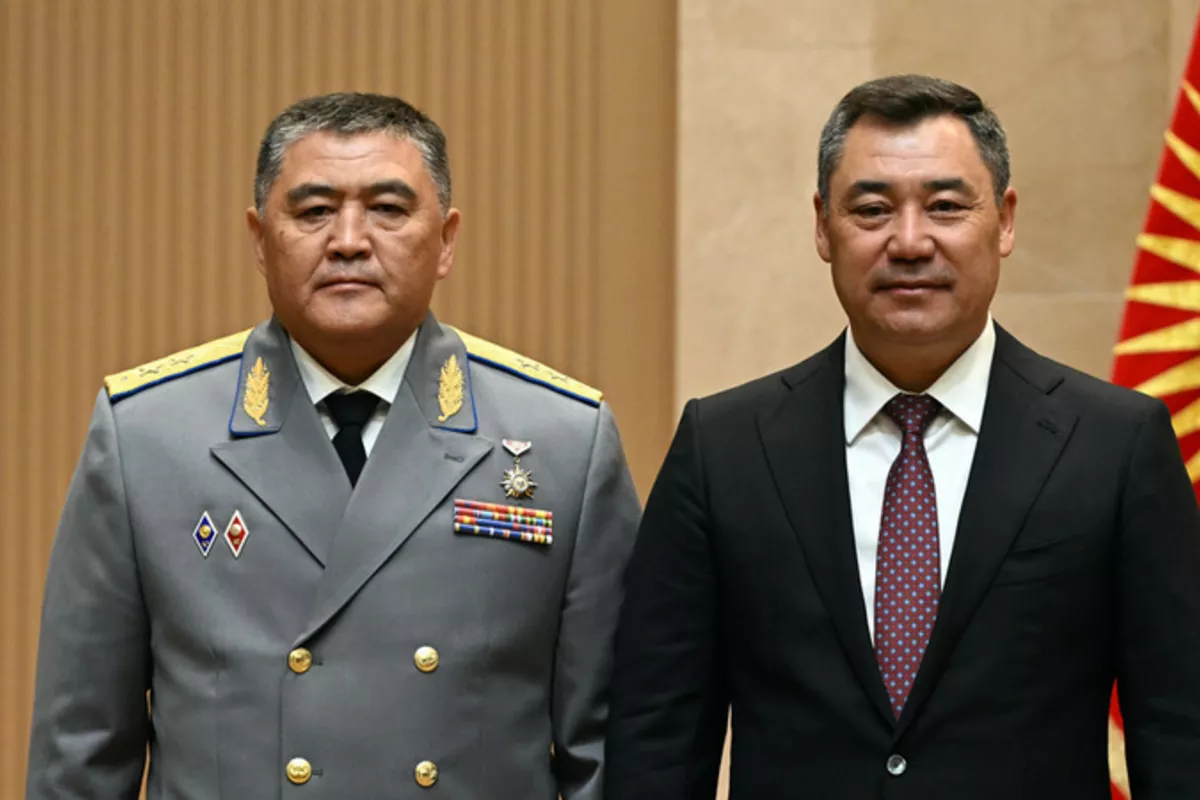
In a move that has sent shockwaves through Kyrgyzstan’s political establishment, President Sadyr Japarov on February 10 dismissed national security chief Kamchybek Tashiyev, a figure widely regarded as his closest ally and informal “co-ruler.”
For more than five years, the Japarov-Tashiyev tandem has defined Kyrgyz politics. Their partnership emerged from the turbulence of 2020, when mass protests and elite infighting reshaped the country’s leadership. Since then, Japarov consolidated presidential authority, while Tashiyev transformed the security apparatus into the most formidable institution in the country.
The sudden dismissal therefore marks not merely a personnel reshuffle but a structural reconfiguration of power in Bishkek.
A Tandem Under Strain
Tashiyev’s removal as head of the State Committee for National Security (GKNB) and as deputy chair of the Cabinet of Ministers came as a surprise, reportedly even to Tashiyev himself. Sources close to him told RFE/RL’s Kyrgyz Service that he learned of the decree while undergoing medical treatment in Munich and described the decision as “completely unexpected.”
Yet analysts had long sensed tensions beneath the surface.
Freelance journalist and Carnegie Russia Eurasia Center analyst Galiya Ibragimova recently observed growing unease between Kyrgyzstan’s two most powerful men. Publicly loyal to Japarov and supportive of his anticipated bid for re-election in January 2027, Tashiyev was simultaneously expanding his own authority, at times appearing to eclipse the president in visibility and operational influence.
In Kyrgyzstan’s highly personalized political culture, such an imbalance was bound to provoke speculation.
Rumors that Tashiyev harbored presidential ambitions intensified ahead of the parliamentary elections held in late November. Some observers interpreted those elections as a rehearsal for a future power struggle within the ruling elite.
Civil activist Mavlyan Askarbekov suggested that if Tashiyev intended to seek the presidency, the present moment might represent his only realistic opportunity.
Institutional Reengineering
The dismissal was accompanied by sweeping structural changes.
The national guard was transferred from GKNB oversight to direct presidential subordination. The border service, previously under GKNB jurisdiction, was made an independent entity. Jumgalbek Shabdanbekov, a former deputy chair of the GKNB, was appointed acting head of the committee.
Officially, presidential spokesman Askat Alagozov framed the move as an effort “to strengthen unity between state structures.”
Unofficially, the decision appears aimed at curbing the institutional autonomy and informal loyalty networks that Tashiyev had cultivated within the security services.
Under Tashiyev’s leadership, the GKNB expanded dramatically in size, resources, and public visibility. New headquarters were built across the country. Rank-and-file conditions improved. Financial flows into the agency increased, though their provenance was often opaque.
Tashiyev personally presided over building inaugurations and apartment handovers to officers. While formally serving the president, many within the security apparatus may have felt primary loyalty to the man who promoted and rewarded them.
As political commentator Peter Leonard noted, the GKNB evolved “from a quiet but omnipresent instrument of coercion into something more formidable.”
In this context, Tashiyev’s removal carries implications far beyond routine bureaucratic rotation.
The Shadow of 2027
Japarov’s presidency has been criticized for authoritarian tendencies, including pressure on independent media and consolidation of executive power. As the January 2027 presidential election approaches, control over coercive institutions becomes paramount.
No incumbent seeking re-election can afford ambiguity within the security hierarchy.
The president may also have calculated that allowing Tashiyev’s authority to grow unchecked risked transforming a loyal enforcer into a potential rival.
Political scientist Emilbek Joroev characterized the decision as both imminent and inevitable. In his view, tandems in high-level politics are inherently short-lived. Even a five-year partnership is unusually durable. Eventually, structural competition replaces personal loyalty.
Such transitions, he noted, are objective political phenomena rather than personal betrayals.
The critical question now is whether this transition unfolds peacefully or escalates into factional confrontation.
Public Discontent and A Petition
The timing of the dismissal coincides with rising socioeconomic tensions.
A petition calling for snap presidential elections was recently submitted to Japarov and Parliament Speaker Nurlanbek Turgunbek uulu. The signatories, including former prime ministers, MPs, and public figures, cited mounting public debt approaching $9 billion, rising living costs, and worsening poverty.
Whether the petition is directly connected to Tashiyev’s removal remains unclear. However, the convergence of elite reshuffling and public discontent creates a volatile political environment.
Tashiyev’s reputation as the “people’s general,” built on high-profile anti-corruption actions and his claim to have dismantled organized crime networks, gave him a populist appeal that extended beyond bureaucratic structures.
His involvement in the 2023 killing of notorious crime boss Kamchybek Kolbayev, shot dead by a GKNB special unit in Bishkek, further solidified his image as a decisive strongman.
Yet decisive strongmen can become politically unpredictable.
Stability or Fragmentation?
For now, there are no visible signs of open confrontation. Tashiyev has not issued a public challenge. The presidency remains firmly in control of the security architecture.
However, Kyrgyzstan’s political history is marked by abrupt shifts and elite realignments. Power vacuums rarely remain empty.
The dismantling of the Japarov-Tashiyev tandem represents the end of a defining chapter in Kyrgyz politics. Whether it ushers in greater institutional centralization under Japarov or triggers a new phase of elite competition will depend on how both men navigate the coming months.
If managed carefully, the transition could consolidate presidential authority ahead of 2027. If mishandled, it could reopen the cycle of instability that has repeatedly reshaped Kyrgyzstan’s political landscape.
One thing is certain: this was not a routine dismissal. It was a recalibration of power at the highest level of the Kyrgyz state, and its consequences will reverberate well beyond Bishkek.