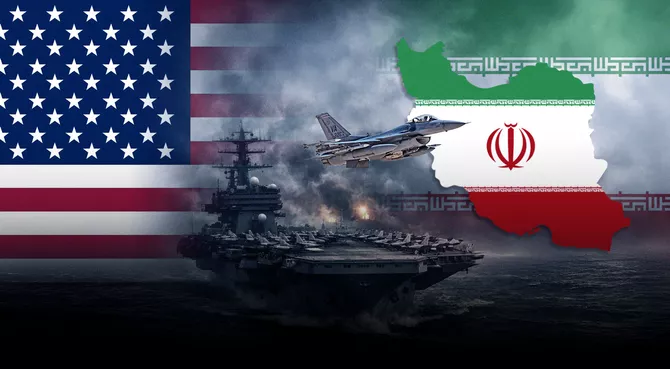
After one month of fighting, the US-Iran war has intensified well beyond initial expectations. Early assumptions in Washington of a swift and decisive outcome have proved misplaced, as Iran broadens its regional response and targets key strategic chokepoints. The growing military build-up has raised the prospect of ground operations, while diplomatic efforts remain uncertain. With no clear path to resolution, the risk of further escalation continues to rise.
In this context, The Caspian Post spoke with Dr. David Felsen, a geopolitical analyst with a PhD from the University of Oxford, who teaches American politics at Georgia Gwinnett College in the United States.
- How do you assess the current trajectory of the US-Iran war after its first month?
- The US-Iran war has intensified, and the United States did not expect this at the commencement of operations over four weeks ago. The US initially stated that any intervention would last from two to four weeks and that once the decapitation of the Iranian leadership was successfully achieved, the Iranians would capitulate.
It was also widely expected that the Iranian people would once again rise up against the Iranian leadership and that regime change would be possible. The current scenario has darkened for the US, its Gulf allies, and Israel, and the Iranian operation has become much more complicated.
Source: Reuters
Iran strategically has sought to bring into the conflict the neighboring Gulf states, including Qatar which had always considered itself a neutral intermediary. It is an attempt by Iran to sew chaos and uncertainty in the region and to put pressure on the US and its allies to cease operations by raising the stakes in the conflict. The seizure of the Strait of Hormuz is similarly meant to put pressure on the US to cease operations.
The great number of countries dependent on the international waterway for oil, including China and much of the rest of Asia, is expected to ramp up international pressure to bring about an end to operations.
Meanwhile, the Trump administration continues to oscillate between ultimatums and attempts at starting negotiations with Iran. President Trump and a large part of his staff are clearly trying to find an off-ramp, a solution, for this conflict. Furthermore, the war has divided his MAGA base.
At the same time, the US is also engaged in a sizeable military buildup in the Middle East that may ultimately lead to further escalation and to a ground invasion of Iran, which will most probably include the seizure of Kharg Island in the hope of exerting pressure on, and disabling, Iran’s energy sector.
- Does the deployment of USS Tripoli (LHA-7) indicate preparations for ground operations?
- The deployment of USS Tripoli and the Tripoli Amphibious Ready Group, brought over from deployment near Taiwan, is part of the largest US military buildup in the Middle East in two decades. The presence on USS Tripoli of 2,500 marines and navy personnel who are skilled at expeditionary operations, including amphibious landings and rapid response missions, indicates heightened US readiness for a ground assault.
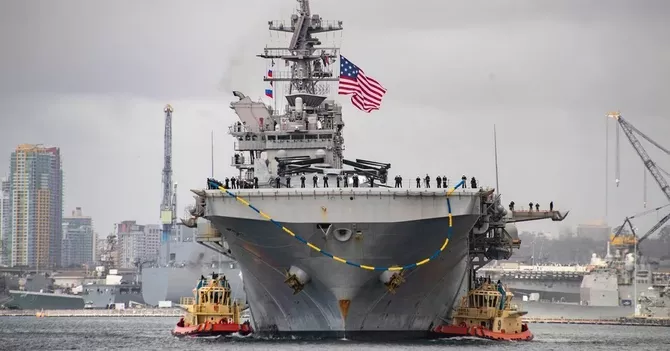
Source: navytimes
The 82nd Airborne Division, skilled at hostile rapid-response situations, is also being sent to the region. Additionally, military hardware such as F-35B Lightning fighters, Ospreys, and helicopters indicates that the US is preparing for the possibility of troop movements and ground operations. Once these assets are deployed, it is highly unlikely that they will not be used. Ground operations are fully expected in the coming weeks.
- What would your assessment be if there were a limited US ground operation inside Iran?
- It is most likely that the United States would seek to seize the Kharg Island to cut off Iranian oil production and try to compel Iran to capitulate and come to the table to meet American demands regarding the dismantling of its nuclear program. The presence of the Marines and the 82nd Airborne Division indicates that the US is prepared for a ground invasion of Kharg Island and likely also of parts of Iran’s mainland.
- Why are targets like Kharg Island and the Strait of Hormuz strategically important?
- Kharg Island is of vital national interest to Iran, since this island is Iran’s main export hub, where 90% of Iran’s crude exports are processed. The island’s infrastructure handles as much as 3 million barrels per day and connects the key pipelines located on Iran’s mainland to international oil tankers. If the island is taken by the US or if the infrastructure on the island is rendered inoperable, it can crush Iran’s oil-dependent economy.
Hence, the island is of strategic importance and clearly a target for the American military.
- Can a short-term targeted intervention be contained, or would it risk escalating into a wider regional conflict?
- Whether a short-term targeted intervention can avoid further and potentially uncontrollable escalation is not known. There is a lot of risk involved in a ground offensive against Iran, especially against Kharg Island. The United States must assume that Iran has prepared defenses and is expecting such a scenario.
Source: CNN
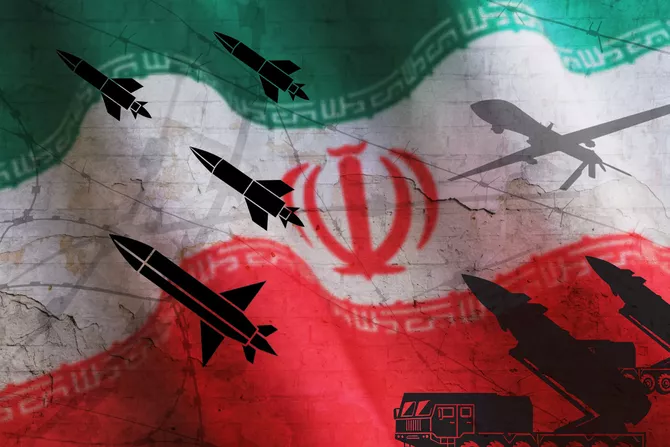
Iran’s strategy has been up until now and will most likely continue to be first, regionalizing the conflict by launching drones and missiles at neighboring Gulf countries to bring more countries into the conflict and heighten regional destabilization, exacting a price from these nations for their hosting of American military bases. Iran will also continue to launch missiles against Israel in response to Israeli attacks.
Secondly, Iran is pursuing a strategy of outlasting American military activity. Iran will seek to force the US to exhaust its offensive and defensive capabilities over the coming weeks.
At the same time, Iran may begin using more lethal weapons in the region. It has so far withheld use of its advanced long-range hypersonic speed Fattah-1 and Fattah-2 missiles. If these were to come into play and inflict significant damage against Iran’s adversaries, the conflict would likely escalate significantly.
- How do you see the end of the US-Iran war unfolding?
- The United States would like to get a treaty that rids Iran of its nuclear program. Israel wants to rid Iran not only of its nuclear program but also of its advanced missile program and its support for proxy terrorist groups throughout the region.
Source: trendsresearch
Yet Iran so far has little interest in negotiating with the United States and has declared that it seeks war reparations from the US, a position that is unthinkable for the US Administration.
Over the coming weeks, the US and Israel will continue to try to wear down Iranian capabilities, though the Trump administration is facing the pressure of upcoming US mid-term elections in November 2026. Additionally, domestic US polls indicate that the war is unpopular in the US.
Therefore, the US will simultaneously continue trying to reach out to Iran privately through backchannels and continue to prepare for a ground assault to increase the pressure on Iran to comply with its denuclearization demands.
It is hard to see how the war might end at the current moment. After four weeks of fighting and with the possibility of ground operations on the horizon, a scenario that was not expected by the US at the beginning of this operation, there is little prospect of a quick end to this conflict. We will likely see at least one or two months more of fighting as both the US and Iran seek an off-ramp that will satisfy their domestic constituencies and national interests.