China has surpassed Russia as Tajikistan’s main trading partner, but Moscow’s declining security role poses a risky dilemma for Beijing.
In 2025, for the first time in over two decades, China surpassed Russia as Tajikistan’s largest trading partner. At first glance this might not seem significant. Tajikistan is the poorest and most remote country in Central Asia. Yet the shift in its main trading partner and affiliated security relationships is worth watching; developments reflect broader changes in the region’s geopolitics as the previous order is being tested, The Caspian Post reports via GIS Reports Online.
The status quo was that Russia maintained its traditional Soviet-era role as the region’s primary security provider while China gradually became a key trading partner and major provider of large-scale infrastructure investments. Though this division of responsibilities is not formally outlined, both nations have found it mutually beneficial. With little desire to engage in regional conflict resolution, Beijing has focused on advancing its Belt and Road Initiative (BRI), while Moscow has been content to uphold its status as the dominant power by managing military affairs.
Russia’s war against Ukraine has upended this arrangement. Governments in Central Asia have become increasingly reluctant to continue collaborating with Moscow, resulting in a security vacuum. That puts Beijing in a critical position: Given the scale of its investments, political instability that escalates into violence poses a real threat.
China’s Expanding Role in Central Asia’s Energy and Trade
The importance of Tajikistan lies in its ability to showcase what the new order could entail. For Beijing, the benefits include growing commerce, promising opportunities in hydrocarbon exploration − mainly natural gas − and in establishing new trade routes through Afghanistan.
A breakdown of Tajikistan’s trade figures shows how the roles of Russia and China as trading partners are evolving. During the first five months of 2025, Sino-Tajik bilateral trade reached $964 million, a 30 percent increase over the same period in 2024. This surge pushed China’s share of Tajikistan’s total foreign trade to 24.8 percent. During the same timeframe, Russo-Tajik trade amounted to about $900 million, or 23.2 percent of the total. It is notable that while China maintains a large trade surplus, Russia has run a significant deficit. Beyond trade, Beijing has long surpassed Moscow as Tajikistan’s largest foreign investor. It is also the country’s biggest foreign creditor, holding a third of Tajikistan’s foreign debt.
China’s expanding economic presence also increases its influence in the region. This pattern is similar to that seen in other countries, involving substantial investments in infrastructure and trade promotion, paired with generous financial lending and initiatives to promote Chinese culture and language skills. Though the latter has faced pushback in Kazakhstan and Uzbekistan, governments in Tajikistan and neighboring Kyrgyzstan are generally supportive of strengthening ties with China.
Meanwhile, Russia’s role as a regional hegemon is shrinking fast. Its previous monopoly on gas exports from Central Asia has been disrupted by China, and Kazakhstan is now looking to shift its oil exports away from the Russian Black Sea terminal in Novorossiysk to Baku, Azerbaijan. Even before its full-scale invasion of Ukraine, Russia was already grappling with a declining role in Moscow-led organizations such as the Eurasian Economic Union, which is modeled after the European Union, and the Collective Security Treaty Organization, which resembles NATO.
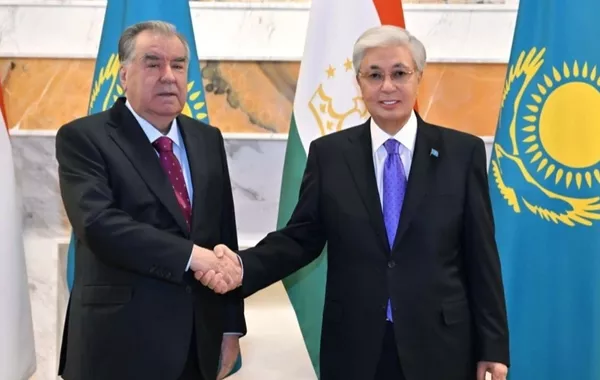
A defining moment occurred in May 2023 when Chinese President Xi Jinping invited the five Central Asian countries to a meeting in the ancient city of Xi’an. This marked the first-ever China-Central Asia Summit held without Russia. The summit focused on enhancing economic, energy and security relations among the participant nations. The countries established plans for the summit to be held biannually; accordingly, the second summit took place in June 2025 in the Kazakh capital of Astana, with Kazakh President Kassym-Jomart Tokayev serving as the host.
What is at stake for Beijing is a combination of access to hydrocarbon resources, mainly natural gas, and cooperation in building BRI infrastructure. So far, Tajikistan’s role in these ambitions has been minor.
Tajikistan, historically an energy importer, has only recently begun seriously exploring possibilities for hydrocarbon extraction. One notable site is the Bokhtar field in the southwest of the country, within the Afghan-Tajik basin. This field is believed to contain “truly super-giant reserves” of both oil and gas. It borders the Amu Darya basin, which turned Turkmenistan into an energy superpower, giving Beijing reason to believe it can significantly expand its role in Central Asian energy production. After the withdrawal of the Canadian firm Tethys and the French company Total in the previous decade, Chinese state-owned CNPC remains the sole operator of the field.
The backbone of the BRI was established across Uzbekistan and Kazakhstan, with the bulk of China’s hydrocarbon imports from Turkmenistan transported via pipelines that traverse both countries. While this may now be changing, the proximity to Afghanistan underscores that any sharp decline in security could have serious economic repercussions.
China’s Afghan-Tajik BRI Strategy
As a direct result of Russia’s war against Ukraine, China is adjusting its strategy regarding the BRI. Fearing that Kazakhstan and Uzbekistan might face pressure to enforce Western sanctions, China is working to establish alternate transport routes through Kyrgyzstan and Tajikistan, whose governments are seen as more reliable, with two potential onward routes through Afghanistan. One would connect with Turkmenistan, providing access to its gas fields. The other is the China-Pakistan Economic Corridor, linking to Gwadar Port in Pakistan on the Indian Ocean. This route could help ensure that vital trade flows remain uninterrupted by the United States Navy in the Straits of Malacca. Nevertheless, both prospects depend on maintaining security in Afghanistan.
As Tajikistan’s economic and geopolitical importance increases, the long-standing division of roles between China and Russia is being tested. After the Soviet Union collapsed, Russia took on the responsibility of securing Tajikistan’s 1,357-kilometer border with the notoriously unstable Afghanistan. The task is extremely difficult due to the mountainous terrain. The border has become a major hotspot for drug trafficking and infiltration by militant Islamist groups. Although some Russian military leaders are reportedly complicit in the drug trade, combating Islamist terrorism has been a shared priority for both China and Russia.
Two factors suggest Russia may no longer be able - or willing - to fulfill its end of the bargain. First, the war in Ukraine is draining military resources that would otherwise be allocated to other engagements, including its presence in Tajikistan. Second, relations between Moscow and Dushanbe have deteriorated considerably. This decline is linked to a terrorist attack on Moscow’s Crocus City Hall in March 2024, which was attributed to Tajiks associated with the Afghanistan-based terrorist group known as the Islamic State Khorasan Province (ISKP). The incident sparked a wave of anti-Tajik sentiment in Russia and led to the deportation of migrant workers, whose remittances are vital for the Tajik economy.
Beijing now faces a critical question: Can it rely on Russia for ongoing security assistance to enable its economic activities in Central Asia? China has long been concerned that the infiltration of Islamist terror groups from Afghanistan could lead to the radicalization of its Muslim Uighur population in Xinjiang. Recently, China has also faced attacks on its nationals working in Tajikistan. Following a series of such incidents in November 2025, the Chinese embassy in Dushanbe urged its nationals to evacuate the border area. The embassy demanded that “Tajikistan take all necessary measures to ensure the safety of Chinese enterprises and citizens in Tajikistan.”
The situation is complicated as the attacks are thought to have been orchestrated by ISKP, which seemingly aims to undermine the Taliban’s authority. Ibraheem Bahiss, an analyst based in Kabul with the International Crisis Group, explains that “the aim is to shatter the Taliban’s image as a security provider with whom the regional governments should engage.”
Given that Tajikistan has a long record of strained relations with the Taliban, it was no surprise that when the U.S. abruptly pulled out of Afghanistan in 2021, Tajikistan opted not to recognize the new government in Kabul. Subsequently, when Moscow chose to acknowledge the Taliban and lifted its designation as a terrorist organization, tensions between Dushanbe and Moscow escalated. As Beijing tries to engage in dialogue with Kabul, it finds itself in a precarious balancing act.