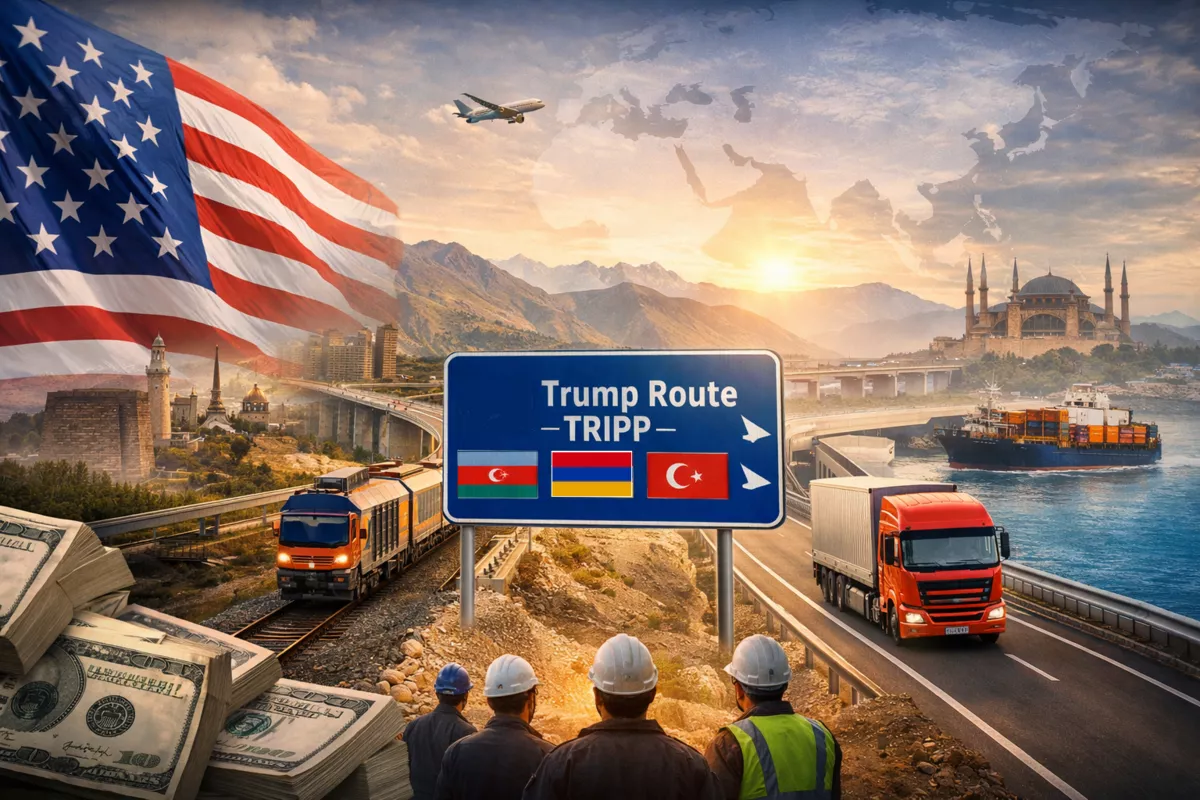
In recent years, Eurasia’s transport and transit strategy has undergone a profound transformation. One of the most notable elements of this shift is the TRIPP project (Trump Route for International Peace and Prosperity), a new transport and transit corridor through southern Armenia intended to help move the region beyond decades of conflict while reshaping long-established logistical routes.
Initially, infrastructure projects under China’s Belt and Road Initiative played a central role in Eurasian integration, stretching from China through Central Asia toward Europe and the Middle East. Chinese investment and participation in major transport hubs promised to strengthen Beijing’s influence over global trade routes. However, with the emergence of TRIPP, new forces have entered the geopolitical equation. The United States has sought not only to facilitate a settlement between Armenia and Azerbaijan but also to assume oversight of the transit project, specifically, the road through Meghri.
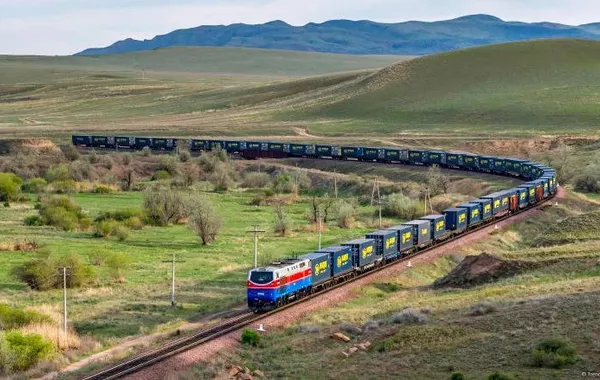
Before TRIPP appeared, China’s primary focus was on strengthening the Middle and Northern Corridors, both integral to the Belt and Road framework. After the outbreak of the war in Ukraine and the imposition of sanctions on Russia, the Northern route became increasingly problematic, elevating the Middle Corridor, running through Central Asia, the Caspian Sea, Azerbaijan, Georgia, and Türkiye, to the principal transit link between China and Europe.
TRIPP is often portrayed as opening a shorter and potentially more advantageous path from Central Asia to the Black Sea and Europe via the South Caucasus, bypassing not only Russia and Iran but also existing China-linked routes. Some observers suggest that, in the future, a significant portion of cargo currently moving along Chinese corridors could be redirected to this new pathway, making those routes less attractive.
However, such forecasts lack solid economic substantiation. Nevertheless, they continue to circulate, often framed as evidence of a Chinese setback in the regional logistics arena.
The Just Security website has argued that China long functioned as the primary investor and an external “balancer” in Central Asia and the Caucasus. With the advent of TRIPP, regional states have gained a new vector of cooperation with the United States, where Washington acts not only as a mediator but also as a practical infrastructure operator. This development potentially weakens Beijing’s traditional approach of consolidating influence through economic ties and infrastructure projects.
According to RBC, while the Belt and Road Initiative continues to advance, a concrete corridor is already taking shape through the South Caucasus that could compete with Chinese routes in terms of speed, tariffs, and stability.
At the same time, experts do not believe that TRIPP will fully displace China from Eurasia’s transport strategy. Rather, China is losing its monopoly, not its presence.
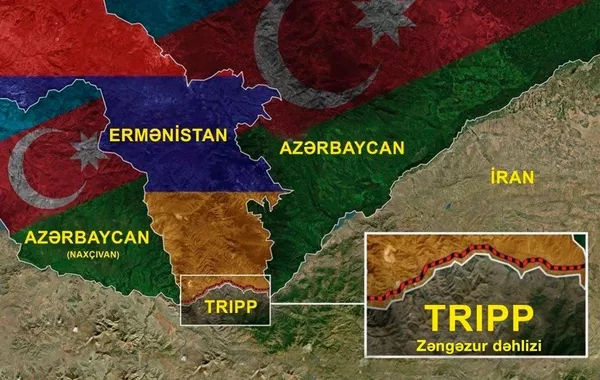
Photo credit: modern.az
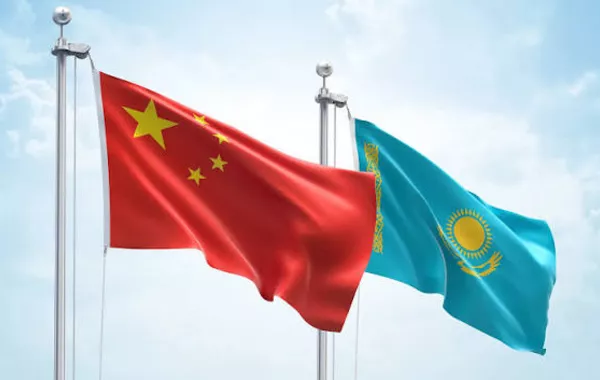
TRIPP is less an economic undertaking than a political one. It has become a symbol of geopolitical competition in which, according to some interpretations, the United States has outmaneuvered China. Some commentators have even suggested that the Washington Declaration has prevailed over the Shanghai Declaration, referring to separate cooperation documents Azerbaijan concluded with the United States and China. In the Shanghai Declaration, Azerbaijan and China identified cooperation within the Belt and Road framework as a key priority.
Claims of one agreement’s “victory” over another are debatable. Azerbaijan remains a reliable partner of China within the Belt and Road Initiative, of which the Middle Corridor, actively functioning and continuing to develop across Central Asia, is an integral component. As for TRIPP, it is also rooted in the Zangezur Corridor concept long promoted by Azerbaijan. In essence, the change in name has altered little. For Azerbaijan, TRIPP is less about international transit than about securing a direct connection with Nakhchivan, a link it is determined to obtain. From the standpoint of international transit, the project may be of greater interest to Armenia, which for years struggled to integrate into Belt and Road networks due to geographic isolation, unresolved conflict, and lack of infrastructure.
Logistics specialists generally argue that TRIPP cannot rival the Middle Corridor and may instead emerge as one of its branches. Another challenge is that TRIPP is widely perceived as a political project, leaving its economic viability open to question. Much depends on U.S. involvement. After building the road, Washington may encourage partners to redirect cargo flows from the Baku-Tbilisi-Kars (BTK) railway to the new corridor.
American media have also emphasized that the Trump Route for Peace and Prosperity could prove significant for China because it creates a new transit channel through the South Caucasus for exporting uranium, gold, and rare earth metals from Central Asia while bypassing Russia and Iran. Such a route could reduce Beijing’s geopolitical leverage and its role in supplying critical resources to Western markets.
Notably, the transit of Central Asian rare earth materials via TRIPP is also referenced in the U.S.-Azerbaijan Strategic Partnership Charter, a key provision that sheds light on the project’s underlying intent. The United States’ interest in the Meghri route is linked to ensuring the delivery of Central Asian resources to Western markets under American supervision. From a purely geographic perspective, speaking of “bypassing China” may be overstated. Nevertheless, Washington appears keen for these cargoes to move through a corridor under its influence, potentially even avoiding Georgian ports where Chinese involvement exists. European actors are also showing interest. The European Commission has recently signaled its intention to finance modernization of TRIPP’s Nakhchivan segment.
China, in theory, could have entered this space earlier and taken the Zangezur project under its wing. Such a move might have been possible under different circumstances, but not in a post-conflict region lacking a finalized peace agreement or delimited borders. Technically, constructing a 40 kilometer railway would not have posed a challenge for Beijing. Yet TRIPP is fundamentally about politics, not economics. Its realization required the involvement of a party whose proposal Yerevan could not easily refuse.
For five years, Armenia delayed implementation of the transport provisions outlined in the November 10, 2020 trilateral statement, delays that even Russia could not overcome. Beijing, lacking both political influence and strategic interests in the region, was unlikely to enter such a contest, particularly if it meant competing directly with Moscow. As a result, China largely observed developments from the sidelines, though some believe it might have been able to secure Armenian participation through economic incentives, a possibility considered limited.
Ultimately, it was the United States that presented Yerevan with an offer difficult to decline. Azerbaijan finds this arrangement acceptable on multiple levels, as it enables Baku to see its long-standing connectivity vision implemented by a leading global power. Washington’s involvement is viewed as a guarantee that Armenia will adhere to the agreements, assurances that neither Russia nor China could have provided in the same way.
One question now attracting attention is whether the United States will allow Chinese cargo to transit via TRIPP. Armenian producers are particularly concerned. Armenia exports approximately 52 percent of its mined raw materials to China, currently via long and costly maritime routes. A land connection through Meghri could make shipments faster and cheaper. Russian companies operating in Armenia’s mining sector also have an interest in such logistics, another factor that could complicate U.S. decisions.
All parties, regardless of official rhetoric, recognize that TRIPP is driven more by political considerations than economic ones. Yet such dynamics reflect the realities of today’s geopolitical landscape. The project remains far from completion. Indeed, it has yet to truly begin. As events unfold, its actual significance will become clearer over time.
By Tural Heybatov