TRIPP vs. Belt and Road: Washington Is Building a Corridor to Counter China
U.S. Vice President J.D. Vance's visit to Yerevan and Baku marks more than a symbolic diplomatic gesture. It represents a significant step toward consolidating a sustained American political and economic presence in the South Caucasus.
Far from being a one-off signal, the trip builds on a process that began six months ago in the Oval Office, when President Trump facilitated a breakthrough rapprochement between Azerbaijan and Armenia. That diplomatic initiative culminated in the Joint Declaration signed by President Ilham Aliyev and Prime Minister Nikol Pashinyan, a document that laid the foundation for a new regional architecture.
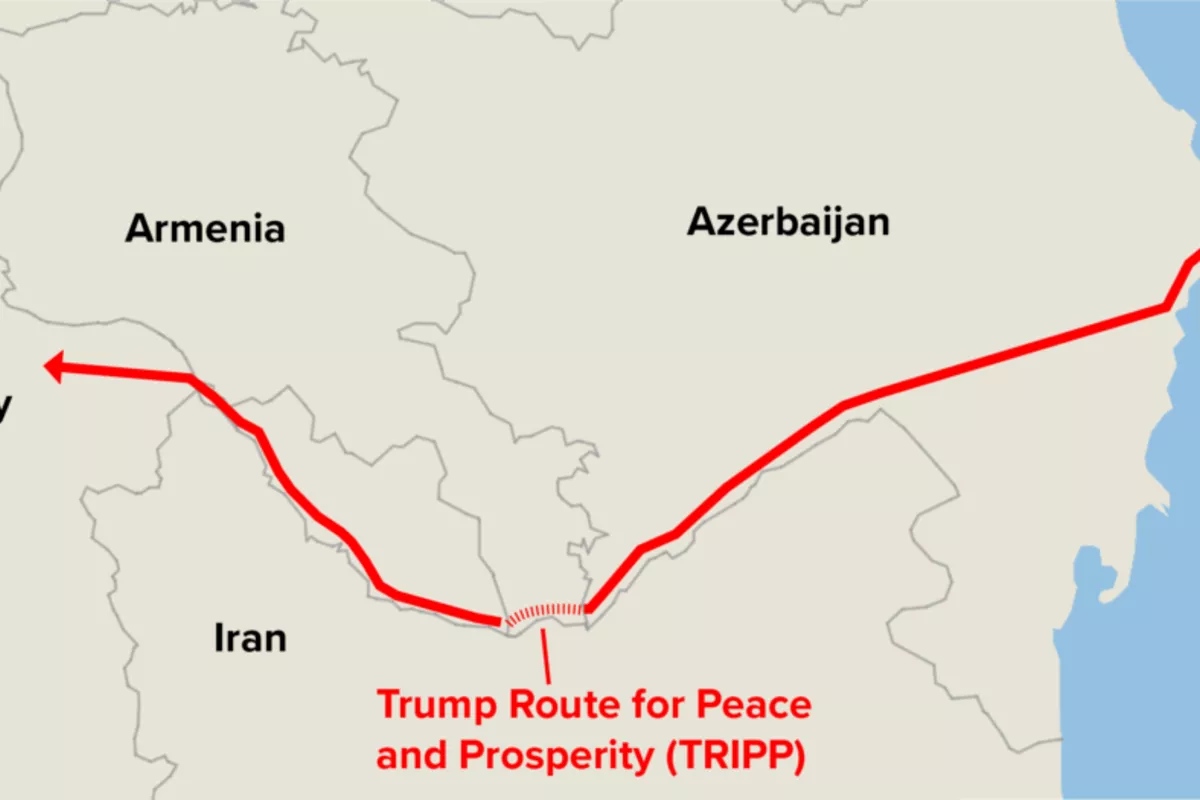
At the center of Washington’s renewed engagement lies the Trump Route for International Peace and Prosperity (TRIPP). This initiative reflects a central pillar of the U.S. National Security Strategy adopted in December 2025: the diversification of trade corridors to strengthen American geopolitical leverage, particularly vis-à-vis China. TRIPP envisions the establishment of a new U.S.-anchored trade route to Central Asia that bypasses both Iran and Russia. In doing so, it reshapes the strategic map of Eurasia.
The economic implications are substantial. Central Asia holds significant reserves of rare earth elements and other critical minerals essential for advanced manufacturing, renewable energy technologies, and defense systems. Securing diversified access to these resources is now a top priority for Washington. TRIPP thus serves not only as a peace initiative but also as a structural component of a broader strategy to ensure supply chain resilience and reduce dependency on rival powers.
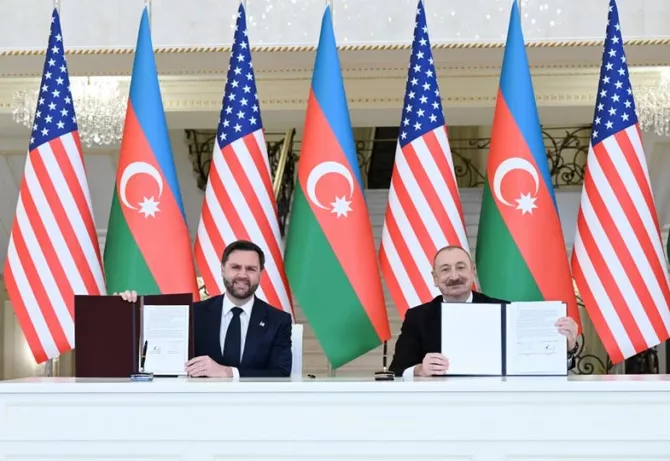
Photo: Azertac
For Armenia, closer economic engagement with the United States offers a historic opportunity. Beyond the trade corridor itself, Washington has signaled interest in expanding cooperation in nuclear energy, critical minerals, and broader strategic partnership mechanisms. These initiatives provide Prime Minister Pashinyan with much-needed political space to advance a comprehensive peace treaty with Azerbaijan following Armenia’s profound military setbacks in 2020 and 2023, which resulted in the loss of Nagorno-Karabakh.
The shifting regional landscape after the Karabakh developments has undeniably altered calculations in all capitals. Armenia’s strategic isolation, Russia’s diminished bandwidth due to the war in Ukraine, and Azerbaijan’s strengthened regional standing have created conditions conducive to diplomatic innovation. In this environment, U.S. engagement appears less an intrusion than a response to a power vacuum.
The inclusion of both Yerevan and Baku in Vance’s itinerary underscores Washington’s intention to treat the peace process as bilateral and mutually reinforcing. Further symbolic reinforcement came with the inclusion of both Armenia and Azerbaijan in President Trump’s “Board of Peace.” While arguably limited in operational scope beyond Gaza, the initiative signals sustained American attention to conflict resolution and regional stabilization.
Equally telling, however, was the exclusion of Tbilisi from the vice president’s itinerary. Georgia has long been considered a cornerstone of U.S. engagement in the South Caucasus. Yet in recent years, the ruling Georgian Dream Party has aligned more closely with Moscow and Beijing. This shift reflects not only economic pragmatism but also deep divisions within Georgian society.
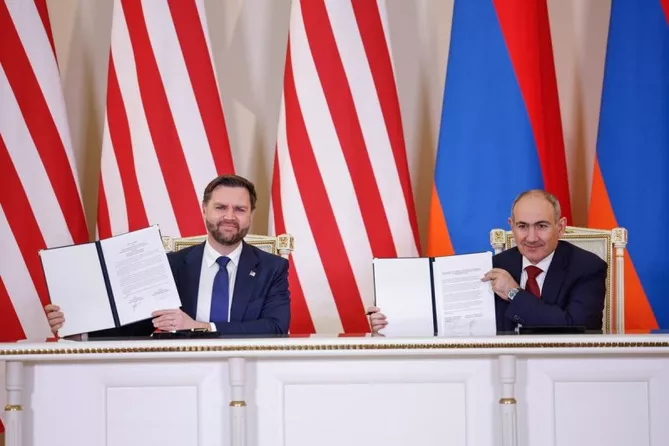
Photo: Armenian Prime Minister's Office
In 2024, Georgia suspended its Strategic Partnership Charter with the United States following American accusations of democratic backsliding and the imposition of financial sanctions on several Georgian officials, including Georgian Dream founder Bidzina Ivanishvili. Against this backdrop, Vance’s decision not to include Tbilisi signals a recalibration of U.S. priorities. While economic ties between the United States and Georgia remain robust, Washington is clearly prioritizing countries that align more directly with its evolving strategic framework.
This recalibration should not be interpreted as abandonment but rather as conditional engagement. The United States is signaling that deeper integration into emerging Eurasian trade corridors and security frameworks requires alignment with democratic norms and strategic cooperation.
The broader geopolitical context further clarifies Washington’s calculations. Russia’s war in Ukraine has significantly weakened Moscow’s economic and political influence across the South Caucasus and the Middle East. The Kremlin’s capacity to project power into Armenia was already constrained in 2023, and the war has only intensified those limitations. Nevertheless, the Russia-Armenia security partnership persists. Moscow maintains a military base in Gyumri, and in response to discussions surrounding TRIPP and expanding U.S. economic initiatives, Russia has reportedly strengthened its military presence there.
At the same time, both Moscow and Tehran view U.S. corridor diplomacy with suspicion. A transport route that bypasses both Russia and Iran inevitably diminishes their leverage. Yet the Kremlin’s response is likely to remain measured, at least in the near term. Ongoing negotiations between Washington and Moscow over Ukraine create incentives for caution rather than escalation in the South Caucasus.
Iran, too, faces strategic constraints. The consolidation of an American-influenced trade corridor north of its borders would curtail Tehran’s ambitions to position itself as a transit hub between East and West. However, Iran’s capacity to disrupt the process is limited by economic pressures and regional overstretch.
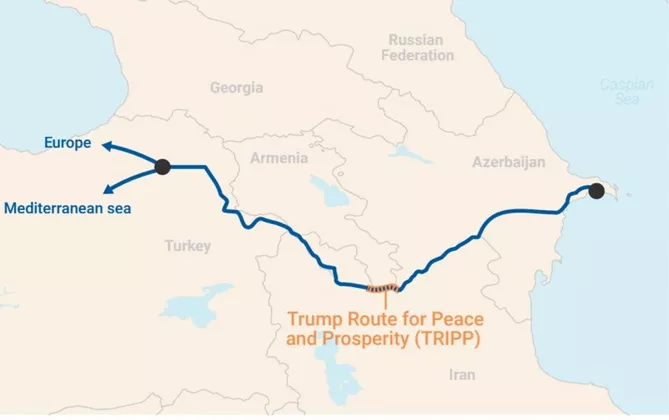
Photo: CaspianNews
Ultimately, Vance’s visit reflects a broader transformation in U.S. global strategy. The South Caucasus is no longer viewed solely through the lens of conflict management. It is now seen as a strategic hinge linking Europe, Central Asia, and the Middle East, a region where trade routes, energy flows, and great power competition intersect.
Whether TRIPP will achieve its ambitious objectives depends on sustained diplomatic engagement, economic investment, and regional political will. Peace between Armenia and Azerbaijan remains fragile, and external pressures from Russia and Iran will persist. Yet the logic driving U.S. engagement is clear: secure diversified corridors, strengthen partnerships aligned with American strategic interests, and prevent adversarial powers from consolidating control over Eurasian connectivity.
Vance’s trip, therefore, should be understood not as a fleeting diplomatic gesture but as part of a deliberate and long-term repositioning of the United States in a region whose importance is rapidly increasing. The South Caucasus is becoming a central arena in the contest over the future of Eurasian order, and Washington has decided it cannot afford to remain on the sidelines.