Azerbaijan Joins Central Asia’s Inner Circle and Changes Game
In her latest analysis for The Jamestown Foundation, Rosa Bayramli explores how Azerbaijan’s historic accession to the Consultative Meetings of the Heads of State of Central Asia is reshaping regional dynamics, redefining economic and strategic linkages across Eurasia, and signaling a new era of cooperation between the South Caucasus and Central Asia.
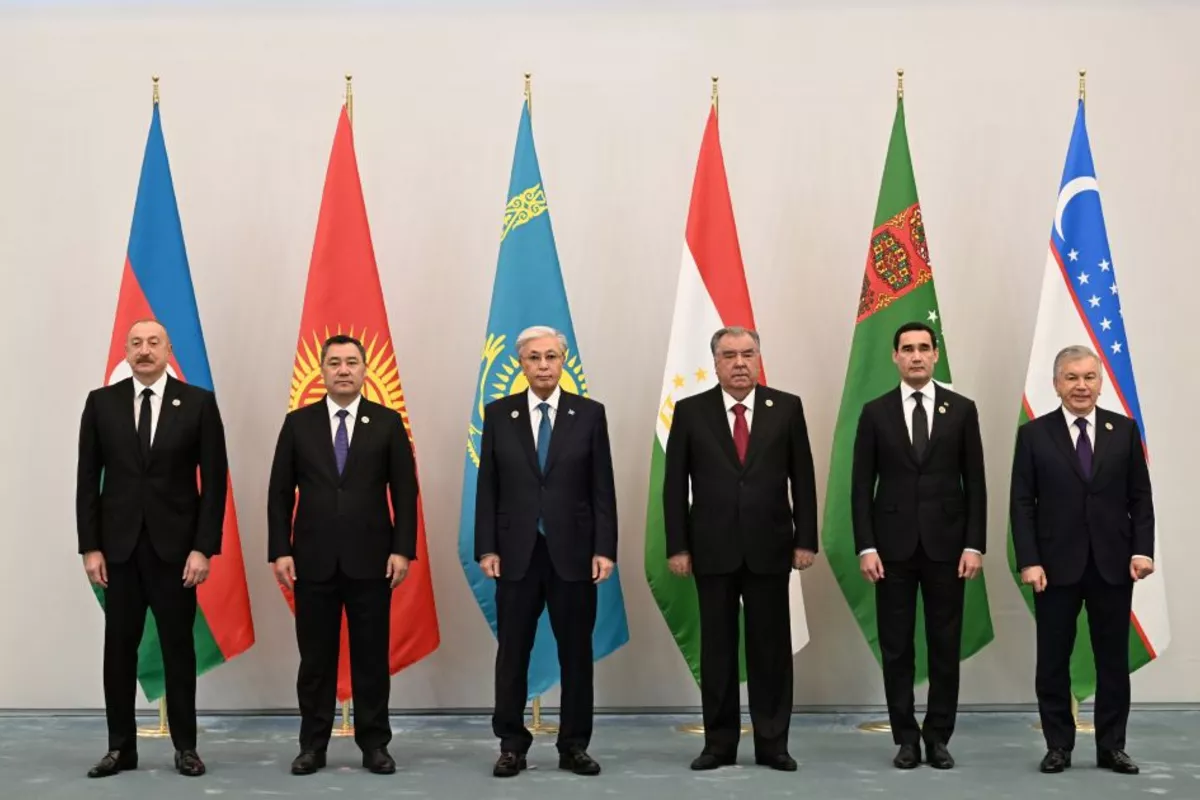
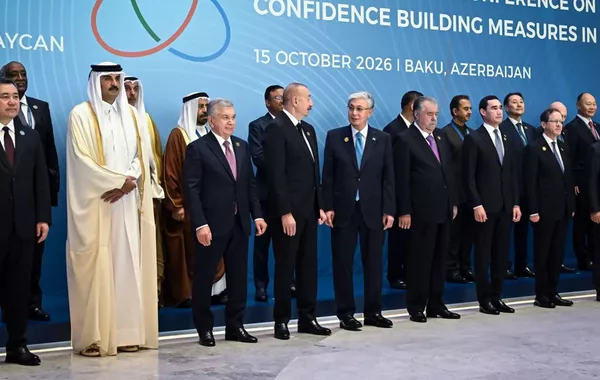
On November 16, 2025, Azerbaijan joined the Consultative Meetings of Heads of State of Central Asia as a full participant, becoming the first non-Central Asian country to be included in this high-level regional forum. Founded in 2018 predominantly through the efforts of Uzbekistan under President Shavkat Mirziyoyev, the consultative framework originated from a wider regional transition toward active engagement and rapprochement, signifying a collective acknowledgment among Central Asian nations that intensified internal coordination was essential to bolster regional stability, sovereignty, and international significance. Azerbaijan’s formal accession followed earlier high-level engagement. Azerbaijani President Ilham Aliyev had already participated in this format, attending the consultative meetings in Dushanbe in 2023 and in Astana in 2024.
This development signifies an increasing initiative to strengthen connections between Central Asia and the South Caucasus, driven by economic considerations, political factors, and global changes that have made regional collaboration increasingly essential. As trade and industrial output increase throughout Central Asia, landlocked economies face growing challenges in ensuring reliable, cost-effective access to international markets. Stable transit routes are crucial to maintaining competitiveness. Cooperation with Azerbaijan is widely regarded as a means to reduce dependence on conventional routes via Russia or Iran, while ensuring more secure access to European and global markets. Acknowledging this evolving landscape, Kyrgyz President Sadyr Japarov stated that the expansion of the consultative format to encompass Azerbaijan would “open new opportunities and broad horizons for cooperation in Central Asia, particularly in international transit, logistics, and energy,” while connecting Azerbaijan’s integration with developing transportation initiatives, such as the China-Kyrgyzstan-Uzbekistan railway, and characterizing the Zangezur Corridor (also known as the Trump Route for International Peace and Prosperity (TRIPP)) as a natural progression of this expanding transcontinental connectivity.
Within this framework, transportation, logistics, and multimodal networks linking Central Asia, the Caspian Sea, and the South Caucasus have gained increased strategic significance. In this context, Aliyev’s assessment that “Central Asia and Azerbaijan today form a single geopolitical and geo-economic region” captures the broader strategic logic behind Azerbaijan’s inclusion.
This reassessment has unfolded alongside a noticeable rise in Western engagement in Central Asia. The European Union used the first EU-Central Asia Summit in Samarkand, Uzbekistan, in April 2025 to announce a 12 billion euro ($14 million) Global Gateway investment package alongside investments in critical raw materials, clean energy, and digital infrastructure. Many of these investments are aimed at strengthening the Trans-Caspian Transport Corridor, which Brussels regards as a priority route connecting Europe and Central Asia through the South Caucasus and Türkiye. This focus was reinforced at the Trans-Caspian Transport Corridor and Connectivity Investors Forum in Tashkent in November 2025, where discussions centered on regulatory alignment, infrastructure financing, and capacity expansion. The United States also recently engaged with Central Asia at the C5+1 Summit in Washington, D.C., on November 6, 2025, where transportation and trade infrastructure development were discussed. These changes have highlighted that a route through the South Caucasus, especially through Azerbaijan, is becoming a key part of a stronger and more varied network for connecting Eurasia.
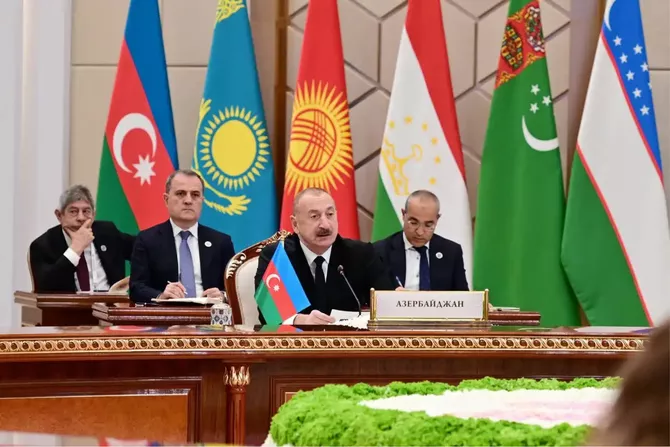
photo: OC Media
Azerbaijan’s joining the Consultative Meetings platform does not constitute automatic accession to the C5+1 formats used by external partners such as the European Union, the United States, or the People’s Republic of China. These mechanisms were designed to structure engagement between third parties and the five Central Asian states and continue to operate within that framework. At present, cooperation with actors such as the European Union and the United States remains organized around the C5+1 format, while Azerbaijan engages through parallel bilateral and multilateral channels.
At the same time, Central Asian leaders increasingly frame Azerbaijan’s inclusion as a means of strengthening the region’s collective international posture. Mirziyoyev described Azerbaijan’s accession to the consultative meetings as a “historic” step for the region, stating that this move would “build a solid bridge between Central Asia and the South Caucasus, paving the way for the formation of a unified space of cooperation,” which, in his words, would “strengthen the strategic interconnectedness and resilience of both regions”. Mirziyoyev emphasized, “Cooperation within the ‘Central Asia+’ formats has intensified. The region now speaks with a unified position on authoritative international platforms,” adding that Azerbaijan’s accession would make the region’s voice “even more significant” globally.
As Azerbaijan’s role in Trans-Caspian connectivity continues to expand and its participation in regional consultative mechanisms deepens, the question of whether existing C5+1 frameworks remain adequate is therefore likely to gain prominence. Over time, adapting these formats to reflect the region’s evolving political and economic geography could allow external partners to engage more effectively with the full range of actors shaping Eurasia’s east-west corridors.
These developments indicate a potential subsequent stage in the transformation of the consultative meetings themselves. Initially envisioned as an informal forum for dialogue and confidence-building, the format has progressively broadened in scope, frequency, and political significance. Additionally, Mirziyoyev proposed formalizing the existing informal meetings of Central Asian leaders into a more structured regional framework, dubbed a “Community of Central Asia,” to enhance economic integration within a region comprising more than 80 million residents. This proposal, presented during a meeting involving Azerbaijan, underscores how the consultative format is already extending beyond its original scope.
Azerbaijan’s accession reinforces this trajectory and enhances the likelihood of more extensive institutionalization in the future, even in the absence of any formal declaration of such a transformation. The consultative mechanism can develop gradually-through more structured agendas, coordinated initiatives, and ongoing high-level engagement-into a central forum for regional consensus. In this context, Azerbaijan’s involvement not only expands the geographic scope of the format but also enhances its ability to serve as a coordinating hub connecting Central Asia, the Caspian Basin, and the South Caucasus.
Azerbaijan’s participation strengthens the consultative platform’s capacity to serve as a bridge across Eurasia. By establishing a more direct connection between Central Asia, the South Caucasus, Türkiye, and European markets, the expanded framework strengthens resilience, promotes diversification, and reinforces strategic autonomy for the participating nations. In this context, Azerbaijan’s inclusion expands a regional forum. It fosters the development of a more integrated and balanced Eurasian region, where collaboration across the Caspian Sea promotes stability, connectivity, and sustainable economic growth.