Central Asia is rapidly emerging as a key frontier for China’s expanding business ambitions, as Beijing deepens its economic engagement across the region through trade, infrastructure, and investment. According to analysis published by Eurasianet, Chinese companies are strengthening their presence in sectors ranging from energy and mining to logistics, manufacturing, and digital infrastructure, reshaping regional economies and trade routes.
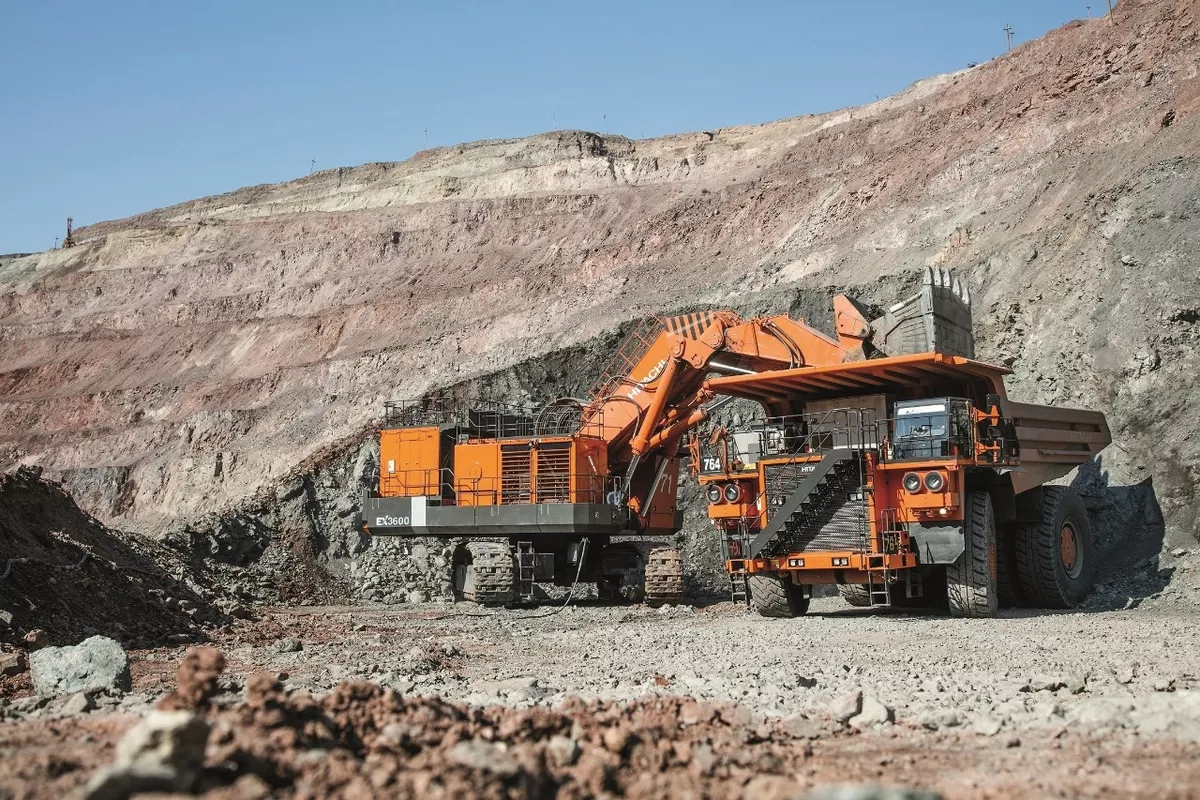
Chinese entities are making a push to expand joint ventures and corporate takeovers in Central Asia. In Kazakhstan, the mining sector appears to be a focus of Chinese attention. The Zhejiang Mining Heavy Industry Co., Ltd. signed a conditional deal to pay 29.15 billion Kazakh tenge (about $57 million) for Kazakhstan’s JV Alaigyr LLP, which holds mining rights to a major silver and lead field, as well as licenses to explore two more fields. Elsewhere a consortium of Chinese companies announced the purchase for $1.8 million of the Kazakh entity Spetzpostavka Absolute, which holds the rights to Kordai tungsten and uranium deposits, as well as exploration permits for rare, non-ferrous and precious metals in Kazakhstan’s Jambyl region. Local observers attribute the seeming disparity between the potential value of the acquired assets and the comparatively low purchase prices to a lack of capitalization of the Kazakh companies. In the case of the Alaigyr sale, the company carries significant debt, which Zhejiang will assume. Elsewhere, a group of Chinese companies intends to launch 14 various manufacturing projects worth 52.2 billion tenge (around $102 million) in the West Kazakhstan Region, LS reports, citing the region’s business association Aqjaiyq. In Uzbekistan, the number of Chinese-Uzbek joint ventures and Chinese companies has more than doubled over the past two years, rising to 5,044 in 2025 from 2,337 in 2023, according to official Uzbek statistics. In prior years, the number of Chinese companies grew by about 100-200 annually. China now accounts for more than a quarter of all foreign companies or joint ventures operating in this Central Asian state.
photo: Asia Society
Central Asia
A delegation from the China-Central Asia Cooperation Center for Desertification Prevention and Control visited Uzbekistan, Kazakhstan, Tajikistan, and Kyrgyzstan aiming to develop joint projects involving water-resource management and efficient agricultural practices. After the visit, the PRC-based Center announced it will organize two training seminars in China for Central Asian specialists, and two trainings in Central Asia. The Center was set up under a Xi Jinping decree based on priorities announced at the second China-Central Asia summit in 2025.
China’s Weinan Vocational and Technical College conducted a training workshop for farmers and agricultural sector officials from the five Central Asian states to demonstrate China’s cutting-edge agricultural technologies and practices. Three hundred farmers from across the region have participated in such trainings over the past three years.

photo: Eurasian Star
Kazakhstan
Prices for Chinese cars are set for a double-digit increase in 2026. Several factors are driving the price hikes, including increased VAT and recycling fees, stricter import-export regulations by both Chinese and Kazakh authorities, and unfavorable exchange rates. Against that background, China’s leading auto brand Chery announced that it would start offering its affordable C8 crossovers for sale in the country.
The head of Kazakhstan’s national railway company, KTZ, met with Chinese Ambassador Han Chunlin in Astana for talks aimed at untangling existing transport bottlenecks, in particular delays experienced by Kazakh freight trains carrying China-bound exports. The two also discussed expanding rail links between the two states, according to APK Inform. The ambassador did not commit to anything except “continued joint efforts.” Despite the transit delays, bilateral railroad traffic grew by 11 percent to 35.6 million tons in 2025, including 15 percent growth in intermodal container traffic via the Trans-Caspian International Transport Route (TITR).
Kazakhstan’s Senate ratified the Asia-Pacific Regional Convention on the Recognition of Qualifications. Ratification is expected to help facilitate recognition of Kazakhstan’s higher education diplomas, scholarly degrees and other qualifications across Asia and the Pacific, including in China.
A seminar dedicated to the preservation and promotion of intangible cultural heritage was held in Beijing as part of preparations for the Cross-Cultural Year of Kazakhstan and China in 2026, an initiative that includes festivals, educational programs, and cultural exchange projects.
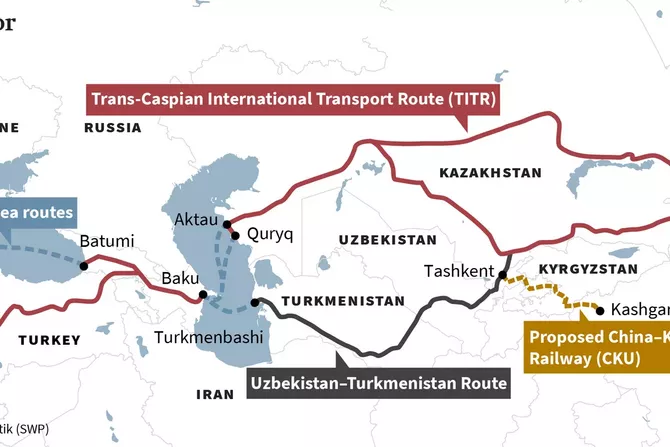
photo: Caspian Post
Uzbekistan
Cargo traffic via the branches of the Middle Corridor that run through Uzbek territory has roughly doubled in recent years, going from about 500,000 tons in 2020 to more than 1 million tons in 2025, reports Uzbekistan’s Ministry of Transport. Traffic between Uzbekistan and China via Kyrgyzstan has skyrocketed from about 34,000 tons to 1.8 million tons over the same period.
The Directorate of Tashkent’s Industrial Zones and China’s Shihezi National Economic and Technological Development Zone signed deals to set up a joint storage and logistic center, as well as an exhibition center, in order to promote trade.
Uzbekistan’s president, Shavkat Mirziyoyev, signed a law on ratifying the agreement to establish a permanent secretariat for the C5 + China cooperation platform. The law was passed by Uzbekistan’s parliament in late 2025.
A team of Chinese and Uzbek archaeologists have unearthed the remains of the walls of the ancient Silk Road city of Kuva, located in the Ferghana Valley of present-day Uzbekistan. The discoveries date from the 3rd century BC to the 10th century AD. The news agency framed the discoveries as a symbolic win for the Belt and Road initiative that positions itself as a present-day Silk Road.
A delegation of Uzbekistan’s government agencies in charge of promoting textile and leather industries visited several of China’s provinces to explore sales and partnership opportunities, reports Dunyo. The only tangible result was an agreement for a Chinese delegation to visit Uzbekistan later in 2026.
The first flight on a new passenger route from the Chinese city of Kashgar to Uzbekistan’s capital, Tashkent, occurred on January 14. The flight will operate weekly.
photo: CGTN
Kyrgyzstan
Chinese leader Xi Jinping is expected to visit Kyrgyzstan in 2026, Kyrgyz Foreign Minister Jeenbek Kulubaev has announced. He also mentioned a “full schedule” of other bilateral meetings, without offering specifics.
China’s net investments in Kyrgyzstan totaled $2.1 billion as of the end of 2025, according to the Eurasian Development Bank.
Work on building the second hydropower unit of the Kambarata-2 HPP, implemented primarily by Chinese contractors, is proceeding on schedule, according to Kyrgyzstan’s national electric company EPP.
China accounted for only three of the 112 cases of violations recorded at Kyrgyzstan’s border crossings during inspections of imported agricultural goods.
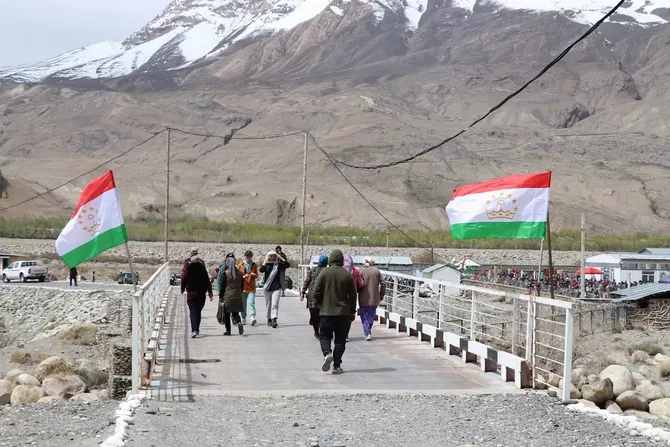
photo: Asia Plus
Tajikistan
Construction of the Qalai-Khumb-Vanj section of the Dushanbe-Khorog-Kulma highway remains suspended for the second consecutive month. Work will resume only after the security of construction workers can be assured along the Tajik-Afghan border. Five Chinese laborers were killed in two separate incidents reportedly involving militants on the Afghan side of the Afghan-Tajik border in late November of last year.
Representatives from Tajik State Pedagogical University and China’s Vocational and Technical Institute of the Defense Industry of Shaanxi Province met to discuss the potential expansion of scientific and educational cooperation. Such contacts are part of a trend of Tajik and Chinese higher education institutions making efforts to organize educational exchanges, joint degrees and other joint projects.
photo: turkmenistan.gov.tm
Turkmenistan
Turkmenistan’s Talvas Yoly Co. and the Turkmen Logistics Association officially announced the start of preparations for a Turkmen-Chinese business forum and exhibition scheduled for April 28-30, 2026.
The city of Ashgabat took delivery of 194 Chinese-made vehicles for use in essential municipal services, including garbage trucks, street sweeping and cleaning vehicles, mobile workshops and public transit buses.