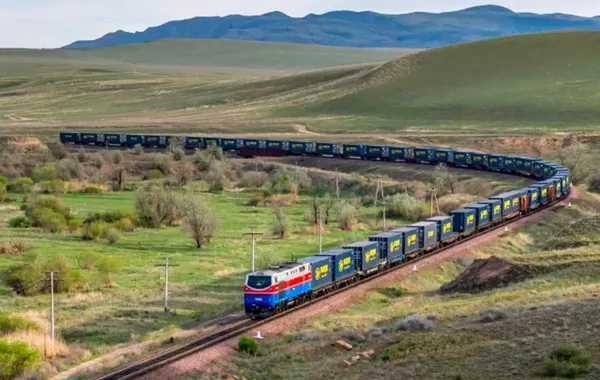
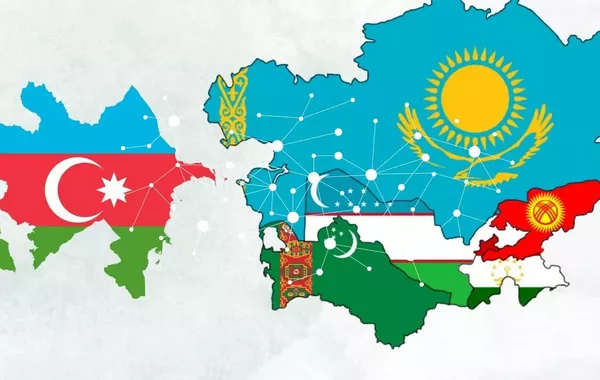
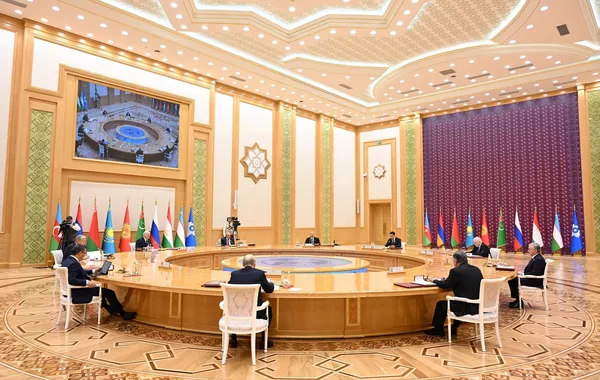
In early July, Uzbek President Shavkat Mirziyoyev paid a state visit to Georgia. Less than two weeks later, Turkmen President Serdar Berdimuhamedov arrived in Tbilisi. In diplomacy, such a concentration of high-level visits is rarely a mere coincidence of scheduling. What we are witnessing is part of a much broader process: Central Asia is seeking reliable access to Western markets, Georgia is looking for new support in the East, and a vast arena of geo-economic bargaining is emerging between the Caspian and Black seas.
The Uzbek president's official website confirmed that a Declaration on the Establishment of a Strategic Partnership was signed on July 3. The two sides agreed to cooperate in customs, digitalization, education, investment, labor migration and tourism. Of particular importance are agreements on an electronic permit system for freight carriers, the use of the ports of Poti and Batumi, the creation of a logistics hub, and the possible integration of the China-Kyrgyzstan-Uzbekistan railway, which is currently under construction, with the Baku-Tbilisi-Kars line.
Turkmenistan’s Foreign Ministry reported that Berdimuhamedov’s visit resulted in the signing of a joint statement and a substantial package of intergovernmental documents. Transport, energy, infrastructure and international supply chains were discussed at a business forum attended by around 250 companies. The Turkmen side proposed establishing its own terminal on Georgia’s Black Sea coast. Documents on railway and maritime cooperation were also signed.
The World Bank believes that, if administrative and infrastructure barriers are removed, the Middle Corridor could triple its freight volumes and halve transit times by 2030. The European Union, meanwhile, has mobilized an international investment package worth €10 billion for the Trans-Caspian route, while the broader Global Gateway package for Central Asia is valued at €12 billion.
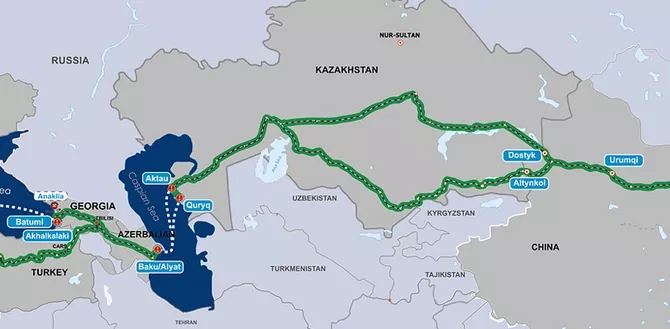
photo: eurasianet
The line to Tbilisi formed long before the July visits
The visits by Mirziyoyev and Berdimuhamedov were the political culmination of processes that had already been advancing at the technical level.
On February 10, 2026, Ashgabat hosted a four-party meeting of the heads of the railway authorities of Azerbaijan, Georgia, Uzbekistan and Turkmenistan. They discussed the digitalization of freight operations, an assessment of the Middle Corridor, measures to improve its competitiveness and ways to increase cargo volumes. A corresponding protocol was signed.
In other words, the railway officials met first, and the presidents followed. This is how serious transport corridors are usually built: politics formalizes what logistics experts have already begun calculating in tonnes, tariffs and hours.
At the same time, the Georgian authorities were intensifying contacts with Kazakhstan, Kyrgyzstan and Tajikistan. Tbilisi is conducting a systematic eastward campaign aimed at establishing Georgia as Central Asia’s permanent Western partner. The July visits should therefore be viewed as elements of a single strategy rather than two separate bilateral events.
The first reason: Central Asia no longer wants to depend on a single door
For decades, the countries of Central Asia were tied to transport infrastructure oriented primarily northward. Railways, pipelines, industrial links and export routes were created within the Soviet economic system, with Moscow at its center.
Following the outbreak of the Russia-Ukraine war, the northern route retained its economic importance but acquired additional political, sanctions-related and insurance risks. This does not mean that Central Asia is breaking with Russia. Tashkent, Ashgabat, Astana and the region’s other capitals continue to cooperate with Moscow.
The strategy is more nuanced: none of these countries wants its entire foreign trade to depend on the condition of a single route, a single power or a single conflict.
Southern routes through Iran also carry political and financial risks. The eastern direction connects the region with China, but excessive dependence on Beijing could turn transport integration into economic asymmetry. The western route through the Caspian Sea, Azerbaijan, Georgia and Türkiye is therefore becoming a geopolitical insurance policy for Central Asia.
The Middle Corridor is valuable even when it is more expensive than the maritime or northern routes. Its main advantage is the availability of choice. In today’s world, having a second route can sometimes be more valuable than having the shortest one.
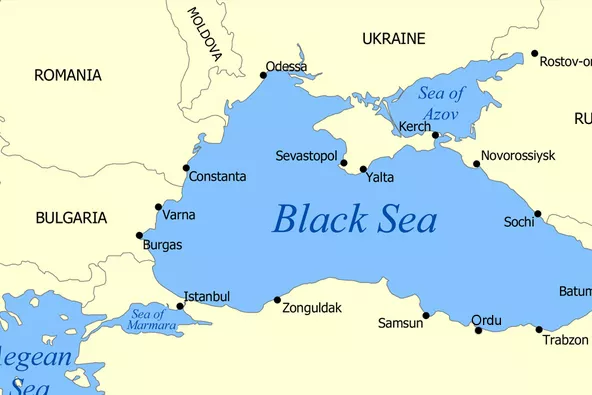
photo: getty images
The second reason: Georgia controls Eurasia’s overland gateway to the Black Sea
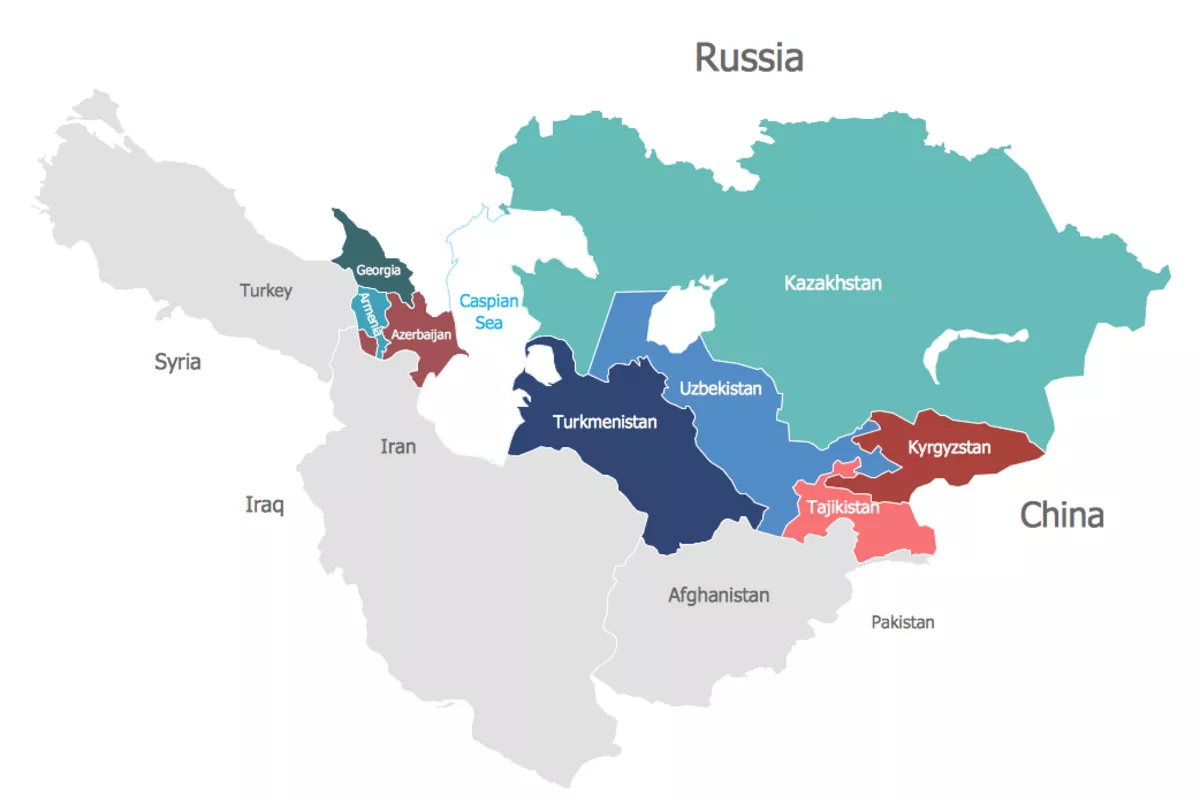
Uzbekistan is surrounded by countries that themselves have no access to the open ocean. Turkmenistan has a coastline on the Caspian Sea, but the Caspian is an enclosed body of water. To reach global maritime routes, cargo must pass through Azerbaijan and then move either toward Türkiye or Georgia’s ports.
Within this system, Georgia serves as the western gateway. Poti and Batumi provide access to the Black Sea, the Baku-Tbilisi-Kars railway connects the Caspian region with the Turkish rail network, and the future deep-water port of Anaklia is seen as a potential hub capable of handling larger vessels.
This is why Mirziyoyev’s talks were not about abstract friendship. Tashkent wants to use Poti and Batumi for Uzbek cargo, establish a logistics hub, an industrial zone and a showroom for Uzbek products in Georgia. A decision was also made to open an Uzbek embassy in Tbilisi.
This amounts to the infrastructure of a permanent presence - diplomatic, commercial and logistical.
Uzbekistan and Georgia intend to increase bilateral trade to $1 billion. In 2025, trade turnover stood at around $270 million, while it exceeded $100 million in the first months of 2026. The target is ambitious, but its significance extends beyond bilateral commerce. Tashkent expects Georgia to become a platform through which Uzbek goods can reach Türkiye, Eastern Europe and, eventually, the wider EU market.
The third reason: Uzbekistan is building its own export geopolitics
Uzbekistan is gradually becoming Central Asia’s economic center of gravity. It is the region’s largest consumer market, with expanding industrial production, electrical engineering, textiles, food processing, pharmaceuticals and mineral extraction.
As production increases, Tashkent is confronted with a fundamental problem: manufacturing goods is only the first step; they must also be delivered to buyers at a competitive cost. For a country separated from the sea by at least two other states, transport policy effectively becomes an extension of foreign policy.
Mirziyoyev’s proposal to examine the possibility of linking the China-Kyrgyzstan-Uzbekistan railway with the Baku-Tbilisi-Kars line reveals the scale of the ambition. If implemented, it would create a new transport arc: Chinese and Central Asian cargo would move through Uzbekistan toward the Caspian Sea, then through Azerbaijan and Georgia to Türkiye and Europe.
Uzbekistan does not want to become a transit appendage to projects designed by others. It seeks to become one of the route’s architects. A strategic partnership with Georgia gives Tashkent a political foothold at the corridor’s western end.
photo: bbc
The fourth reason: Turkmenistan needs its own berth on the Black Sea
Ashgabat’s motivation differs from that of Uzbekistan.
Uzbekistan offers the market a growing flow of industrial and agricultural products. Turkmenistan has natural gas, petroleum products, chemicals, fertilizers, textiles and the port of Turkmenbashi on the Caspian Sea. For Ashgabat, the central objective is to diversify its transport and export opportunities.
During the Georgian-Turkmen business forum, Berdimuhamedov said that the two sides were discussing the establishment of a Turkmen terminal on Georgia’s Black Sea coast. This was perhaps the most substantial element of the visit.
A dedicated or specialized terminal would allow Turkmenistan to organize stable freight flows along the Turkmenbashi-Alat-Georgia-Black Sea chain.
The memoranda signed between Turkmen transport agencies and Georgian Railway, together with documents on maritime safety and professional training, indicate that Ashgabat is moving beyond general rhetoric about the Great Silk Road and beginning to address its operational mechanics.
Energy cooperation was also on the agenda. However, it would be premature to expect the immediate construction of a major gas pipeline across the Caspian Sea. Significant political, commercial and infrastructure obstacles remain.
A more realistic scenario would involve expanding shipments of petrochemicals, fertilizers, liquefied and processed products, developing terminal capacity and using swap arrangements.
The fifth reason: Europe is calling Central Asia - but the road runs through the South Caucasus
In April 2025, the EU and Central Asia elevated their relations to the level of a strategic partnership. The European side announced a €12 billion Global Gateway package covering transport, critical minerals, energy, water and digital communications. Of this amount, international financial institutions are prepared to mobilize around €10 billion for transport connectivity.
The European model envisages delivering cargo from Central Asia in approximately 15 days. On the map, the route looks as follows: Central Asia-Caspian Sea-Azerbaijan-Georgia-Black Sea or Türkiye-EU.
A trip to Tbilisi therefore becomes an indirect step toward Europe for any Central Asian leader. It is impossible to negotiate with Brussels over the Trans-Caspian Corridor while ignoring Georgian ports and railways.
Georgia is also attractive to Uzbekistan and Turkmenistan because of its existing free-trade agreement with the EU. Georgia’s political accession process has effectively stalled, but the economic and legal infrastructure, including the Deep and Comprehensive Free Trade Area, remains in place.
photo: getty images
Azerbaijan is the invisible center of these visits
A Georgia-centric interpretation may tempt observers to declare Tbilisi the principal hub of a new Eurasia. That would be a geographical exaggeration.
Azerbaijan lies between Central Asia and Georgia. It is through the Azerbaijani port of Alat that cargo arriving across the Caspian is received. From there, it crosses Azerbaijani territory toward Georgia, the Baku-Tbilisi-Kars railway and the ports of Poti and Batumi.
Uzbekistan can sign a strategic partnership with Georgia, and Turkmenistan can reach an agreement on a Black Sea terminal, but the physical viability of both projects depends on Azerbaijan. This is why the February meeting of railway officials was held in an Azerbaijan-Georgia-Uzbekistan-Turkmenistan format.
The actual configuration looks like this:
Central Asia generates the cargo; Turkmenistan and Kazakhstan provide Caspian departure points; Azerbaijan serves as the central hinge; Georgia opens the way to the Black Sea; and Türkiye connects the system with Europe’s railway and industrial networks.
Remove any one link, and the entire structure begins to falter.
Tbilisi needs these visits too
Central Asia is moving toward the Black Sea. Georgia, for its part, is moving toward Central Asia.
The Georgian government’s relations with the EU and several Western countries are in deep crisis. The Council of the European Union has officially stated that Georgia’s accession process effectively came to a halt in 2024. European institutions have linked this development to the domestic policies of the Georgian authorities and democratic backsliding.
Against this background, Tbilisi needs to demonstrate that the country remains relevant, economically attractive and geopolitically indispensable. Visits by Central Asian leaders allow the Georgian government to show domestic and international audiences that political disagreements with Brussels have not turned the country into an international outcast.
A form of diplomatic compensation is emerging. The more difficult Georgia’s relations with the West become, the more actively it develops ties with Central Asia, China, the Caspian states and the Middle East.
This does not necessarily mean that Georgia is making a final turn away from Europe. Tbilisi is instead attempting to create a multi-vector system in which the country’s value is determined by geography, transit and access to markets.
There is, however, a dangerous illusion here: geography can generate transit revenue, but it cannot replace investor confidence, stable institutions and predictable rules.
A port without a reliable judicial system remains little more than concrete by the water. A railway without transparent tariffs becomes a long line of stationary freight cars.
Is this an anti-Russian front?
Not yet.
Uzbekistan continues extensive cooperation with Russia, including the construction of a nuclear power plant with the participation of Rosatom. Central Asian states retain trade, energy, migration and military-political ties with Moscow.
The July visits to Georgia should be understood as diversification rather than a demonstrative departure from Russia’s orbit. Tashkent and Ashgabat are building additional routes while avoiding a hard choice between Russia, China, Europe and Türkiye.
Over time, however, economic diversification inevitably produces political consequences. A state with three export routes negotiates with major powers more confidently than a state with only one.
Moscow may therefore remain relaxed about the Middle Corridor as long as it serves as an additional option. If it begins systematically displacing the northern route, Russia’s attitude is likely to harden.
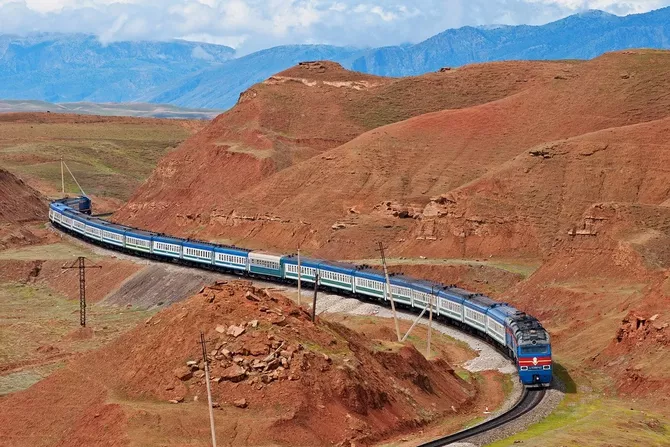
photo: getty images
China is also interested - but it will not surrender control
Beijing is interested in stable overland routes to Europe. The Middle Corridor could become one of the branches of China’s Belt and Road Initiative. The China-Kyrgyzstan-Uzbekistan railway strengthens this potential.
At the same time, China is unlikely to welcome a route controlled entirely by the European Union, Türkiye or the United States. Beijing will seek to invest in terminals, railways, digital platforms and logistics companies, thereby gaining influence over the infrastructure itself.
For Central Asian countries, this creates an ambiguous situation. Chinese capital accelerates construction, but an excessive Chinese presence could simply replace dependence on Russian transport networks with dependence on China.
Uzbekistan and Turkmenistan are therefore attempting to involve multiple parties in these projects simultaneously - the EU, Türkiye, Azerbaijan, Georgia, international banks and the private sector.
Here, multi-vector diplomacy is not a decorative concept. It is a means of preventing any single power from monopolizing the route.
The corridor’s greatest enemy is a customs officer with a stamp
The problem with the Middle Corridor is that it already exists politically but is still struggling to prove its commercial viability.
Cargo crosses several borders, two seas, railway systems with different track gauges, ports, ferry crossings and customs procedures. Each section adds costs, delays and the need for transshipment.
The World Bank has noted that operational inefficiencies could make the route take three times longer than the northern alternative. At the same time, the bank believes that freight volumes could be tripled and transit times halved if participating countries synchronize tariffs, digitalize documents, ensure regular shipping services and eliminate infrastructure bottlenecks.
This is why the agreements on customs cooperation and the E-Permit system signed by Uzbekistan and Georgia are especially important. They may appear less impressive than a declaration of strategic partnership, but an electronic permit could prove more useful than a dozen ceremonial speeches.
Corridors rarely fail because they lack a historic mission. They are usually killed by uncoordinated tariffs, idle ferries, paper consignment notes and an official who has gone out for lunch.
Competition between routes is only beginning
Georgia does not have a guaranteed monopoly over Central Asia’s western outlet.
Routes through Kazakhstan, Iran, Afghanistan and Pakistan are being developed or discussed. Following changes in the transport configuration of the South Caucasus, a route through Azerbaijan, Nakhchivan, Armenia and Türkiye could also gain importance. US-backed initiatives surrounding the TRIPP route may create an additional overland axis.
For Azerbaijan, new routes could complement one another. For Georgia, some of them may become competitors.
If cargo can move more quickly and cheaply directly from Azerbaijan to Türkiye, bypassing Georgian ports and part of the country’s railway infrastructure, Tbilisi’s transit position will weaken.
This explains the urgency shown by the Georgian leadership. Georgia is trying to consolidate its partnerships now, while its geographical role remains critically important. Tbilisi wants future routes to be designed with Georgia, rather than around it.
What comes next?
Several interconnected processes can be expected over the next two years.
First, new multilateral formats are likely to emerge involving Azerbaijan, Georgia, Uzbekistan, Turkmenistan and probably Kazakhstan. Bilateral visits will gradually develop into a permanent Caspian-Black Sea transport platform.
Second, Uzbekistan will begin creating commercial infrastructure in Georgia: warehouses, distribution centers, exhibition facilities, joint ventures and transport offices. Reaching the $1 billion trade target will require a permanent physical presence for Uzbek businesses.
Third, the proposal for a Turkmen terminal on the Black Sea will move into the feasibility-study stage. Its implementation will depend on guaranteed cargo volumes, the ownership model and the choice of port.
Fourth, Azerbaijan will strengthen its role as a coordinator. Baku is interested in ensuring that cargo flows from Uzbekistan and Turkmenistan pass through Alat and the country’s railway network. Without an active Azerbaijani policy, Georgian-Central Asian agreements will remain geographically incomplete.
Fifth, competition for control of the corridor’s digital architecture will become as important as the construction of railway tracks. Whoever controls electronic documents, cargo data, tariff platforms, insurance and financing gains influence over the route without having to own the entire road.

photo: getty images
Forecast: Georgia can become a hub - or remain an attractive arrow on the map
The July visits demonstrate that Central Asia has begun to view Georgia as part of its own economic security. This is significant diplomatic capital for Tbilisi.
The final outcome, however, will depend not on the number of national flags displayed at the airport but on four indicators: border-crossing speed, transport costs, the regularity of Caspian and Black Sea shipping, and Georgia’s ability to expand its port capacity.
If Tbilisi accelerates the development of Anaklia, modernizes its railways, ensures transparent tariffs and preserves access to European financial institutions, Georgia could become the western operational center of the Trans-Caspian space.
If infrastructure projects continue to face delays, the political conflict with the EU deepens, and competing routes through Türkiye and Armenia receive substantial funding, the high-profile July visits risk remaining a diplomatic performance with only limited freight traffic to follow.
Yet the very fact that this line has formed already speaks volumes. Central Asia no longer wants to remain an inland region of the continent. It is searching for the sea, new markets and room for maneuver. Georgia is offering it a western door.
The main question is now different: will Tbilisi be able to open that door wide enough before its neighbors build another one?